Hey!

Welcome, and you can check out my posts. But, I don't write here anymore. So, if you are interested, come on over to https://sandhyavaradh.com/

Sunday, May 17, 2020

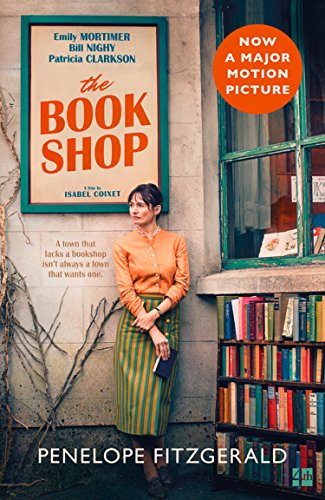
The Bookshop

Title: The Bookshop
Author: Penelope Fitzgerald
''A good book is the precious lifeblood of a master spirit, embalmed and treasured up on purpose to a life beyond life,'' and as such it must surely be a necessary commodity.''
Florence Green is a middle-aged woman, who with the little inherited money that she has, wants to open up a bookshop in the town of Hardborough. She chooses a quaint, cozy corner of the town with the 'Old House' that is believed to be haunted. Establishing a fully-running bookshop amongst a town of people who question the need to read and find no necessity for a bookshop, Florence is forced to come up with ways to promote reading along with selling books. Her business blooms for a small time, and right when everything seems to be falling in place for Florence, she finds herself face to face in battle with the town's most elite and powerful doyenne of art, Mrs. Gamart, who wants to acquire the 'Old House' to set up an art centre. 
"Art, culture, literature seem to improve no one in Hardborough. The most ‘cultured’, ‘artistic’ people in this community are also the most monstrous. For the malign Mrs. Gamart, an interest in ‘Culture’ brings social status and the illusion of sophistication. She will happily abandon compassion and decency to establish her precious arts centre, vital if the town is to compete socially with high-and-mighty Aldeburgh."
The Bookshop captures the fight, against ignorance and prejudice, using the base of morality, and captures the strong, brave, kind-hearted and wholesome Florence fighting till her last might to keep the bookshop against a wave of targeted actions by the power-greedy Mrs. Gamart. But, she loses the battle. As Fitzgerald puts it: 'she did not know that morality is seldom a safe guide for human conduct'.

The Bookshop is a classic story of strength, endurance, and the determination we all need to exhibit, but is encased in the truth of how the powerful can still walk over us. Florence Green is a wonderfully chiseled character who is kind and firm, determined yet powerless, and someone who never, ever gives up. Not even when the book ends with her eviction from the Old House. 

I really liked the book- it's a modern classic!

Saturday, May 16, 2020

Slow Shift: From Paperback to E-books

Credits: art by Mom
The physical presence of the book in our hand, the scent of the time-tested old copy wafting to our senses as we caress the worn out jacket with so many creases, which seems like the copy wants a crease for every fond reader who read it, the tinted print paper with words crafted in Garamond, an old-school appeal of the paperback and hard-bound: we all love it. 

Or, for some of them, a fresh, crisp copy- with no scribbles, no creases, no bent pages, the fresh scent of new print where the ink can still be smelt, a copy that's theirs and only theirs- is something to be loved, adored, and cherished. 

Nothing can replace it. Agreed. Yet, we have to slowly shift to the world where we buy more e-books than physical copies. Why? Here are three good reasons.

1. Save paper. The more you are willing to buy, the more they are willing to print. And, tens of thousands of people buy it, and they print tens of thousands of more copies. And, that's a whole lot of paper, there. The world is inching towards less and less resources every single day, and you can do your bit to reduce such wastage. When you think from this angle, even the most ardent fan of physical copies tend to pause and think for a moment. Do that: pause, and think a bit.

2. You never have to give away your books. You'll have them with you, and you don't have to think about a space for them. It's definitely more efficient in terms of how you can manage your books! No more do you have to worry and bother about your books not fitting within you air baggage allowance, voila!

3. Notes, Highlights, Quotes- the three best features of e-books. You can save all of them in a manner that you just need to do a key-word search to get them out in a jiffy. This can be really useful to those of us who write regularly. Vaguely remember a quote from The Little Prince on life? You'll have it ready. This is such a beautiful thing, and I really enjoy looking through these highlights and notes of the e-books I read. Amazon Kindle is great, and it neatly arranges the highlights and notes under a tab for each book. I also really like how Google Play Books creates a drive folder, and makes all the highlights and notes in a document, with each book having a different document. Such arrangement is a huge repository of wonderful, ready insights and key-points when you need them!

We are all human, and we all love to flaunt. If you sit in the class reading an Anthony Powell, it is sure to attract eyes and amp up your social image, while reading the same as an e-book won't really bring that much attention. We all love that attention, even if we aren't reading the book because of the attention. Even otherwise, we love to collect, display what we read, have a wall full of books, and all that- but times change, and the need of the world changes, and we must change, too. 

Buy from a sale of old-stock of books, but try avoiding a fresh copy. If your grand-dad has a great library, that's wonderful! Keep it. But, try to shift slowly into more e-books when you plan to buy something anyway. The supply will go down if the demand does, and that's definitely in your hands. If you still want a physical copy of something, get it, but don't make it a habit. 

I have started reading more through e-books now, and I have actually grown a liking to it. Take your time, shift slowly, but shift- because it definitely helps!

Friday, May 15, 2020

Loving Shakespeare: A Convergence Of Many Factors


To read, or not to read, that is the question: but, if you do read Shakespeare, read it as you like it

For the longest time during my schooldays, I hated reading Shakespeare, more because of the fact that I never understood and consequentially it just bored me. The world of thy, thou, art, hath, shalt and other other archaic usages made my head rivet, thanks to lack of comprehension. At this stage in Class VIII, we got one of the best English teachers I had in school and a compulsory, non-detailed lesson of The Merchant of Venice. And, that turned around the world of Shakespeare for me. I fell in love with The Merchant of Venice, with Portia (also as Balthazar), Antonio, Bassanio, Gratiano, Shylock, and everyone!

I remember me slipping into a mull of thoughts when Shylock breaks out on his moving monologue.  
"I am a Jew. Hath
not a Jew eyes? hath not a Jew hands, organs,
dimensions, senses, affections, passions? fed with
the same food, hurt with the same weapons, subject
to the same diseases, healed by the same means,
warmed and cooled by the same winter and summer, as
a Christian is? If you prick us, do we not bleed?
if you tickle us, do we not laugh? if you poison
us, do we not die? and if you wrong us, shall we not
revenge? If we are like you in the rest, we will
resemble you in that. If a Jew wrong a Christian,
what is his humility? Revenge. If a Christian
wrong a Jew, what should his sufferance be by
Christian example? Why, revenge. The villany you
teach me, I will execute, and it shall go hard but I
will better the instruction." 
I remember my excitement at Gratiano's sarcastic comeback at Shylock, giving the Jew a taste of his own medicine on calling Balthazar(Portia) as the most learned judge when she went against Antonio, every single time my English teacher read out the 'O learned judge! Mark, Jew: a learned judge!' with the utmost zest and sneer of Gratiano. What a pleasure it was to read Shakespeare, suddenly!

The same year, we also had Julius Caesar to be performed as a play for internals, and I remember the enthusiasm with which I took up the lead to read the original play and work on the script, and I also remember playing Brutus! Our teacher really liked the play, and we felt so proud!

I went on to read Hamlet, Romeo and Juliet, The Tempest, Macbeth, The Comedy of Errors, A Midsummer Night's Dream and As You Like It after that- and I enjoyed every one of them! In Class IX, I took part in a stage play of The Taming of the Shrew for my school anniversary, and it was again a wonderful experience with the story and being a part of it!

That's when I realized I had to be taught to read Shakespeare, and that has to happen at the right age. Maybe a couple of years younger, I'd have refused to give it a try, and maybe a couple of years older- I'd have refused to change my view about Shakespeare. I'm sure that these non-detailed books planned for syllabus maybe with that optimum view- but I was extremely lucky to get a teacher who could make me fall in love with it!

This reminds me of the "right book, right time" theory by Sara Nelson in So Many Books, So Little Time.

If you are one of those who don't really think you can read and enjoy Shakespeare- try listening to someone who knows to read his work, and follow the text while it is being read out loud! It can really do wonders, like it did with me!

Thursday, May 14, 2020

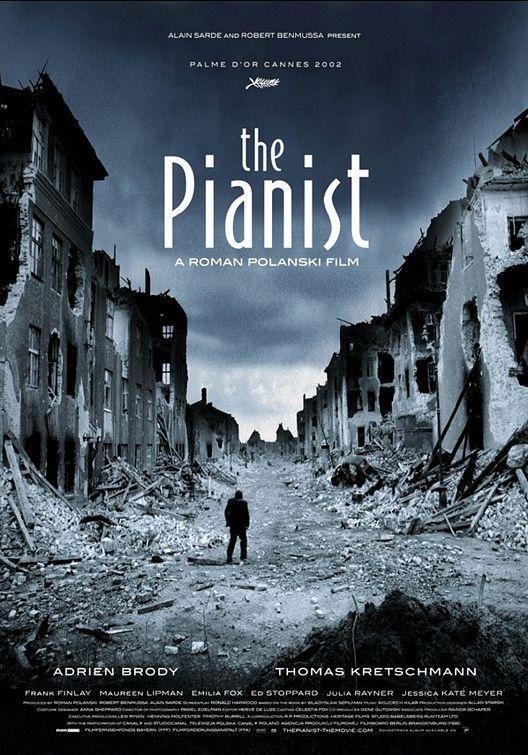
The Pianist

Movie: The Pianist
Directed by: Roman Polanski
Written by: Ronald Harwood
Starring: Adrien Brody, Thomas Kretschmann, Frank Finlay, Maureen Lipman, Emilia Fox, Ed Stoppard, Julia Rayner, Jessica Kate Meyer
Music by: Wojciech Kilar
Running time: 150 minutes

"If you prick us, do we not bleed? 
It you tickle us, do we not laugh? 
If you poison us, do we not die? 
And if you wrong us, shall we not revenge?"
- Shylock in The Merchant of Venice

September 1939, when the German Nazis bomb Warsaw, Poland for the first time, a Polish radio station where Władysław Szpilman, the pianist, plays for the radio, is also hit by the bombings. The story progresses slowly inching towards the 1940s as the Nazis get a stronghold on Poland abusing the Polish Jews. 

The Szpilman family is forced to disgraceful treatment for being Jews. They quickly descend from being a respectul, prosperous, and peaceful family living in a decent locality to huddling in a "Jewish district" that soon turns into a hungry, desperate Warsaw ghetto, where anyone did anything to survive. As part of Operation Reinhard, Szpilman and his family are packed in an cramped train to the death camp in Treblinka in August 1942. However, a friend in the Jewish Ghetto Police recognizes Władysław, pulls him out of the crowd with the intention of saving him, and separates him from his family to his utter terror.

The Pianist is the heart-wrenching story of the sights of slaughtered Jews, unwavering grip of fear, and the good-hearted help and luck from several non-Jewish friends that Wladyslaw witnesses as he tries to live through the barbaric holocaust, waiting for the Russians, French and the English to put an end to the agony-filled years of World War II. The film tries in no way to make it like a thriller, or make its protagonist the hero. The film doesn't convert the protagonist to lead a revolution. It captures the essence of his fear, the torment, and the dreadful consciousness in the viewer that, without a miracle, not even the fittest survived. And, this is why the film hits you so close. 

The film is based on the actual memoir titled The Pianist  by Władysław Szpilman, a Polish-Jewish Holocaust survivor who later settled in Poland and continued to be a pianist and composer. 

Brody is unbelievably real on screen as Wladyslaw, with a spectacular performance that convinces you he is the hauntingly sublime personality- the pianist. The movie doesn't cover all of the holocaust, and it doesn't aim to. It focuses only, and only, on our protagonist, what he saw, what he felt, and what he did. There are no tears as you look at Brody as Wladyslaw, only a close feeling of poignant and evocative emotions that settle in your heart, slowly and slowly as you see the pianist go from a positive, optimistic man, to a desperate Jew on the run to save his life. 

I loved the film, it is a must-watch!

Wednesday, May 13, 2020

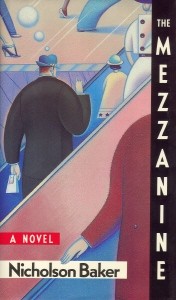
The Mezzanine

Title: The Mezzanine
Author: Nicholson Baker

What can happen over a lunch hour? Well, a lot can happen over the lunch hour

Howie works in the office, his job is unspecified. It is lunchtime, and our hero has popcorn, hot-dog, cookie and milk. We ride with Howie up the escalator to the mezzanine of his office, and also travel through his beautifully keen mind as he explores the most mundane things in the most interesting way. 

How did paper milk cartons replace glass milk bottles? Have you ever wondered on the miracle of perforation? Have you ever bothered to notice the buoyant nature of plastic straws? Have you ever given two thoughts about vending machines, paper towel dispensers, and popcorn poppers? Too boring? Try Howie's mind, as Baker glides you through the magnetic maze of meandering thoughts of everyday triviality in the most bizarrely eloquent string of illustrative and vivid word play.  

The Mezzanine is an extremely humorous, plot-less, and conflict-less brilliance drowned in a versatile brandishing of descriptive, detailed, and intricate narration of the regular monotony captured in the most ingenious and amusing flow of language, nailing every act to it's very atom, and also through generously sprinkled extensive footnotes. 

Here's an excerpt to show you the well-arrayed wordplay!
“The neurons that do expire are the ones that made imitation possible. When you are capable of skillful imitation, the sweep of choices before you is too large; but when your brain loses its spare capacity, and along with it some agility, some joy in winging it, and the ambition to do things that don't suit it, then you finally have to settle down to do well the few things that your brain really can do well--the rest no longer seems pressing and distracting, because it is now permanently out of reach. The feeling that you are stupider than you were is what finally interests you in the really complex subjects of life: in change, in experience, in the ways other people have adjusted to disappointment and narrowed ability. You realize that you are no prodigy, your shoulders relax, and you begin to look around you, seeing local color unrivaled by blue glows of algebra and abstraction.”
As a hilarious gimmick, The Mezzanine entertains you thoroughly leaving you smiling unawares at the vast description of broken shoelaces, comments on Aurelius's Meditations- all made in the same zest and comic droll. 

I loved it, it was a very amusing read!

Tuesday, May 12, 2020

Whee, Whizz, Wish-away!

Maiden young, plump and sweet,
laid back and dreaming in her seat,
of gushing rivers and lofty heights,
of a kind world sans ugly fights.
Sense and sensibility- she thought,
in humankind was a missing part
among pretentious vanity and futile pity,
genuine empathy was a dire necessity.
Pride and prejudice- all around,
yet not one voice can be heard profound
that stays the pride and lends a hand,
she thought, since we only demand.
Persuasion, might be the key,
to sensitize all around in need-
so the maiden thought she would rise
and lead the world to paradise.
Love and friendship, and good old hope,
our maiden believed, would suffice,
unaware that a change to cope
must come within all men and mice.
Dawning sense, she looked about
to see those around cry and shout
the same things she wished to change,
and grappled with the situation strange,
or not so strange- it wasn't just fate,
she found a way for them to educate.
Things fell in place, steady and slow,
she felt no surprise now- long way to grow,
she thought and smiled
as she laid back and smiled,
and slid to another dream, like a child.

Monday, May 11, 2020

Mind-Map


Expression through words is one of the most beautiful forms of art. But, humans by nature are undoubtedly visual creatures. Even while reading a piece of literature, poetry, any report or description, there is an image that our brain tends to associate with the text. Sometimes, one of the highest praises that a classic literature gets is on how it paints a ‘vivid picture’. Which is why, a mind-map is most successful in translating thoughts on paper. 

We all know what is a mind-map, even if some of us may not call it that. It could more or less be described as a pictorially graphical layout of ideas, concepts, and their sequences branching from a central, core thematic approach. It is literally mapping what's in the mind in respect of a chosen theme or subject. 

Before I write anything, I usually have a mind-map. From my academic research to casual essays, there is always a theme, and I brainstorm ideas around all aspects of the central theme using a mind-map. But, why should you use a mind-map?

1. You get a clear picture of the content you are going to translate into writing.
2. You immediately get to know if you have a lack of content on a subject, which would leave you with unanswered question areas on which you can hypothesize your perspectives. 
3. It gives you further insight into which questions need more research on. 
4. You get to roughly know how much emphasis and words to allocate to every aspect. This is very useful when there is a word limit, and ensures that you don’t harp long on a trivial aspect and write only two lines on an important one.
5. You brainstorm each aspect, and it is easy to spot what you have missed.
6. You successfully avoid repetition. 

A writing translated from a mind-map clearly shows high on planning, and also results in a coherent and easily comprehensible work. This is true even for creative writing as an art, and I have personal experience with that. A mind-map doesn’t have to be in a rigid format- it is more like a rough sketch for you to get an overall feel of ‘I know what I’m doing’. 

So, try it out, experiment, and find your own formula as to how to organize what you write! 

Sunday, May 10, 2020

The Land Of The Rising Yen

Title: The Land Of The Rising Yen- Japan
Author: George Mikes

A brief outline on the history along with some detailed observations and anecdotes on the culture and people of Japan as Mikes saw in the 1970s, The Land Of The Rising Yen beautifully and gently captures Japan in the post-war and pre-boom period of the country. 

The book divides itself into three parts, one each on the people, the way they live, and the places. Believing that this Oriental heartland is "scrutable" as contrary to stereotyped expectations, Mikes goes on to explore this wonderland through light-hearted humour and keen observations on the Japanese lifestyle. 
"Stereotyped images die hard and there is always good reason for their existence."
With the above thesis, George Mikes meanders through the habits of kimono-clad men and women in Japan bowing ceremoniously, the shades of their pagodas, their geisha girls, antique string instruments that are akin to their culture, flower ceremonies, tea parties, and the tales of furious and disgruntled samurai

Mikes is floored by the Japanese courtesy throughout the book, and makes sure you are too. Not one chapter goes without yet another hilarious anecdote on embarrassments, misunderstandings, and the sheer awe he develops for the "Japanese manners". He observes how the art of saying 'no' is not one of the great Japanese arts, and that the exquisite manners of the Japanese could be exasperating, not to single out their "mania for bowing"! Here is an entertaining piece from the book, where George Mikes reflects on their intense affection for politeness:
"If you ask a Japanese a question he does not understand, he will smile politely, because pointing out that he has failed to understand might imply that you expressed yourself obscurely; if you ask him a question he understands perfectly but which happens to be embarrassing, he will also smile politely. In other words, if he doesn't understand you he will act as if he did; if he does understand you he will act as if he didn't."
A very interesting chapter is one titled 'Ladies and Gentlemen' where Mikes explores the similarity between the Japanese and the British, Americans, Chinese, and French. I also loved the chapter where he attempts to dissect the Japanese language. While surprised at the influence of English in the language, he wonders for a long time through his journey in Japan how he still couldn't understand one single word in a conversation, and the answer to which he sums up as:
"The answer is that the Japanese take the words and then twist them, adapt them, beyond recognition."
It is heartening to read as he joyfully describes his new discovery where the Japanese add a vowel in the end of English words, and spell r's instead of l's. Cheese became cheesu, flight became frightu, hotel became hoteru, and nonsense became nonsensu

The author also takes you through the 'ugly city' of Tokyo, the beauty of Kyoto, and the Manchester of Japan: Osaka (a rare-ish city in Japan where the people preferred cash to symphony orchestras). 

Being an Indian, somehow, reading about 1970s Japan brought with it a little bit of happy familiarity. It was not the kimonos that I felt familiar with, but the Japanese wearing a pant when they went to office and changing to a more comfortable, traditional outfit when they came home. It wasn't the dishes that were familiar, it was the way they stuck to their traditional dishes. The tinge of familiarity from an Indian's perspective, on a view of Japan in the 1970s by a European- that's an amusing cocktail of criss-crossing cultural identities!

I loved The Land Of The Rising Yen. With the wonderfully quirky ink cartoons by Zabo, a French cartoonist, this is an enchanting and humorously genteel piece of work on the Japanese, giving you a brief introduction and first-hand chronicle on Japan and the Japanese hospitality! This is a book where Mikes has had a enjoyable, pleasant, and entertaining time in Japan, and sums it up for you! 

The only thing to keep in mind is that the book dates back to the 1970s and is not essentially about the experiences that one may have in Japan today. However, it gives great and respectful insight into the Japanese culture! I loved it! 

Saturday, May 9, 2020

A Story On Stage


A story, on stage.
A large house, with a houseful.
A wide stage, and a wider screen.
A retracting curtain revealing the story.
A beautiful set, and enticing personas.
An enigma expressed, a hurdle crossed.
A weakness overcome, a strength employed.
A conveyed moral, an attempt to better.
A win for the good, and a lesson for the bad.
A mixed opinion- on the shades of grey.
An open question, a thumping finale.
A heartfelt cheer for the glory well-staged-
with unabashed performances, the crowd in a craze.
A warm welcome, a happy hug.
A celebration, with a lively tenor.
A meeting, with closed circuits.
A start, and another story.
A story, on stage.

Friday, May 8, 2020

Friday-Thoughts On First Drafts

First drafts don't have to be perfect, they just have to be written. 

It is not without meaning and purpose that it is called a ‘first draft’. A first draft captures the abstract story that runs in your mind, and traps it in ink so that it can take a shape that you can re-look at, and it makes sure that the idea doesn’t fade away. It is written only to be rewritten better and made finer. The concept, content, and the rough base without which you cannot have the story is what makes this preliminary version the most important aspect of getting a good story. 

When I wrote my first two short novels, I was most successful in completing the process of writing it. Nitpicking and perfecting everything in your writing when you are just writing it for the first time is unnecessary, and often leads to the work remaining incomplete. I have personally experienced that perfecting unnecessarily while writing also breaks the creative flow, and it can actually lead to the loss of a naturally occurring scene that your mind saw in the flow of writing. 

When you are actually writing a story, developing your characters on paper for the first time, what is more important is to capture all the various small, interesting details that come in your mind about them and their setting, even if it is not written in your best form. That is exactly what a first draft is for. 

Improvisations, changes, and your best skills come in later as you enhance your draft and make those subtle corrections that you want, to your heart’s content. But, your biggest and most important achievement is to get your first draft written. 

Have any incomplete writing? Take it out, and just write your heart’s content without looking back on corrections!

Thursday, May 7, 2020

What Do I Do In Life?

Five years ago, in 2015, I took out the dizziness of choosing a stream after class X as an essay: Science or Commerce? But, I ended up choosing law after class XII for which the stream I chose in class X didn't matter one bit, and neither was the physics that I studied through two years of junior college (fancy name for class XI and XII).

Now, I am near the end of third year and have two more years left to wrap up college. Yet, it is probably good to start thinking about what I want to do. No clue. The one thing that I have retained from schooldays till now is to change and fancy a different idea every day. I study law, and I really like it. It is one of the most interesting fields, and I am happy to be studying this subject that shall be relevant and necessary as long as humans continue to exist. 

Unlike back at the time of Class X, where everybody had an opinion to share, people don't really have much to say now. Looks like they bully only teenage kids, I escaped that zone. So, here are a couple of options for me-

One, I can choose litigation after graduation- that would basically be underpaid slogging for a couple of years at the most happening area and scenes in law. 

Two, I can join a law firm. Pay scale depends on which firm. If the pay scale is good, I don't know if I am good enough for them to take me in (haha, we need scores buddy, and you got to be there right on top, since when have 'good' scores ever been good enough?) If it's a firm that is going to definitely be glad to have me in, I'm not really sure about the money part. 

Three, I can postpone this whole decision and just study further. LLM is a ready option, and then I can go on studying till I have finally found out what I can do. But, I still haven't given up those hopes on Criminology and Forensic Sciences as a niche within the domain of law (hehe, Perry Mason influence is becoming actionable this time). Again, there are numerous sub questions as to where and how and when, and we won't go into those. Good idea? Bad idea? 

Four, I can do something completely unrelated to law. Two sub-questions arise(both from my parents and myself): One, why did I study five years of law then?! Two, what other thing will I do?

Five, I can work on a startup related to the legal field, or otherwise, if I do have ideas. This one's not easy, and not for all of us, I guess. I'm not sure if this is for me. Yet, it is appealing in terms of freedom, creativity and scope of the work I'd be doing in this. Also, the contribution might be very significant. 

Six, I can join a social work group related to law. A noble intention but not so much money in it for a young graduate. So, maybe this may not be the immediate choice after graduation. 

Seven, I can pursue a hobby to be my profession. But, I don't want to, at least not after graduation. This is not going to be my plan-A. I don't want to write for a living. I want to write everyday, more and more, as something I love doing. Also, I like intense work in a professional way, I think. So, this option has been ruled out by me, personally. 

I don't really think I am the type who can exit college with a mastermind plan to open up a physical business, or run a cafe, or anything like that- so such options aren't even options for me by choice. I am attached to academics, and it is something that I get and something that I can be good at, and also something that I really enjoy. 

My parents are clear that whatever I do, I should be happy and content (of course, earn some money if possible). And they stand by the advise they gave me through my life and also 5 years ago- "But whatever you choose, do it sincerely and be in the top.

All the options listed are open, and I retain the phrase I used for myself back in class X: someone like me, who is not exactly very interested in one particular thing but likes everything without even disliking any- what should we choose?

Two years left, and I am mulling on ideas. Suddenly, two years doesn't seem a very long time. Let's see, it's not far off!

Wednesday, May 6, 2020

Holding On To Sanity

A deadly pandemic brought the world to a stand as we all gleefully entered into 2020. Highly credible extrapolations suggest that India is yet to see the peak, and it may take till the end of September to be a little more safer than now. 

Placed right in between these woeful state of affairs, we might lose it a little. So, here are some reminders that can help us all hold on to sanity. 

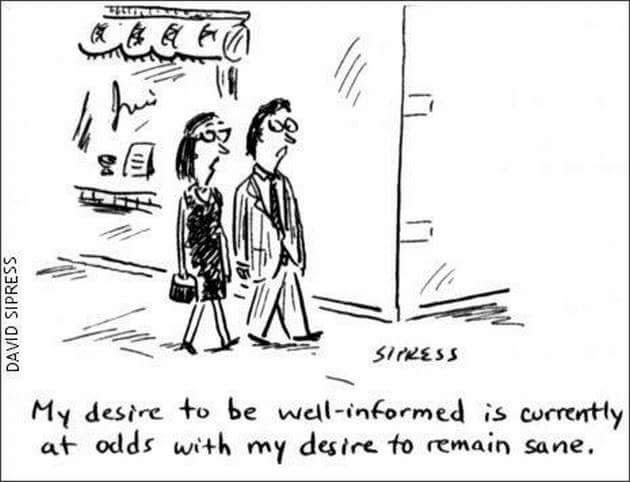
1. You don't have to watch every update about COVID-19. Yes, it is important to have a general knowledge about what's going on, but stop looking at the news for every bit of fluctuating statistics if it mentally bothers you, and if you can afford to skip it. Like the picture says: the desire to be well-informed is really at odds with the desire to remain sane, currently. 

2. Do not forward news without verifying it. Forwarding to a hundred people on your contact list about a news that came on Whatsapp that has no basis or credentials is not at all helpful to anyone. In fact, it disrupts peace and truth. Please, do not pass on anything that you aren't sure about. Always check the source. 

3. Avoid going out. Avoid thinking it's a deadly pandemic that the world is facing but it won't get to you. You are part of the world, and you need to be cautious. 

4. Always err on the safer side. It's okay to be extra careful and wear a mask, sanitize, wash hands, even when it seems unnecessary. Right now, that could just be the best thing you can do to yourself and to others around you. 

5. Do not trouble people for information they may not be in a position to give. True, your college hasn't told you how examinations are going to be held as yet. True, you haven't received the notifications on your project. True, that the government is extending the lockdown and no one exactly knows when things will get alright. Also true that maybe they can figure it out. Yet, don't push too much. It's okay for people to wait, not decide and take some time during these circumstances. Let's try to be patient. 

6. If possible, pay the salary for this month for the helpers who come to your house. If possible. For some of them, their only earnings is that, and those who can help should help. 

7. Occupy yourselves. There might be a lot of pressure on yourself to be productive, but it's alright- just do something. I'm sure it'll be of some use, at least entertainment. 

Pressure piles on involuntarily, but you can try to take less of it. The degrees vary but everyone is in a fix, thanks to corona. So, help in all ways you feel confident that you can. What may seem as a pretty insignificant help may be extremely significant to those who are in need of it. Every little counts. Stay in, stay safe, and stay mentally preoccupied to come out of this lockdown healthy and happy!

Tuesday, May 5, 2020

Traversing (Personally Unknown) Territories

Moot got over? Coming for that seven-cheesy pizza (large, with that 1+1 offer).
Mid-semester happening? Need to cheer up, shall we have fries and cold coffee? And hey, repeat that order.
Mid-semester got over? Let's get that scrumptious veg lasange, mon ami. Need a break.
Mid-semester results came in today? Good? Damn, let's celebrate. Not that good? Come on, time to cheer up! All with some mouth watering mysore masal dosas.
Weekend? Let's just get out of the campus. 
Weekday? Long day, can we at least have something nice to eat?
Birthday? Hey, wait up, you got to take us to the most expensive place that we'll choose and your dad, of course, will pay the bill. 

In college, every little thing is an excuse to go out and eat (my semester budgets stand testament to that). College gave me an opportunity to explore food like I have never done until my schooldays, and fair enough because that is primarily what college days are for- eating. Dessert to me until schooldays was vanilla ice cream, and falooda. But after I got to college, things were in for a fancier outlook. They wanted cheesecakes, caramel puddings, and freak-shakes. I learnt what a waffle, a sizzler, and a momo is after I got to college, and I was genuinely surprised that people were surprised about me not knowing. Why would I, haha? We used to eat gulab jamun with ice-cream after a meal, usually.

Finding friends who also didn't know much was the greatest fun. It was great going to restaurants where I didn't understand what the dishes in the menu card were. Google really is your best friend. Okay google, what the hell is a gnocchi?

Five years of college- that seemed way too long when I was wrapping up class 12. That's like the time I took to go from class V to X. Crazy. But time ran. I am in my third year of law school, and I can't believe three years of college is already over. COVID-19 has further pushed us to cut back on the time left. Also missing aloo cheese parathas with an extremely generous amount of butter smeared on it from my college night mess . Every day is an excuse for it, we didn't even need to look for an occasion! 

Let's stay in, stay safe, and pray we get over with this terrible spell. I hope I get to go back to college soon, and I also hope I get to have as much fun in the rest of the two years! 

Monday, May 4, 2020

Presumed Innocent

Title: Presumed Innocent
Author: Scott Turow

Carolyn Polhemus is dead. Rusty had an affair with Carolyn. Carolyn also had an affair with Horgan. Horgan is Rusty's boss. Rusty is employed under Horgan for the re-election campaign. Rusty is assigned the prosecutor to deal with Carolyn's case. What happens? A tight knot of a solid conflict of interest. Rusty's campaign job with Horgan is on the rocks- he stays in employment if Horgan wins, or gets fired if Horgan loses- and the latter happens. Rusty finds himself not only fired, but also charged with murder by the winner of the elections. His only hope is Alejandro Sandy Stern, an Argentinian lawyer whom he approaches to deal with the case.

Presumed Innocent is a fast-paced court drama, taking us in giddy rounds through the ever-evolving possibilities of Rusty's innocence and guilt, as it plays with the evidences found on record. As Stern battles with Rusty to open up to him, and battles the case in court, we try to find the missing piece along the way to pin one person responsible, to shift the weight of blame on one individual, but in vain. 

The book has elaborately drawn out court scenes, and explores the importance of evidence in a case, the presumption of innocence, the honesty of judges, and the state of morality in which the justice delivered is wrapped in. 

Presumed Innocent has some of the most brilliant, spellbinding interrogations and cross examinations in the scenes where the case is tried. The courtroom scenes are absolutely enthralling, and keeps you hooked to every sway in the storyline. The other scenes that build up to the court room scenes are also interesting, however I enjoyed the court scenes better.

This is a brilliantly detailed mystery and legal thriller, and Scott Turow keeps you on the tow and engaged till the very end. There are absolutely no spoilers here, and the book has a brilliant finale that puts an end to the question of what happened to Carolyn Polhemus. 

With a perfectly clever storyline, and even cleverer scene sequences that neatly present the construct and deconstruct of the central plot- I absolutely loved it!

Sunday, May 3, 2020

Opening Pandora's Box

Title: Opening Pandora's Box: Phrases Borrowed from the Classics and the Stories Behind Them
Author: Ferdie Addis

Weaving through countless classic tales of Greek mythology, their heroes, gods, demigods, demons and kings, we stumble upon those phrases that we know by contemporary parlance. Opening Pandora’s Box, is an awesome book. As it leads you into phrases and the stories behind them, we relive the Midas touch, the terror of the Chimera, encounter a Gorgon stare, work like a Trojan, meet mighty Gods with titanic strength, heroes with Stoic endurance, and finally find out what actually is to pile Pelion upon Ossa. 
"The aim of this book is to prise open the lid of the English language, just like Pandora did with her famous box, and let the weird and wonderful stories that we used to know come blinking out again into the light of day."
This book is published by the Michael O’ Mara Books Limited. It was first published in Great Britain in 2010. It opens up to a mythical world of tales through which the English that we speak today has borrowed and derived countless phrases from! It is a light-hearted, spellbinding narration of the stories that encompass the actual sense of the classic idiomatic expressions. 

Ferdie Addis gives us a book that equally stands out as a sorted introduction to Greek mythology, and also as a reference into how phrasal references developed in the language that we use today. This was one of the books I loved, and also referred while writing my own stories (just like I used to refer Know Your English by Upendran). 

Do pick this book up and give it a glance, it is sure to keep you captivated while also making sure you become that much more aware about the language! 

Saturday, May 2, 2020

How Should A CV Be?

Should a CV be interesting? Should it stand out? Should it show them why you you are good enough for the job you apply? 
Applying frantically to all the big shot law firms with a CV that thousands of other students will also have, I always wondered how they select on the basis of a CV. Let's be honest, here. The CV has to be in a given format that is prescribed, and most of the details that are asked is about your academic performances, and academic achievements. 

Another honest point that we must encounter is that there are a lot of brilliant students out there, and a lot of them have good CVs in a way that there is nothing to say one is better than the other. So, how then do they decide to give internship to one over the other?

I have two internship experiences, and on the last day, I asked this very question to the partners in both the firms. 

Firm 1 Partner: If you are a topper, I care, and if you are failure, I'm interested. If you are in the middle, it doesn't matter. I took you in because you had good scores. 

Firm 2 Partner: I don't really check the CV much. CV is a fraud, students obviously make it in a way and with the view to impress. I rely on the cover letter they write. If they have taken the efforts to write a genuine cover letter, I take them in. 

Well, within this meager sample space that I took opinions from, I have a conclusion that getting the internship-

a) it's mostly just luck, hahahahahaha(contd...)-  but not all of it!
b) there is nothing to feel bad about if you don't land an internship
c) also, there is nothing to feel too great about if you do get one
d) networking and keeping in touch with people you get to know from your internships is important- if you think you'll get on merit every time, you may be just wrong
e) you can't give up on the CV building

Be open to learning. Keep working, not just to get an internship. And, at least be brave enough to face truth, and write true achievements on the CV. You can state some achievement in a more polished way than it actually is, that's a talent (with which I feel I have come close to mastery). However, please don't write things you never did just so you can amp up your bio. 

COVID-19 has put an end to all internship talks for now (I have absolutely no complaints, and in fact, yay). So, focus on actual skill building, and not plain script building! This is a great time to do more productive things (of course, only if you want to) and then you can actually include them on the CV! Whether or not the list of things you did gets you a job, I am sure you will be that much prouder about yourself! 

Friday, May 1, 2020

5 Really Wonderful Newsletters To Subscribe To

One of my friends recently asked me what are the good newsletters to follow. I didn't have many, but some of the ones that I did were subscriptions I really liked. So I thought I'll put a list of them up here from what I follow, and also regularly read. Do add to the list with your own favorite newsletters that we can all discover!

1. Braipickings - A beautiful collection of articles "across art, science, philosophy, creativity, children's books, and other strands of our search for truth, beauty, and meaning" as Maria Popova puts it.

2. Literary Hub - This newsletter is something that is very useful for readers, bringing out a treasure of information on fiction, poetry, podcasts, crime novels, and also gives you regular reading lists!

3. London Review of Books - Another wonderful newsletter that brings to your inbox many interesting thoughts on books, history, classics, philosophy, law and life!

4. Farnam St. - "No spam. No politics. No BS." This is similar to brainpickings, yet offers it in a fresh and different package, and in little doses of all-round subjects!

5. 1440 Daily digest - Culture, science, sports, politics, business, and more - all in a 5-minute read. It is more like broad update on what's happening around the world in general. It's a nice one to keep a general tab on things. 

Also, if you enjoy reading my blog, you can subscribe here to read in your inbox! If you have a newsletter that you enjoy reading, then add to the list in the comments below! Have a great weekend, and happy reading!

Thursday, April 30, 2020

Iah: A Musical Feature

This evening saw the release of What If There Were 360 Days In A Year, the wondrous dedicated creativity of a year- culminating in a 14-track mixtape of Iah's music. I loved Môr and Monsoon Palace from the mixtape. But, who is Iah?

Pushing the boundaries of creativity, breaking the grounds on perspectives, Iah makes the music that attempts to communicate at a dimension that can be expressed and understood only through a boundless medium of art like music. 

Swapnil Shreshtha, as Iah, explores a side that is a figment of imagination in the real world, but a versatile reality in the dimension of the world of electronic music, as reversed from “hai” meaning “what is” in Hindi. 
What If There Were 360 Days In A Year
Coming from a small town in India, what started as an unconscious and reflexive attraction to rock and metal at the age of twelve, only led to a fifteen year old Swapnil ending up being a part of a three-member band, sparking the ignition to become the seamless artist that he is today. At sixteen years of age, with no formal training in music and with no actual instruments to experiment the self-taught interest, Swapnil was forced to a point where he might have had to wrap up the music in him. And, discovering electronic music at that point was the first major climacteric of his life. 

And, then on came an exponential curve in the exploration of electronic music which led to the birth of Iah. To Iah, music is not just an escape to the surreal, but a way to express what is impossible to be expressed through words. To Iah, music is the only dimension that supports the gravity of his perspective and thoughts. And to Iah, the music he makes is the creative bonanza that he cannot hold back. 

Iah makes electronic music that is atmospheric and glitchy, and is influenced by various genres like hip-hop, trap, drum and bass, and many others, in line with Iah’s belief, truly and wholly, that the genre cannot define a music where the music must define the genre. Therefore, traversing on a landscape of genre that works on his own style, Iah makes music on a mix of personal style and atmospheric electronic music. 

Iah previously made music and remixed songs under the project pen name of Indus, and has worked on several other music collaborations, and produced with upcoming artists, especially rappers. With a recent release of a well-received EP ‘Arcana’ in October 2019 consisting of three songs- Affection, Cocoon, and Found- the artist has pieced together an intimate and important journey of personal metamorphosis. Recently, two beautiful singles Bulletproof and Dusty Rose were released by Iah only to meet a vibrant, warm reception, and many features! 


Music to Iah is something divine and spiritual. Coming from a small town himself, the aim of this phenomenal, upcoming artist is one that is as expressive about himself as his music. The young artist hopes that one day he can build a strong community for artists like producers, singers, rappers, songwriters, filmmakers, designers, painters, illustrators and many others of all kinds, who can work with each other with collaboration and funding, so that the art can be created in an environment of support and strength. 

Iah’s music opens a wormhole to an alternate realm of perspective through detailed, expressive and intimate music baring every beat originating from his mind of music.

Swapnil is a dear friend from the University, and I am glad that his music meets the world. There is a definite joy when the artist connects to an audience, and that is the greatest achievement of today's world of technology!

You can access Swapnil as Iah here:

Wednesday, April 29, 2020

Animal Farm

Title: Animal Farm
Author: George Orwell

The animals were in distress. The farm owner Mr. Jones was mistreating them more with every passing day as he dived deeper into alcoholism. Old Major, the wise, elderly boar, composed and sang the stirring revolutionary anthem for the animals, in a tune something between ‘Clementine’ and ‘La Curcuracha’. 
Beasts of England, beasts of Ireland, Beasts of every land and clime, Hearken well and spread my tidings Of the golden future time.
Two young pigs, Napoleon and Snowball continue the revolution, and are instrumental in ridding the farm of the lousy human owner. The animals draw up the Seven Commandments of Animalism, the fundamental of which is "all animals are equal". For some time, things continue pleasantly on the newly renamed and established 'Animal Farm'. But, with Snowball's growing good intentions, Napoleon finds the need to silence him in order to emerge as the supreme commander of the Animal Farm. Napoleon falsely frames Snowball, and banishes him. 

As Napoleon and his group of faithful pigs stoop down to breaking every law in the Seven Commandments, Napoleon amends the law to suit his unlawful needs. 

The piety of the Animal Farm falls with the final blow to the very meaning of the revolution against humans when the maxim "all animals are equal" is amended to "all animals are equal, but some animals are more equal than others".
"Twelve voices were shouting in anger, and they were all alike. No question, now, what had happened to the faces of the pigs. The creatures outside looked from pig to man, and from man to pig, and from pig to man again; but already it was impossible to say which was which."
Animal Farm  is an allegorical satire on the soviet totalitarianism. In this satire, the pigs were written in the role of the Bolshevik revolutionaries, and to overthrow and oust the human owners of the farm, setting it up as a commune in which, at first, and only at first, all animals were equal.

It is a short, engaging read that captures in the essence what the desire for position and power can do, and how it has the power to destroy the very thing that you stood for to get in power, if you are not grounded to your cause. I really liked the book!

Tuesday, April 28, 2020

Seabiscuit: An American Legend

Title: Seabiscuit: An American Legend
Author: Laura Hillenbrand

"It began with a young man on a train, pushing west."

Charles S. Howard was a man who set out to find where his restless heart would rest, leaving the comfort of the eastern cities of America to explore the western part. Reaching San Francisco, Howard found the opportunity in automobiles in a city where they swore to stand by horse rides. Taking up a franchise dealership of Buick, Howard went on determined to convince the people into a future with automated locomotion. And for that, Howard drove in car races with the exact models he was supposed to sell, and offered driving lessons as not a single person in the wide town of San Francisco knew how to drive even if they were rich enough to afford a car. 

An earthquake in 1906 worked in the favour of Howard, as he proved the value of automobiles to the city of magnificent distances(as a witness of the disaster put it) by converting all the cars in his showroom into an ambulance that helped so many firemen and so many victims to safety. Suddenly, in a one-day spin, Howard was a rich, daring, dashing, photogenic, articulate, young achiever who, according to the media, was always doing something stunning and always saying something quotable afterward.

The fateful loss of his son, during a promotional event relating to automobiles, left Howard distancing himself into a recluse. When he got out, he got himself into performing and facilitating various philanthropic activities. Now successful, Howard slipped back into a restlessness, and pushed farther west only to discover his love for what he replaced. Horses. However, he was interested in racehorces
"In keeping with his love of lost causes, Howard bought only the worst-looking horses at the sale, animals who lingered in the ring, attracting few, if any, bids."
One of those worst-looking horses was the thoroughbred, light-bay beauty Seabiscuit, who would grow to dominate the columns of popular newspapers of the whole of America, and rise to be an icon of identity for the American nation.  A series of events lead Howard to stumble upon "The Loan Plainsman" Smith, the finest horse trainer America would ever see, and Pollard, the talented jockey of Seabiscuit. 

The book vividly describes the magnificent horse, and his lovable quirks. Hillenbrand captures them in such amazing details that reading about Seabiscuit and his life made me feel a part of it. The narrative is fast-paced and you gallop through the chapters racing along with the timeless experiences of Seabiscuit and the world of horse-racing. The book leaves you with an exhilarated feeling as you root for your Seabiscuit, whose defect and quirks and the soft, mischevious, sweet-treat-loving heart you would have grown so fond by that time.  
"In 1938, near the end of a decade of monumental turmoil, the year’s number-one newsmaker was not Franklin Delano Roosevelt, Hitler, or Mussolini. It wasn’t Pope Pius XI, nor was it Lou Gehrig, Howard Hughes, or Clark Gable. The subject of the most newspaper column inches in 1938 wasn’t even a person. It was an undersized, crooked-legged racehorse named Seabiscuit."
Laura Hillenbrand lavishly spends her chapters introducing us to Howard, Smith, Pollard and Seabiscuit, each with their own fitting grandeur. It is a pleasure to read the small, interesting bits of Seabiscuit's life with Smith, and Smith's life with his favourite champion racehorse. I thoroughly enjoyed the descriptive episodes where Smith is lovingly worried about the grooms feeding treats to Seabiscuit leading him to put on weight, and is torn between firing them for not following his instructions and letting them stay because the horse was so enamoured by them. Smith's merry in taking the media reporters on a ride is even more merry to read about! 
“Turf writers and clockers swear by Tom Smith,” moaned a reporter, “and very often they just swear.”
 “So long, Charley” cries Woolf, the jockey during Seabiscuit's ultimate win against War Admiral, what is still considered to the greatest race in the history of horse-racing. The victory cry came to stay for decades as the winning exclamation of jockeys. Seabiscuit and Howard grew old together, when Seabiscuit retired from racing, after breaking all the records possible. 
"Seabiscuit settled well into his retirement. Knowing he needed activity, Howard taught him how to herd cattle. The horse loved it, nipping at the animals’ rumps and torturing them as he had once tortured War Admiral and Kayak."
Finally, I would like to give you one fair warning that the book itself gives. I haven't watched the movie on Seabiscuit, but here's the excerpt from the book: 
"Hollywood took the tale of Seabiscuit’s life, deleted everything interesting, and made an inexcusably bad movie, The Story of Seabiscuit, starring Shirley Temple. They cast one of Seabiscuit’s sons in the title role. When they set up to film the War Admiral match race, they deliberately chose a woefully sluggish horse to play War Admiral. Unfortunately, the Seabiscuit son was even slower."
I absolutely loved the book, and I am so glad I read it. This book had a weird way of making me so happy with every win by Seabiscuit, and I have come to love the way the horses were described. I think it is one of the best narratives- descriptive, fast-paced, and doing full justice to its story! It's a must-read!

Monday, April 27, 2020

A Slice Of Poetry And Life

My second language in school was always Tamizh- from class one to ten. Ten years of exposure into the language, and we still used to make so many spelling errors, and read a little slowly, at least most of us. Though hours on end was spent memorizing for my Tamizh exams, the classes and the learning were always fun.

I really enjoyed many of the pieces of poetry that we read through our syllabus in school. Tamizh is a beautiful language, and there have been stalwarts who played with its beauty in the most mesmerizing, meaningful manner. One of my most favourite poems is a poem written by Andagakavi Veeraraghavar which is a standing example of the beauty and richness of the language.

When I was in class nine, we were given an assignment to portray a personality through a recital of something famous they did or any characteristic dialogues by them. I had chosen Bharatiyar, or fondly Bharati, who was also known as 'Mahakavi' for being the torch bearing pioneer of modern Tamil poetry. I recited the poem below for my project. This is one of his most classic, famous poems, and I have attempted to translate the broad meaning for those who do not know Tamizh- though my translation does no justice to the poem. 

தேடிச் சோறுநிதந் தின்று - பல
சின்னஞ் சிறுகதைகள் பேசி - மனம்
வாடித் துன்பமிக உழன்று - பிறர்
வாடப் பலசெயல்கள் செய்து - நரை
கூடிக் கிழப்பருவ மெய்தி - கொடுங்
கூற்றுக் கிரையெனப்பின் மாயும் - பல
வேடிக்கை மனிதரைப் போலே - நான்
வீழ்வே னென்று நினைத் தாயோ?

Scavenging for food and feeding yourself every day, chit-chatting around and gossiping through many stories, getting disappointed and tossing over a plethora of troubles that come on the way, also acting in ways that disappoint others, hairs graying slowly and growing old, dying after a spell of life with much slandering, like so many men who live their lives this way- did you think that I'd fall prey to their ways?

The word "kootru" on the third last line has two meanings- one, slanders or utterances, and two, the death God Yama in Hindu mythology. So, Bharati plays with the language and talks of a death after a life harsh utterances and the death after the arrival of the fearful death God Yama.

Back in 2004, my father and his friend, both ardent fans of Bharati, were discussing this very poem, and as my father fondly recalls, their friendship "blossomed over this conservation". My dad's friend, Rakesh Vaidyanathan uncle, went back after the conversation only to unleash his strand of creativity- with a simple and yet very beautiful translation of this poem by Bharati that you can read here.

Search in despair for their daily bread,
gossip trivials and rumors spread,
sad in mind and suffer much pain,
inflict suffering on others in vain,
grow old and feeble, wrinkled and grey,
die and dis-appear, as destiny's prey
funny men, so silly and ill,
fall like them, you fancied, I will?

Bharati was a man way ahead of his time- someone bold enough to not change his ways for others, unabashed to talk truth, and a great visionary and reformer. The teacher liked my recital a lot, and I was one of the people who got shortlisted through the class activity to see a live Tamizh stage play. Later on, I went to write a review of it in Tamizh, and also was one of the five winners of the best reviews. 

It is a sweet memory. Tamizh teachers in school are some of my favourite! And I will forever remember our fun during Tamizh classes in school!

Sunday, April 26, 2020

Stories From My Life: In Black and White

Some time ago, I had participated in a one week black and white photography challenge, where I was trying to capture the important things that surround my life. The whole challenge was to convey a part about your life to people in black and white, but with two important rules: no people, no explanation.

I have a Canon EOS 450D, and all the images were shot on it. So, here I present to you all my seven photos: stories from my life- in black and white!

Day 1/7

Day 2/7

Day 3/7

Day 4/7

Day 5/7

Day 6/7
Day 7/7
Hope you liked them! Leave your comments below!