Hey!

Welcome, and you can check out my posts. But, I don't write here anymore. So, if you are interested, come on over to https://sandhyavaradh.com/
Showing posts with label essay. Show all posts

Monday, June 8, 2020

The Fault In Our Stars, Or Is It?

If you pick an average young child, in a bracket of space that the world would consider as average- not shining the brightest in the lot when the results come and yet not breaking the hearts that floated the expectations to be met- the child will probably not be as much an average in skill. And yet, what you see is an average performer. Why?

The simple answer to such a probing would be that the child didn't want such performance, or couldn't perform because of a certain, determined set of factors. From here, the thought process can take two branches. Let's see both of them. 

One: the clear lack of wanting to do it. It is most likely that the child really didn't care about getting that 10/10, or didn't think that much about it. He/She just cleared off the goal that the society expected, and settled happily in the average category. What's wrong with that? In fact, that's the most sensible thing to do. Assume that you aren't really driven about cleaning your table, and your mom repeatedly keeps asking you to clean. Would you clean it spic and span, and maintain it what way? Or, would you just clean to the extent your mom wants it to be cleaned? Why would you do extra work where in the first place you weren't even that keen about working?

It may happen that when you do what your mom says as a compulsion initially, you may start liking the clean set-up. And, when you start liking it, and when the clean space starts making you happy, that is when you'd go beyond the expectations of anyone around you and rise above the societal average, and fall into that niche category of those with self-driven cleanliness. People will start quoting you as an example to other people who are still in the average zone. This might not happen in every area that the society wants you to perform in, and it might happen only where you become interested genuinely. Or, none of this might happen, and that is also okay. 

The point that I am trying to make is in either case under this first thought process, there is absolutely no issue- because you are happy anyway. So, when does it start taking a negative turn? 

Two: the inability to make yourself do it. The child wants to do it, but doesn't actually do anything for it. You want your table clean, and you tell everyone that you love cleanliness, and you talk long about how you cannot be in a place which isn't clean, and then you never clean. People will have a problem with this, and so will you. Neither are you matching societal expectations, nor are you fulfilling your own. If you have big dreams, then you have to act towards it. You cannot let your imagination run wild to push up your own expectations sky high when your actions can't match it. That is when being in the average category will feel like a failure, in contrast to the first thought process where being in the average was equally happy and okay. 
“The fault, dear Brutus, is not in our stars, but in ourselves.” - William Shakespeare 
That is exactly where it starts taking a negative turn. We may start feeling as if the stars conspire to push us into failure even with so much talent! We'd think of ourselves as capable as someone who is great at what they do. And yes, we may be skill-wise. But, intelligence without actual work, and expectations that don't match activity, is called 'fooling yourself'. That is the last thing that we should do to ourselves. If I want a good blog, I need to write regularly. There is absolutely no point claiming to be a good writer when I don't write anything at all. Nobody will dispute that I may be a good writer, but everybody would agree that just the skill is no use at all. No excuses, and definitely not the one about the 'fault in the stars'. 

Be brave to face yourself, be brave to accept the truth about what you can and cannot do, and if you believe you can do something then go for it. Emphasis: don't forget to GO! At the end of the day, nothing matters as long as you are happy and you don't do any conscious wrong to anyone. But, make sure that you work towards what makes you happy, or if you think you can't do that then be happy about whatever works for you. There is no ranking in either of these ways, because at the end you are happy and that is literally all that counts!

Don't blame your stars, or anyone else, for the choices you personally make. There are already several factors other than that you can probably attribute to your stars, but not on what you had the power to do. There is no point being discontent when the outcome was already predictable considering how much you worked on it. The stars neither get the credit for your successes, nor the blame for your failures. Own them both, they are yours. And learn from them, because it is never too late to learn!

Wednesday, April 15, 2020

Little Grains Of Sand

Here's a nursery rhyme- some food for thought:

'Little drops of water,
little grains of sand-
Make a mighty ocean
and the pleasant land'

Sounds familiar? Rings a true bell?

'Wow, that's such a cool book he has written.'
'Dude, that guy has an awesome blog.'
'He has released his album, and he is just twenty.'

Before you say that next time, look out for the base that they worked on all these years. Their work is as glorious as it stands on date because it has been honed to perfection by practice, and their number of years of hard and smart work. 

When I was around class three, I had swimming in school, and I was dead scared of the water. My dad decided to push me to learn swimming. I did, eventually. After four years of a lot of patience, pep talks, and cheese-cake baits, I finally overcame my fear of the water. Today, I can't do competitive swimming, but I can swim for my own exercise/relaxation any day. It came with practice- to trust the coach who is teaching me, to trust my strokes on water, to trust that I can swim too- over four years! 

Some of us can pick up things quickly, and some of us can take a longer time to learn. I can learn the concepts in an academic lecture much easier and quicker than I can learn to play the Frisbee. And, for some others, it may be the other way around. And both can be learnt, with just a little practice and patience. 

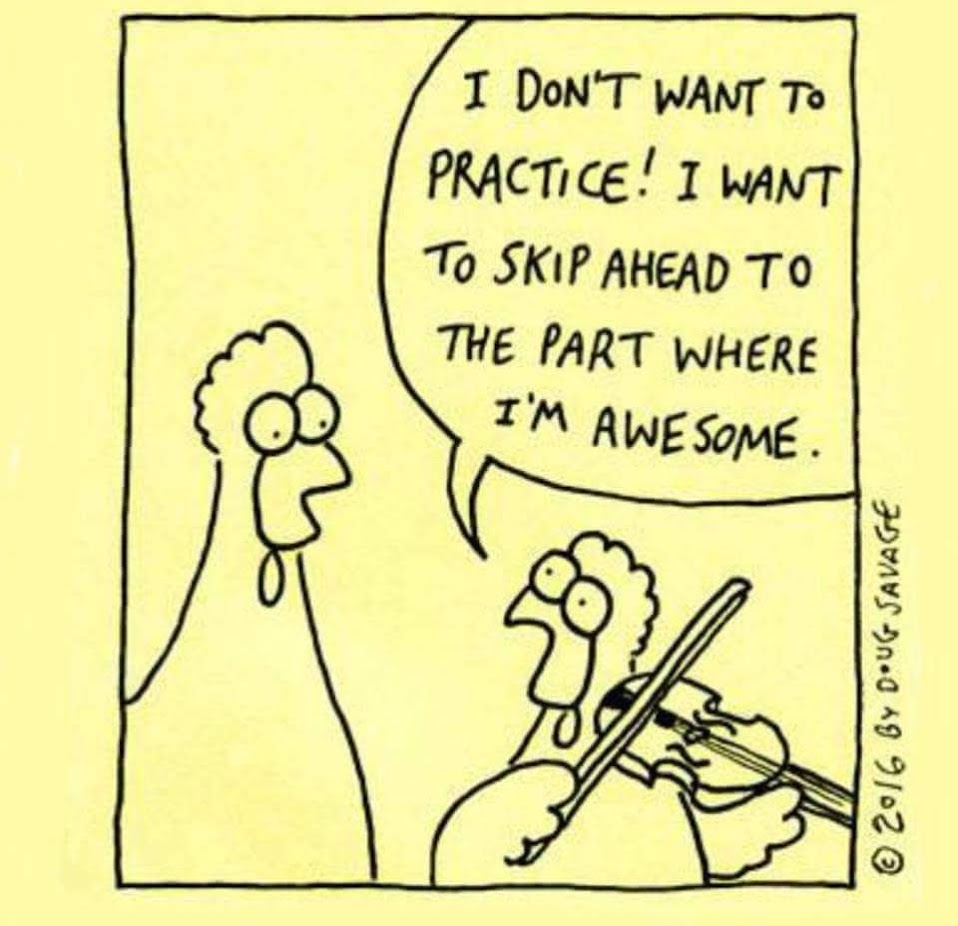
Consider this blog: it started way back in 2010 when I was just 10 years old, with the only readership audience being my proud parents. If I just want to skip to the part where my blog has a hundred thousand followers and daily readers, it's not going to happen unless I work towards it through the years leading up to it. It may or may not happen in the future, but it definitely won't without consistency and practice. Same thing applies when it comes to weight loss or a toned body. You cannot demand an awesome, fit self if you don't really exercise everyday. 

The concept that was taught to us as kindergarten kids is a big life lesson that we often tend to forget as we grow up. Looking for shortcuts to success is nothing but a real waste of precious time, as there are none. In fact, shortcuts are just going to delay every little moment when you could have actually worked on it. It is not for nothing that we have been taught young that practice makes perfect.

My dad keeps repeating over and again to me, to do my little bit today and not to think too much about whether it would fructify. Your only job is to match your reality every day to your dreams. It will come true automatically, if you work everyday on it. No success story was made on a single day, single hit. 

So let's all tame down on our daydreams, and work towards our dreams, enjoying the process every bit. And, if you don't teach yourself to enjoy the process, it is highly unlikely that you would enjoy the result as much! 

Friday, March 13, 2020

Forensic Science and Medico-Legal Jurisprudence: A Reflection Since Ancient Times

Sushruta-Samhita-Plastic-Surgery-india.jpg
The use of forensic techniques has been existent throughout history to solve crimes, initiating from the early existence of man. Forensic Science was intact in its simplest forms and kept on expanding throughout the prehistoric era. Prehistoric forensics is also considered as the building blocks of modern forensic techniques. 

Alfred Swaine Taylor’s Principles and Practice of Medical Jurisprudence (1865) expounds the concept of Medical jurisprudence, and also forensic medicine, legal medicine or state medicine, as the science which teaches application of every branch of medical knowledge to the purpose of the law.

The term ‘forensics’ is derived from the Latin word forensis. Forensis essentially means ‘of the forum’, which in ancient sense referred to where civic and legal matters were up for discussion. Though the terms ‘medical jurisprudence’ and ‘forensic medicine’ have been used interchangeably by many at many different places, there is a thin line of differentiation that segregates one subject from the other. 

Medical Jurisprudence essentially refers to all those questions that affect the social right of individuals and brings the one who administers medical advice, the medical practitioner, in contact with law when there is a violation of right that the victim suffers. In simple terms, medical jurisprudence is the legal aspect of medical practice. Whereas, forensic medicine is the application of legal aspect of medical practice to given situations or circumstances. This thin line of difference is usually muddled up, when actually these terms are supposed to be used technically and in a highly discreet manner. 

Another important branch that comes under the wing of forensics and medical jurisprudence is toxicology. Toxicology is the study of symptoms, diagnosis and treatment of poisons, and methods of detecting them. 

Combining the understanding of these basic terms, the application of such technical knowledge can be seen through the ancient Indian medico-legal treatises and works that break down the essentials of these advanced sciences to the minute level.

Ancient India was one of the golden ages of scholarly developments. Various treatises, literature, textbooks and other scholarly forms of original work were written and published during this time period. These intellectual pieces of writing covered a spectrum of issues and topics that was required to aid and guide the people or the government. Also, this was the period where the concept of state formation, and thus a unified regulation, came up and hence, elaborate details on sensitive but highly relevant issues such as crime and justice, were penned down. 
On a similar tone, issues on forensic medicine or examination of sudden death was also elaborately dealt with in the ancient texts. After reviewing the articles and various primary and secondary sources provided by scholars of different time periods since then, we come to acknowledge the fact that ancient India in its time was much ahead in forensic sciences as compared to other countries of that era.

The legal reception of forensic identification science varies from one legal system to another, and one culture to another. The processes and systems that exist today in India in the fields of medical jurisprudence, forensic medicine and toxicology, are derived strongly from the various scholarly texts of its rich and abundant historical literature and culture. It reflects the highly civilized and extremely educated characteristics of the ancient society of India. It reflects that India has always been a progressive nation giving great importance to scientific procedures, logical and legal soundness. Thus, by studying and analysing such primary sources of invaluable knowledge from indian predecessors, the science of forensics must grow and improve to fulfill the prima facie aim of imparting justice, overcoming hurdles such as corruption, to the sufferer.

NOTE: Image is that of Charaka Samhita. 

Monday, March 9, 2020

The Power Of Coalition

Image from Indian Express
India is a vast country accommodating an abundance of sociologically variant groups, co-existing in glaring inequalities. It is an indisputable fact that one of the key factors to bring a change towards the positive direction, in terms of lifting the seeming parlance of equality into something that actually exists, is the nature of the government, playing an important role in steering the country towards development. And, it resonates clearly that a coalition is much more effective in creating a change that is harmonious to development. 

Why is it right to think that a coalition government possesses the potential to reconstruct the steep pyramid of inequality into a platform of equality accessible to all? There are a numerous reasons to the same, but considering the scope of this essay, two concerns that very important for India shall be analysed. 

The first concern where the coalition government walks over a single party government is the field of economic development. The economy of India can be characterized as a developing mixed-economy. The 1990s in India is rightly termed as the ‘Era of Coalitions’. The ex-RBI Governor Dr. Venugopal Reddy, in a speech to the audience from Hudson Institute, Washington, USA, said that the highest growth in India from 1990 to 2014 was clearly during coalition governments. The consensus-based decisions that happen in a coalition government greatly help in the Indian context. A coalition produces better economic results than a single party with a strong majority. When the economic status of the country progresses, it is an empirically proven point that gender equality is promoted and the gender gap is reduced, with the right policies in place. Thus, the country inches closer to, not one, but two prominent ideals- economic development and gender equality. 

The second concern addressed by a coalition, better than a single party, is that of social stratification. The fact that a coalition government is an amalgam of multiple parties with widely varying ideologies is often considered a defect. It is seen as a hurdle to progress because of the long-drawn process of framing policies, incorporating all their ideologies. But, it is important to note that the same may be seen as one of the greatest strengths of this form of government. The varying ideologies bring out balanced policies, and ensure that they do not act as a boost to just one or few sections of the society. By framing policies that are less discriminatory and more accommodating, it is only a natural consequence that the gaps of social stratification will begin to close slowly but steadily. 

All systems have their own merits and defects. So, how do we decide which system is better? One method is looking into the matrix of risks versus benefits. When benefits outweigh risks, it is upto us to step up to the challenge of deciding to create a positive change. For a country like India, equality is still a far away goal, and a coalition government might be the first little right step towards it.

I wrote this essay for an event, but eventually did not send it through. Arguments for and against a coalition government is clearly possible, and this essay was written from the standpoint of the topic we were given: The Power of Coalition.

Saturday, February 29, 2020

Random Acts Of Kindness

I remember, we had a very ironic CBSE activity when I was in school: a compulsory 'random' act of kindness. And, we had to come to the class, and narrate what random act of kindness we performed. How did it turn out? A big, fat joke. While the idea of being kind is a noble and important one to teach to young boys and girls, the fact that they made us do a compulsory kind act for grades defeated the whole purpose. Honestly, none of us said the truth. We just invented something on the spot, and when one kid said something nice, ten kids after that repeated the same thing with mild twists in the story. Very effective lesson, isn't it?

In fact, it is not that none of us were kind. It is just that when your act of kindness is truly random and inherent in your behaviour, you will never realize or acknowledge it as doing something "kind". A true, natural act of kindness is appreciated, praised and cherished by the receiver or the onlooker, never by yourself. And, if you really are going to note down and boast about a random act of kindness, then there are more chances than not that you had a hidden personal agenda behind the act, and it wasn't really out of inherent "kindness". 

Kindness is all around us. We do, not one, but hundreds of random kind activities for the people around us. We pick up a dropped pen. We say thank you. We allow somebody to stand before us in a line. We share our food. We listen to their rants. We share their highs and lows. And, they do the same to us. That's where the important part comes. While it is absolutely not necessary to consciously keep track of doing kind things, we should always take a moment out and consciously appreciate the kind act others do. Well now, taking time out to give them a nice word of appreciation in itself is a kind act!

Kindness is like respect. You be kind, and you will see others being kind to you. Kindness is a wide umbrella that incorporates and overlaps with other key human traits such as forgiveness and helpfulness. So, even though the CBSE could not execute a noble lesson, we all got the message clear and right. 

So, as the image says, in a world where you can be anything: be kind!

Tuesday, February 18, 2020

Is Reading Fiction Mere Entertainment?

Books provide us with an escape from the hardships of our time. They take us to places that we may never go. They not only increase vocabulary, creative thinking and morals, but they also give us new ideas to use in our lives. Simon Lake who is the father of modern submarines actually got the idea from a work of fiction called Twenty Thousand Leagues Under the Sea. Can you believe that? 

Without fiction books, where would we be? Quoting George Martin: 
"A reader lives a thousand lives before he dies. The man who never reads, lives only one."

Those who read fiction are capable of empathy, and develop the ability to frame opinions, beliefs and interests apart from their own. They have access to hundreds of souls, and the collected wisdom of all them. They have seen things others would never understand, and have experienced instances that others would never know. They will learn not just what it is to be like themselves, but also what it is to be like someone else. They are wise beyond their years. And, the light of experience shines from such little experience.

Fiction also allows you the ability to "think outside the box" and teaches readers to have an open mind and gives us the ability to imagine things we never thought possible. Imagining something that doesn't exist allows you to imagine how things would be if it was possible, think of ways to make it possible, and  inspire you to create and find solutions.

Fiction is a very large genre of books, and not all qualify as fantasy or science fiction.

A fictional book can have a large amount of facts interspersed with fictional characters, or thoughts or ideals, allowing us to fill in the gaps of historical reference with possibilities that could have actually occurred. Fiction gives an important link of connection to our everyday life in trying to understand and see from the perspective of others. 

The ability to "put yourself in someone else's shoes" is an ability so many are severely lacking in. Fiction allows us to hear a person's unsaid secrets and, while being immersed in their world, become a part of their progression in life. Fiction gives readers the ability to escape, and set the reset button in how the world is viewed. Every new book is from a different perspective of a different character, and the substance viewed changes with changing perspectives. There is a balance. 

Whatever the rival claims on our leisure, we still find time for a good novel. Fiction may undergo some changes with the years, but in some form or the other it is likely to remain one of our chief sources of pleasure and learning.

Thursday, February 13, 2020

Author's Chair

We had a beautiful intra-class contest in school every year during our primary schooldays: Author's Chair. We all had to write one story and one poem, and our English teacher used to read all of them over a few days, and declare a winner, a runner, and a commendable piece under each of those two categories. And, the ones selected got to wear a crown, sit on the "Author's Chair" and read out their poem or story to the whole class. 

I wrote my first story in Class IV for Author's Chair. I still remember us waiting expectantly, with bated breaths, to see if our story or poem would make the cut. My class IV English teacher was one of the most favourite teachers in school, and I remember how much I wanted a word of praise from her. I had worked so hard on my piece. While my poem didn't make it, my story won. I still so fondly remember walking up proudly, wearing a crown, and reading out my first written story on the famed Author's Chair. It is such a beautiful, cherished moment, and I could have never thought of a better way I could have shared my first story. 

We used to have DEAR sessions- Drop Everything and Read! During these sessions, every single person in the school had to drop all their work, pick up a book, and just read for an hour. We used to love it. We made sure that we already had a book planned for the session, so that we could start reading without any delays.

I had a great friends circle with a lot of readers during my high school. We used to rush to the library, and make sure we got all the books we wanted before others could. We used to then rotate the books amongst ourselves, until all of us had read all of them. We used to pre-book the novels we wanted to read the next week. The librarian teachers were one of my closest and best teachers, I could even take the liberty to say they were one of my best friends, in school. They beamed every time I entered, and kept books stacked away for me, which they felt I'd enjoy. They used to discuss the books and authors with me, and get my review and opinion on the novels. They were one of my most favourite memories in school. 

I remember, once I complained to my high school librarian that the books were stocked in a haphazard way in the library, and how it was difficult to locate the ones I wanted. She asked me smilingly: 'Is it not your library? Why don't you do something about it?' I was mildly taken aback, but she was right. I got the sense of feeling that the library is mine, and it is my school. So, I went back home that same day, made a list of the authors in the library, and made small name cards for them. I went back to her the next day to proudly tell her my idea on how to organise the library, and from that day till today the library follows the system of name cards that I made and began.

School is one of the places that can do magic, and a world of wonder, to students.  I felt happy every single day I went to school. And now, my school is one of the things I'm proudest about in my life. And, mine undeniably did a world of wonder to me.

The school did us proud. Now it's high time we return the favor, isn't it?

Friday, February 7, 2020

Focus Points For Growth As A Society


Any government has multiple roles and responsibilities. Topping them is the duty to provide healthcare facilities to all, and also empowering the nation through measures taken towards education for all. 

Good health and basic education are the fundamental keys to development. While good health is indispensable for life itself, a good education is the one that can take the society forward. A healthy body and healthy mind, makes people more cultured and mature. It promotes healthy thoughts, and makes people broad-minded. Education is the key to tackling various social issues that we face in the world today. In a world where advancement and newer technologies spell the future, it is important that a nation promotes active learning and empowers the youth. It is important that the government prioritizes and utilizes its resources in providing these two basic necessities to the nation. 

Art and culture is something that makes the society. Culture is what the society is, and art is what such a society expresses in its own ethnic forms. Since they are inherent traits of any society, they are capable of surviving even if the government doesn’t spend too much resources on them. Art and culture are passed on from generation to generation. They are important too, but do not take a place above crucial factors such as health and education in the priority table. 

Finally, what is the use of a culturally rich nation which is way backward when it comes to parameters such as health and education. What we should understand is that education promotes art and culture. Not the vice-versa. So, by spending more resources on health and education, we not only enhance the literacy level but also the cultural aspect of the society. Thus, the government should definitely spend more resources on health and education than on art and culture.

Wednesday, February 5, 2020

Education: In Consonance With Holistic Personality Development

We all go to school to get ‘educated’. We all ‘learn’ something in school. Before we try to analyse whether today’s educational system is inclined towards ‘skill development’ or ‘holistic personality development’, we must ask ourselves- what is education? 

Education is the process of learning that facilitates acquirement of knowledge and enables development. Skill development is the process of developing those skills that help us perform those various complex jobs that we have to, in life. And holistic personality development is the process of developing those qualities and perspectives that make sure our ‘skills’ are humane and useful to others. 

The need for a holistic education system is definitely gaining a lot of supporters in the current world. Parents want their children to not just acquire a set of skills, but learn to use them in a way productive to the various causes of humanity. The definitions of terms such as ‘success’ and ‘ambition’ are sincerely being re-evaluated. No more is success just pure profit for the self. If personal gain comes at the cost of another, or cost of a greater good, it is not considered to be success. In simpler terms, it is now seen as how much you give to the society, instead of how much you take from it. 

‘Learning’ has also taken a new dimension. Einstein in one of his speeches, on the role of school in development, says that it is more important to teach how to ‘acquire a skill’ than to teach the skill itself. 

What is the point of learning in rote the mere contents of a textbook? Thirty years back, knowing facts and historical points, and being on the know-how of something may have been a cool skill. Today, all it takes is a single google search! The world is changing at a pace so fast that the skill set required to adapt to the contemporary necessities is almost never constant. Therefore, more than putting pressure on children to excel in one particular skill, it is better to teach children how to learn a skill, because the skills that you teach them today may not really be needed tomorrow. 

To conclude, today’s education is shifting towards a more holistic system than a mere skill development process, due to the increasing relevance of exponential technological advancements, and also seeing the world from a humanitarian perspective that can help in tackling many of the current global problems that we face today.

Monday, February 3, 2020

How Do We Write In The Present World Of TL;DR

The world today is driven by audio-visuals. Paintings, photographs, films, music- they rule the game. When people claim to have read an article or a book, I can bet they have not most of the times. It is a world where very few love descriptive, lengthy texts. Its is a world fast-paced, and one that required the impact of words to match their pace. 

So then, are words powerless? Of course, they are not! But, words now need to fit within a square box. 100 words; 200 maximum. I don't believe anybody who is not specifically there for it would read it otherwise. I see comments saying TL; DR to blog posts. They aren't even ready to write the long of it: too long, didn't read. So, that's how the world runs today, nobody wants to read a long post. What started as a brilliant  concept of Twitter is now the norm of the brain in today's world. Is it sad? Not really. Writing evolves, and styles do too. It is a happy challenge for those who court words and want to create an impact. Random thoughts, but valid ones. What do you think?

Sunday, January 26, 2020

Sri Pingali Venkayya- The Man Behind Our Tiranga

I wrote this essay for a competition when I was in school. I did not know who Pingali Venkayya was before that, and felt pretty ashamed when I came to know that he is the man behind our national flag- Tiranga. I thought that I might have already put it up on my blog, and wanted to share the post today. But when I found that I hadn't, I wanted to share the essay, on account of India's 71st Republic Day, today! Happy Republic Day, and happy reading! Jai Hind!

Every free nation of the world has its own flag. It symbolizes the ideals that a country fundamentally stands for. At all national meetings, festivals, and occasions, it is the national flag that flies high. It is by the national tricolour, the tiranga, that India has its identity. Waving the national flag creates a sense of unity and patriotism in the country. Be it a cricket match, or a national event, the tricolour flag of India flies proudly. It is hoisted in the Red Fort every year by our President and Prime Minister during Independence Day, 15th August, and Republic Day, 26th January. And, this flag is a slightly altered form of Sri Pingali Venkayya’s design of the Indian National Flag.

Sri Pingali Venkayya was born in the village of Bhatlapenumarru, Krishna district, near Masulipatnam, Andhra Pradesh. After finishing his schooling at Machilipatnam, he went to Colombo for further studies. He first met Mahatma Gandhi while he served for the British in the Anglo-Boer war, fighting for the British, in South Africa. He was kindled and inspired by Gandhi, and was also greatly influenced by his ideas. He became a Gandhian.

During the duration of five years that Sri Pingali Venkayya stayed in North India, he actively participated in politics. After the 1906 Congress session with Dadabhai Naoroji, Pingali Venkayya manifested himself as an activist. 

During the National Conference of the Indian National Congress, Sri Venkayya came up with the proposal of having a unique flag for the Indian National Congress. Mahatma Gandhi liked and approved of Pingali Venkayya’s idea. He asked Venkayya to design a flag himself. Sri Pingali Venkayya proposed the tricolour(tiranga)- saffron, white and green- with a chakra or spinning wheel in the centre. This design was the basis for the National Flag of India. 

Our National Flag, in the form that it is now flown, was adopted during the meeting of Constituent Assembly held on the 22 July 1947, a few days before India's Independence from the British on 15 August, 1947. It served as the national flag of the Dominion of India between 15 August, 1947 and 26 January, 1950, and became the flag of Republic of India after that. The term "tricolour" or “tiranga” refers to the Indian national flag.

What do the three colours, that Sri Pingali Venkayya created for the Indian flag, represent?

The saffron colour represents courage, the white colour represents truth and peace, and the green colour represents faith and Prosperity. The saffron represents the Hindus, the white represents the Christians, and the green represents the Muslims, creating a unity among the three major religions of the Indian population. The Indian National flag is a perfect model representing an “Independent”, “Republic” and “Secular” India. It is the pictorial representation of the Nation.

Sri Pingali Venkayya definitely has to be attributed for creating the idea and design, on the basis of which our present National Flag of India has been created. It has been so many years since the adoption of our Indian flag, and still the flag is hoisted up creating a strong bond among the Indians. The tiranga unites the diversity of India.

Knowing about Pingali Venkayya’s contribution to the nation, and the important relevance it has in our nation today, will serve the purpose of institutional memories of the nation and the Freedom Struggle, to keep the youth of India motivated and inspired to stand up to basic values. This will help the youth to participate actively in Indian politics, and also be responsible citizens of India, upholding the constitutional values that India's flag stands for.

Monday, January 20, 2020

A to Z: On How To Create A Sustainable Change

Image from Sustainability Illustrated

Apple fell on Newton's head, and then suddenly we all realized the concept of gravity. 
But, gravity had always existed, and continued to exist. 
Can we draw a parallel, and say that be it discoveries or imagination it always derives its source from what already exists? 
Do you think humans have the capability to create something that in no way existed before? 
Every object we know, though the object might have been new at some point, is made up of stuff that we know and exists. 
For instance, let's consider the creature of imagination: unicorns. 
Given the fact that we know of the existence of horns and horses, we pieced together two elements that exist to imagine something that doesn't. 
How and what, then, do we pride ourselves to have discovered?
Is the various combinations, of what already exists that we piece together, something to feel accomplished about?
Just a few seconds of thought is enough to realize that humans can just shape what is given to them, and not create anything novel. 
Knowing this, is it fair for us to deplete the resources that we have?
Life would come to a standstill, if the resources we have are not used effectively.
Mankind is an intelligent species, and such intelligence is a double-edged sword. 
Not so long ago, our ancestors seemed to have lived in a world that was replete with resources, and within the short time, we have managed to cause exponential depletion in the name of development.
Our duty, as responsible citizens of, I will not say the world, our own locality, is to make sure that our neighbourhood understands the impacts of irresponsible behaviour, and starts to pay heed to the environment and its resources.
Panacea to this ill is to use the well known principle of 5 R's.
Question your neighbourbood on their practices, and promote small changes for a better future.
Refuse, reduce, reuse, recycle, and rot- all possible products in your neighbourhood.
Stay within your neighbourbood, that's where you can effect a change and actually contribute. 
To help the world, you first need to help yourself, so don't just preach sustainability, you also need to follow it.
Unless every neighbourhood feels the need to change, and also implements change at small levels, there is no way a change can be seen at a city level even, forget the world level.
Very effective ways to help people get into the groove of the 5 R's of sustainability is to start them at schools, work spaces, hotels, restaurants, where there is a lot of scope to do so. 
Where there is a will, there is a way, after all. 
Xerox of documents and unnecessary printouts can be avoided in today's world of technology, so do it only when necessary. 
You need to be the change you want to see.
Zeal is all that is required!

Wednesday, January 15, 2020

The Human Factor In A Future Of AI

Sometime back I had to write this essay from a given prompt titled "The Human Factor In A Future Of AI", and sharing it here for your reading. Comments are welcome!


The world that we see ahead is one where the line between humankind and technology is thinning down further as every day goes by. The rate of development of technology is happening at such an unprecedented, break-neck speed that it has become nearly impossible for the other complementary fields to keep up. The new talk is all about the world of artificial intelligence(AI)- a realm that even the men who have discovered it are not entirely sure about. 

Artificial Intelligence, to be simply put, is the theory and development of computer systems able to perform tasks that normally require human intelligence. The disruption by AI is already happening around us, and it is believed that this is just a microscopic part of an unexplored universe of self-programming intelligence. It is also expected that AI would successfully replace most of the jobs today, thanks to its high efficiency and almost impeccable accuracy. 

So, in this future of artificial intelligence replacing all that humans can do, in a much more efficient and successful manner, is there any human factor left for us to hold on to? Well, it all depends on objectives and perspectives. 

There are still things, definitely, that a machine cannot achieve by replacing a human being. A machine, whether programmed to gain intelligence or not, operates on pure statistics and algorithms. It takes its decisions and makes networks purely on the basis of logical arrangement of probabilities and mathematical models. What a machine lacks is instinct. And, this is human factor in the future of Artificial Intelligence. 

Since time immemorial, we have always known that evolution has been possible and life exists only because of instincts, and so there is no question on the power of it. AI can make machines intelligent enough to understand our instincts and the human emotional quotient, but they could never have one of their own. To simplify: it might gauge our anger and love, but cannot produce the same. That is where humans score over AI. As Australian scientist Alan Finkel puts it (Finkel’s Law): robots won’t replace us because we still need that human touch. Robots do not understand irrational thought and context. These things can be essentially dealt with only through instincts and empathy that AI will not provide the robots with. 

To sum it up: AI could make robots almost life-like but they would never actually have a life because humankind can be two things that AI-bots could never be: human and kind. And, that is essentially the human factor in the future of Artificial Intelligence. 

Tuesday, December 24, 2019

Digital Empowerment- order of the day?

Image from thefutureshapers.com
Change is an ever-happening phenomenon. Changes can be big or small, significant or paltry, impactful or futile: but one cannot deny the existence of continuous change in society. Usually small changes accumulate and snowball into a bigger mass of change. One such massive change that the world has seen in the last 50 years is the Digital Revolution. 

The concept of digital divide refers to the imbalance regarding access to technology that exists across different demographic groupings. There’s a gap between people who have access to information and communication technology, and those who do not. This digital divide has three basic key aspects: global divide, social divide and democratic divide. 

Before trying to debate on whether digital divide can cause a rift, we need to understand the perspectives of the optimists, pessimists and the skeptics. Optimists believe in the positive role of the Internet for transforming poverty and other ills in the society by empowering the people and spreading awareness. Pessimists argue that internet politics privileges the elite who already are active, and hence is detrimental to society. Skeptics vibe with the idea that new technologies alone will make little differences one way or another, and it would have almost zero contribution to the social atmosphere. All three of them are right in their own perspectives of looking at Digital Change. 

In a world run and accelerated by digital techniques and platforms, it is stupid and irrelevant to talk about going back to an era when high-tech gadgets did not exist. So, digital divide is bound to be an issue in the present and upcoming generations. And, this digital divide will definitely mask all other spheres, including politics. Therefore, it is also bound to bring a democratic divide. The impact that the divide has on the society would vary in intensity depending on various background factors and the history of the social group. 

Take the example of India. Many social issues, political issues and societal issues are being effectively conveyed and dealt with using the technological tools available today. 

Therefore, the future has to be one where we focus on trying to reduce the imminent threat of a wide digital divide, which in turn would lead to a democratic divide, by promoting digital empowerment. Digital empowerment is the order of the day, and it is a good choice to learn it with the right attitude, as going without it is no option.

Monday, December 9, 2019

The Next Sci-fi Plot?

Image from Clipart

I have a habit of sitting in class, and connecting the laws I learn to weave a story, a fantastic legal thriller. Perry Mason and John Grisham have fed in too much imagination. I remember sitting in the Contracts class in my second semester in law school listening to the lecture. Our subject of discussion that day was s. 10 of the Indian Contract Act which talks about the validity of a contract or an agreement. Our professor casually threw at us a statement- what if in the future intelligent computers make contracts? Will the same validity criteria hold good then, too?

Of all that he said that day, my mind took fancy to this single statement. A simple, amusing thought: fast forward into the future and see through the lens, to observe two computers placed royally in a five-star meeting hall negotiating and entering into a contract for their respective parties. Good plot for a sci-fi novel, with a villain and a few twists and turns?

Jargon like AI, Machine Learning, Deep Learning, and over-exaggerated threats of an army of computers taking control and wreaking havoc on humans, are all very popular. But how many of us actually know what they mean? I did not, though I was well aware of all the jargon in use. To further explore and understand if this is even possible, I did a small introductory course on AI.

AI can be broken into two parts Artificial Narrow Intelligence (ANI) and Artificial General Intelligence (AGI). While there has been tons of progress in ANI, with all the self-driving cars, speech recognition, visual inspection devices, spam filtering applications, etc., there has been next to no progress in AGI.

So, here’s an imperfect rule I learnt during my most basic quest to understand these terms: anything, any job that we do under a second of thought, is automated or will soon be automated. So, where there is a series of tasks one after another which takes an hour to complete, where each task only requires a second of our thought, it can be automated to be efficient in time, resources and produce an almost-error free result. For example, in speech recognition, though translation of a 15 minute podcast may take us sometime, every word we hear takes us less than a fraction of a second to be understood and written. So, it has been successfully automated considering other factors such as language, accent, etc.

Now, connecting these aspects to law, we need to ponder on two important things.

- What can technology do and what can’t it do in the legal field?
- What proportion of the lawyer’s roles does it take over?

Most clerical jobs such as calculation of stamp duties, searching of case laws, etc. has already been automated and there are a numerous menial tasks through the day of a lawyer that can be further automated.

But can two computers make a contract? The general clauses that exist in a format in every deed of a particular type may be automated, but the negotiation of clauses cannot be done under a second of human thought. Also, there are several unknown extraneous situations that come up between the two parties. And, since there is no progress in AGI, it may be next to impossible for computers to gauge such aspects as of now or in the near future.

But, in a hypothetical situation, if the computers were able to make contracts in representation of their human parties, what would be the criteria of a valid contract? Seems like a question that I’ve thought real less about, as I set around understanding if that is even possible. I can at least say that I do know what the terms mean and their most basic logic. But some good food for thought, isn’t it?

Endnote: I think it would be an interesting sci-fi plot. Should I unleash the imaginative writer in me and give the world its next bestseller?

Sunday, December 8, 2019

#DayOne


There is a constant question that I have been encountering for the last two years from all who know me- why aren’t you writing anymore? Fair question, and yet a tough one to answer, because I do not have one. Be it my parents, my school friends, the closest friends who have constantly read my writings and encouraged me with feedback, the college friends who have discovered my blog which feels stagnant for want of new content- all of them want to know why I stopped writing at some point in the past. Though, I answer to my defense, unconvincing for both me and the questioner, that I will start soon, that I am busy, that I lack the time after a busy day, and a hundred other useless excuses, I have reached that point where I take away the people and just take in the question.

Why am I not writing anymore?

Ten year-old me would frown highly disapprovingly at this almost twenty-year old me letting go of something that was so dear to her childhood. It makes me smile fondly at the thought of how this blog began as a small, unconscious journey in the summer vacations of 2010 to simply write about what I loved doing. Our school had the concept of writing reviews for the books read in our school library. It was a simple, and interesting format. My father, seeing me read one book after another, lost in the classic world of fiction, introduced the concept of a blog to me. It was new, it was fascinating and it was brilliant. I did not have to restrict my narration of what I loved in those books to just my parents, but could share it with the whole world. And, I could record every book I read!

I remember the pre-condition laid by my father when I agreed to the exciting idea of a blog- to get twenty-five posts written and ready before creating a blog. And, then I started writing a review in the same format as my school library provided, and within no time, I had twenty-five posts ready. It all started with a very sincere, childish review of The Wizard of Oz by L. Frank Baum. And, then, there was no stopping the enthusiastic girl for the next five years. Until even 2016, I had my blog going with at least a couple of posts a month, even during my high school years.

What was expected was that, my writing would grow again and reach a peak after I enter college. Did that happen? Nope. What happened, why not? No reason. Or maybe there were reasons. One, my utter laziness? Two, my disinterest in writing? It makes me shudder to think of the second reason, because if you take writing away from me I’d sit wondering of what else I have.

Looking through my blog, I can see me grow. Be it my writing, the books I read, the activities I did, the blog reflects the gradual growth in age and skill. Reflecting, I realize that the writing was that of a 10 year old, obviously childish and filled with heart-warming errors, but the effort was not. And through the years, my writing shaped into something much finer, but today I realize that 10-year old me was a thousand times better in her efforts.

Pause. Let’s not spiral down a path of self-pity as to what has become of the last two-years. There’s still a chance to reach that ‘peak’ within my college years. And, that is by starting. Not today, not tomorrow, but now.

A post a day, is a challenge that my dad has been proposing to me for years now. And, I think 2020 is a good year to see that materialize. Since, I seemed to have no reason to have stopped writing, I decided to give myself a heads-up and get into the habit. So, here’s my #Day1 with a little bit of self-reflection.

Thanks to all those who constantly embarrass me by badgering on what happened to my blog. Thanks to my Dad for introducing me to something brilliant, and also warning me not to lose it.

An optimistic Sandhya (do I see a faint smile on the ten-year old?), wrapping up with a smile, and looking forward to #Day2.

Thursday, April 30, 2015

Essay On "Why is there an increase in violence amongst students in Tamil Nadu?"

Recently, “Nandini Voice For The Deprived” conducted an essay on the topic “Why is there an increase in violence amongst students in Tamil Nadu?” I submitted this article. Here I am giving it for your reading. Feel free to comment!

TOPIC: Why is there an increase in violence amongst students in Tamil Nadu?

Violence refers to acts of aggression. It denotes the quality of being wild, and using physical force to achieve a goal. When do people become violent? One, when they are unable to achieve their goal through skill or logic. Two, when they have always been pampered and suddenly face an opposition or a refusal. Three, when they have grown up seeing violence right from their young days as a justified act. These three arguments prove to be right in the case of students in Tamil Nadu, too.

Writing about students in Tamil Nadu includes school and college students. Resorting to violence when unable to achieve one’s goal is mostly seen in college students, not among school students. That is because, only after coming to college do students come to understand the tough world, and face stiff competition. Pressure builds up on them. They tend to realise that they don’t have the required skills to go into a well respected institution for work. They prefer doing wrong things to achieve their goal, rather than not doing it and starving in the world.

Way to easy money- that again is a greedy thought in students after they finish their college. They want quick money. Violence or nonviolence simply doesn’t matter at that time. ‘A little violence… Nobody’s gonna find out!’ is what those students think. This propels them forward on to vehemence, contributing to growing violence amongst students.

Now let’s take a look at why there is violence amongst school students. Nowadays, the size of families is very small. Maximum includes the grandma, grandpa, mother, father, and an only child. The child gets whatever he/ she wants, from chocolate to bicycle to anything else that crosses the mind. He/She has never been refused, never been scolded, never ever  faced opposition. His/Her verdict had always stood to last. Parents go to office to work all day, and cannot spend any time with the child. And, to convince their conscience, they laud the child with anything and everything in the world that the child wants. Now, what do you think the child’s reaction would be if it ever was refused or opposed? Violence. He/She will not be able to reason out, or even listen to the reasons of the opposition. The first thing that comes to their mind will be ‘How dare you oppose me! Refuse me! Just wait till I beat you up!’ Here comes violence at such a young age. Finally, when they grow up, they will be just the same- with even more ego, and even more fury when there is a refusal.

Also, school children have high energy levels as a natural quality. Amongst these students, some have really high levels of energy that can turn out in a negative way if not guided properly. When such energy is not used productively, it paves the way to a lot of fury and violence. This is not a mistake on the child’s part. They just have to be engaged continuously in activities that supersede or match their energy levels. As proof for this, my dad quotes examples of a lot of “troublesome” kids during his days, who when channelised by PT masters properly, went on to achieve great heights in sports. This is a very important aspect that helps in controlling violence amongst students. Naturally, this applies to students in Tamil Nadu, also.

Seeing violence from young days instills violence. Students generally don’t see people beating or thrashing others on the roads, or other public places. But where they see violence most is in movies. Tamil Nadu is very famous for its movie culture. Every Tamil movie has a hero who will beat, punch, slap, smack, kick and strike the villains, very heroically indeed! And, they do it for the silliest of reasons based on the story. This always ends by  sealing the fact that nothing can be done without beating up people. Also, our present culture seems to believe “might is right”. Why! We even have a tamil saying that literally translates into- brothers cannot help like how beating helps. Great. So, why won’t the school and college students, who make it a point to see every single movie first-day-first-show, not be influenced by these heroes on screen? Many think themselves to be those heroes. They see all situations as if they are like the hero on the screens. And, they adopt violence when they think they ought to, just like the hero they envision themselves to be. To add to these already existing problems, some students around them look up to them as heroes, too, instead of talking sense into them. This only encourages the students to take up violence more confidently than ever. Why not? They seem to have a whole fanbase under them!

Now, a note on how this situation can be stopped from getting worse. Students must be counselled in  colleges, and opportunities have to be given in various fields for them to identify their interests. Parents mustn’t pamper their children. This doesn’t mean that they should completely have their children under control, since that also gives way to violence. Children must understand the concept of liberty with responsibility. Parents must also look for the child’s interest, and channel the child’s energy in a productive way instead of letting it loose to take the route to aggression. In this case, any kind of  sport can help. Finally, it is not at all wrong to watch movies. But, students have to be educated to sufficiently distinguish between the ‘real’ and the ‘reel’.

Let us go back to our middle-school lessons, and recall that India itself came out of the British Raj through non-violence! Anything is possible, not just through violence, but anyway.  
If students understand these causes, and the impacts on themselves and the rest of the society, the situation can certainly turn for the better in Tamil Nadu.

After all, where there is a will to set things right, there is always a way to do it.