Hey!

Welcome, and you can check out my posts. But, I don't write here anymore. So, if you are interested, come on over to https://sandhyavaradh.com/
Showing posts with label biography. Show all posts

Friday, August 28, 2020

The World As I See It

Title: The World As I See It
Author: Albert Einstein
Translated from German to English by: A. Harris

To most of us, we were taught who Einstein was since the time we were taught what science is. But, did we ever really know who Einstein is? We knew Einstein, the universally famous scientist, who was one of the most brilliant of men to have walked this Earth and who talked of things that were way beyond the comprehension of common men. Mark Twain once commented how as a reader and writer, he still could not completely comprehend a single line of Einstein's theories. 

But is that all who Einstein really was? Obviously not. And, his own book The World As I See It gives you a glimpse of another, less-spoken side of this man. We meet Einstein, the human and the thinker, through the miscellaneous collections of Einstein's thoughts on a wide array of things from education, war and peace to religion and life. He portrays what he believes as reason itself manifesting in nature, and emphasizes on the importance of experiencing it. And, he calls such an experience of humans as that which:
"... stands at the cradle of true art and true science."
The chapters and the thoughts are what you might call as haphazard, and yet by the time you wrap up this book you get a clear, appealing picture on this brilliant man's view on the world and it's philosophies. It is a small, quick read that should take more than a couple of hours. I obviously read the translated version by A. Harris, since I don't know German. The translation is top notch, and the book will have you so engrossed in the content that you won't even notice it's translated! 
"A hundred times every day I remind myself that my inner and outer life are based on the labors of other men, living and dead, and that I must exert myself in order to give in the same measure as I have received and am still receiving." 
We take home many lessons- some that we already know in the corner of our mind, and some new. It is just as inspiring and admirable to see Einstein, the thinker, share his perspective. We all admire him, although I wonder if any of us really understand any of his works. So, why not grab this opportunity to understand at least the one book that he did write that works within our ranges of understanding! It's a great read!

Thursday, May 14, 2020

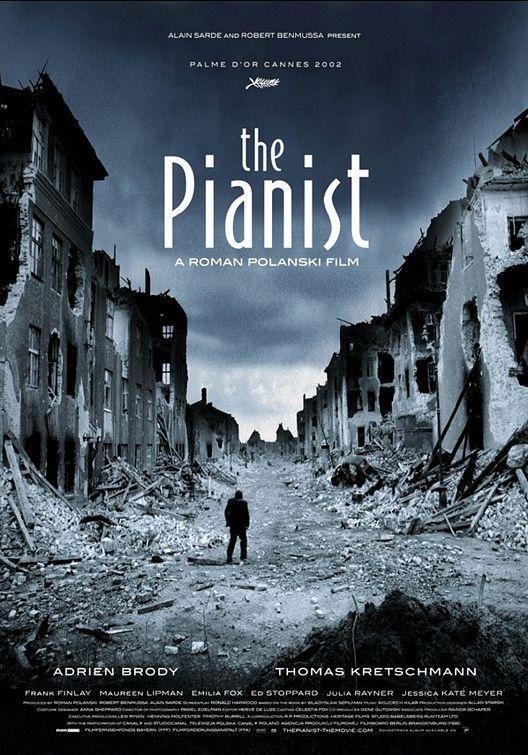
The Pianist

Movie: The Pianist
Directed by: Roman Polanski
Written by: Ronald Harwood
Starring: Adrien Brody, Thomas Kretschmann, Frank Finlay, Maureen Lipman, Emilia Fox, Ed Stoppard, Julia Rayner, Jessica Kate Meyer
Music by: Wojciech Kilar
Running time: 150 minutes

"If you prick us, do we not bleed? 
It you tickle us, do we not laugh? 
If you poison us, do we not die? 
And if you wrong us, shall we not revenge?"
- Shylock in The Merchant of Venice

September 1939, when the German Nazis bomb Warsaw, Poland for the first time, a Polish radio station where Władysław Szpilman, the pianist, plays for the radio, is also hit by the bombings. The story progresses slowly inching towards the 1940s as the Nazis get a stronghold on Poland abusing the Polish Jews. 

The Szpilman family is forced to disgraceful treatment for being Jews. They quickly descend from being a respectul, prosperous, and peaceful family living in a decent locality to huddling in a "Jewish district" that soon turns into a hungry, desperate Warsaw ghetto, where anyone did anything to survive. As part of Operation Reinhard, Szpilman and his family are packed in an cramped train to the death camp in Treblinka in August 1942. However, a friend in the Jewish Ghetto Police recognizes Władysław, pulls him out of the crowd with the intention of saving him, and separates him from his family to his utter terror.

The Pianist is the heart-wrenching story of the sights of slaughtered Jews, unwavering grip of fear, and the good-hearted help and luck from several non-Jewish friends that Wladyslaw witnesses as he tries to live through the barbaric holocaust, waiting for the Russians, French and the English to put an end to the agony-filled years of World War II. The film tries in no way to make it like a thriller, or make its protagonist the hero. The film doesn't convert the protagonist to lead a revolution. It captures the essence of his fear, the torment, and the dreadful consciousness in the viewer that, without a miracle, not even the fittest survived. And, this is why the film hits you so close. 

The film is based on the actual memoir titled The Pianist  by Władysław Szpilman, a Polish-Jewish Holocaust survivor who later settled in Poland and continued to be a pianist and composer. 

Brody is unbelievably real on screen as Wladyslaw, with a spectacular performance that convinces you he is the hauntingly sublime personality- the pianist. The movie doesn't cover all of the holocaust, and it doesn't aim to. It focuses only, and only, on our protagonist, what he saw, what he felt, and what he did. There are no tears as you look at Brody as Wladyslaw, only a close feeling of poignant and evocative emotions that settle in your heart, slowly and slowly as you see the pianist go from a positive, optimistic man, to a desperate Jew on the run to save his life. 

I loved the film, it is a must-watch!

Tuesday, April 28, 2020

Seabiscuit: An American Legend

Title: Seabiscuit: An American Legend
Author: Laura Hillenbrand

"It began with a young man on a train, pushing west."

Charles S. Howard was a man who set out to find where his restless heart would rest, leaving the comfort of the eastern cities of America to explore the western part. Reaching San Francisco, Howard found the opportunity in automobiles in a city where they swore to stand by horse rides. Taking up a franchise dealership of Buick, Howard went on determined to convince the people into a future with automated locomotion. And for that, Howard drove in car races with the exact models he was supposed to sell, and offered driving lessons as not a single person in the wide town of San Francisco knew how to drive even if they were rich enough to afford a car. 

An earthquake in 1906 worked in the favour of Howard, as he proved the value of automobiles to the city of magnificent distances(as a witness of the disaster put it) by converting all the cars in his showroom into an ambulance that helped so many firemen and so many victims to safety. Suddenly, in a one-day spin, Howard was a rich, daring, dashing, photogenic, articulate, young achiever who, according to the media, was always doing something stunning and always saying something quotable afterward.

The fateful loss of his son, during a promotional event relating to automobiles, left Howard distancing himself into a recluse. When he got out, he got himself into performing and facilitating various philanthropic activities. Now successful, Howard slipped back into a restlessness, and pushed farther west only to discover his love for what he replaced. Horses. However, he was interested in racehorces
"In keeping with his love of lost causes, Howard bought only the worst-looking horses at the sale, animals who lingered in the ring, attracting few, if any, bids."
One of those worst-looking horses was the thoroughbred, light-bay beauty Seabiscuit, who would grow to dominate the columns of popular newspapers of the whole of America, and rise to be an icon of identity for the American nation.  A series of events lead Howard to stumble upon "The Loan Plainsman" Smith, the finest horse trainer America would ever see, and Pollard, the talented jockey of Seabiscuit. 

The book vividly describes the magnificent horse, and his lovable quirks. Hillenbrand captures them in such amazing details that reading about Seabiscuit and his life made me feel a part of it. The narrative is fast-paced and you gallop through the chapters racing along with the timeless experiences of Seabiscuit and the world of horse-racing. The book leaves you with an exhilarated feeling as you root for your Seabiscuit, whose defect and quirks and the soft, mischevious, sweet-treat-loving heart you would have grown so fond by that time.  
"In 1938, near the end of a decade of monumental turmoil, the year’s number-one newsmaker was not Franklin Delano Roosevelt, Hitler, or Mussolini. It wasn’t Pope Pius XI, nor was it Lou Gehrig, Howard Hughes, or Clark Gable. The subject of the most newspaper column inches in 1938 wasn’t even a person. It was an undersized, crooked-legged racehorse named Seabiscuit."
Laura Hillenbrand lavishly spends her chapters introducing us to Howard, Smith, Pollard and Seabiscuit, each with their own fitting grandeur. It is a pleasure to read the small, interesting bits of Seabiscuit's life with Smith, and Smith's life with his favourite champion racehorse. I thoroughly enjoyed the descriptive episodes where Smith is lovingly worried about the grooms feeding treats to Seabiscuit leading him to put on weight, and is torn between firing them for not following his instructions and letting them stay because the horse was so enamoured by them. Smith's merry in taking the media reporters on a ride is even more merry to read about! 
“Turf writers and clockers swear by Tom Smith,” moaned a reporter, “and very often they just swear.”
 “So long, Charley” cries Woolf, the jockey during Seabiscuit's ultimate win against War Admiral, what is still considered to the greatest race in the history of horse-racing. The victory cry came to stay for decades as the winning exclamation of jockeys. Seabiscuit and Howard grew old together, when Seabiscuit retired from racing, after breaking all the records possible. 
"Seabiscuit settled well into his retirement. Knowing he needed activity, Howard taught him how to herd cattle. The horse loved it, nipping at the animals’ rumps and torturing them as he had once tortured War Admiral and Kayak."
Finally, I would like to give you one fair warning that the book itself gives. I haven't watched the movie on Seabiscuit, but here's the excerpt from the book: 
"Hollywood took the tale of Seabiscuit’s life, deleted everything interesting, and made an inexcusably bad movie, The Story of Seabiscuit, starring Shirley Temple. They cast one of Seabiscuit’s sons in the title role. When they set up to film the War Admiral match race, they deliberately chose a woefully sluggish horse to play War Admiral. Unfortunately, the Seabiscuit son was even slower."
I absolutely loved the book, and I am so glad I read it. This book had a weird way of making me so happy with every win by Seabiscuit, and I have come to love the way the horses were described. I think it is one of the best narratives- descriptive, fast-paced, and doing full justice to its story! It's a must-read!