Hey!

Welcome, and you can check out my posts. But, I don't write here anymore. So, if you are interested, come on over to https://sandhyavaradh.com/
Showing posts with label reports. Show all posts

Wednesday, September 23, 2020

The Importance Of Being Earnest

Title:
The Importance of Being Earnest: A Trivial Comedy for Serious People
Author: Oscar Wilde

Algernon Moncleiff goes to welcome his best friend Jack Worthing, alias 'Ernest', who comes all the way from countryside to propose to Gwendolen Fairfax, Algernon's cousin. Algernon gives consent to this proposal of Jack on the condition that he explain the inscription on Jack's cigarette case that says:
"From little Cecily, with her fondest love to her dear Uncle Jack."

Ernest confesses on living a life with two identities- the strict and disciplined guardian of young heiress Cecily Cardew through the name of Jack in the countryside, and as the carefree man Earnest in the city. After this confession, Algernon himself confesses to be living a double life. Gwendolen accepts the proposal of Ernest, and convinces him to rechristen himself as 'Ernest' as the name is a big part of why she loved him. Meanwhile, Gwen's mother Lady Bracknell disapproves of Ernest, and forbids any engagement between Gwen and Ernest.

In the meanwhile, Algernon visits Jack's countryside to meet the young, beautiful heiress Cecily Cardew to whom he had been attracted to when Ernest mentioned. He introduces himself to Cecily as 'Ernest', and Cecily presumes him to be the brother of her guardian 'Jack' Worthing. The two fall in love, and plan to get engaged. Since Cecily loved the name 'Ernest', Algernon decides to scrap off his dual identity and rechristen himself as Ernest. 

During this time, Gwendolen decides to run away from Lady Bracknell and come to the countryside to meet Ernest(Jack). She chances upon Cecily, and they both end up claiming that they love 'Ernest'. What ensues is a drama that sends you in fits of laughter, and entertains to ensure a smile is pinned on your face!

This is the first time I am reading a play of Wilde, though I have read his short stories before. I absolutely loved it! With other stories like The Canterville Ghost, one is already familiar the unbeatable humour of Wilde. But, this play is a gem! The fluidity and the spontaneity of the characters that has been captured in the script was mind-blowing. This is a short play, and you can read it in a couple of hours. The interplay of the characters, situations, and their hilarious impersonations left me literally laughing out loud, and enjoying every line of this play! 

This is a must- definitely must- read!

Sunday, September 20, 2020

Milk Teeth

Title:
Milk Teeth
Author: Amrita Mahale

Irawati Kamat, and Kartik Kini are childhood best friends who meet again, after a gap of many years when they had stopped talking as Kartik went abroad to study, in the terrace of Asha Nivas to discuss an issue that is of the deepest concern to its inhabitants: the fate of this establishment and the possibility of a deal for a new flat from the owner and the builder. Ira is a journalist on the civic beat, and her job profile entails that she unearths moving stories of deep corruption, and whips up headlines that would bring out the satisfaction in people for re-affirming their own views on the corrupt nature of the BMC, conveniently shoving away the knowledge that corruption happens only when corruption is allowed by people in general. Kartik works in a corporate job with a big MNC, and is the pictured the perfect boy leading the perfect life his parents could ever hope for. What happens when the Kamats and the Kinis decide that the closeness and friendship of their children that existed several years ago could be extended as a marriage proposal in the present, when the two of them also have lives, past, and limitless dreams of their own, is what makes up the crux of this book.

The best part of this story is the description of Mumbai, and the very familiar set-up that we have even today all over India. The story opens in the locality of 1997 Matunga, when Ira is 28, but goes back to her childhood environment, and the  descriptions of erstwhile Bombay. The whole charm of the book was in how relatable many things were in relation to set-up or environment that we grow up in, without the author going overboard and making it sound artificial. 

Mahale paints a lucid, luminous picture of the 90s Bombay that genuinely brings the setting in front of your eyes. By the end of the first part of the book, I had the whole picture of Asha Nivas, and the street covered in old, green trees branching out benevolent shade, the temple bells ringing in regular intervals, and the walk down the street to the fast food serving dosas of all possible varieties. The beauty of Matunga and its residents have been captured with such beautiful and graceful narration. I loved it.

As for the main storyline: I am not at all a fan of romance. The story takes its time to introduce all the characters living in Asha Nivas, and also the two main characters in great detail. So, for the whole of the first part of the book- it didn't really reveal where the story was going. And, then the second and third parts reveal a lot of the romantic story it deals with in a steady pace. Since, I am not a great fan of this genre in general, I don't think I enjoyed the core story very much. It was good writing, but the genre just fails to interest me completely when it comes to novels. 

The book is much more than just about a love story. It has vivid and enthralling narrative on the post-liberalization era of Mumbai- and it wraps you in what seems like a visual treat when you read the descriptions of the author! But, it did not do anything to change my view on this genre. In fact, it reaffirmed my reasons for why I have consistently never read much from this genre.

Overall, the book is a good read. But, a fair warning to those who do not enjoy this genre: it is likely that you may not enjoy every part of the novel.

Saturday, September 12, 2020

Failing To Succeed

Title:
Failing To Succeed: The Story of India's First E-Commerce Company
Author: K. Vaitheeswaran

We all read success stories all the time, but rarely does anyone write the story of a failure. Yet, it is probably in the stories of failure that we can discover what can go wrong, what we should have done or not done, and what are the inherent risks in doing any activity. Business is definitely top on the list. Vaitheeswaran shares a detailed story of his company failing to succeed, which is also the story of India's first e-commerce company.  

What started as a fascination for the “brilliant business called e-commerce”, soon led to six entrepreneurs- Vaitheeswaran and his five friends- founding the first e-commerce company of India 'Fabmart' in 1999. As the American company Amazon.com was becoming increasingly popular outside India, India was still very new to the whole world of e-commerce. We were still in a stage when people were getting used to the idea of internet. Fabmart's founders, after a lot of deliberation, decided to stand out from other e-commerce industries of that time, and launched Fabmart with music instead of selling books which companies like Amazon and Rediff were doing. 

"In those days, 80 per cent of music sales in India were in cassettes, and only 20 per cent were in CDs. It is a reflection of the enormous changes over the past fifteen years that while India’s first e-commerce site launched with music cassettes, in less than twenty years, music has jumped through cassettes, CDs, iPods and now almost all music is free or streamed."

A big dream needed sound funding, and that was when Reliance opened up to invest in start-ups, and Fabmart was one of them. 
“We signed a simple agreement with Reliance Industries and got going with our dreams.”
When all seemed to go well, and the big dreams were getting bigger- everything went topsy-turvy for Fabmart. Fights in the company board that seemed to be too tough to put to rest, and a steady loss and eventual dry up of all funding for the company including the funding by Reliance, pushed India's first e-commerce company to the brink of collapse. Fabmart became Fabmall, and eventually became Indiaplaza- falling lower by every passing year. 

As the detailed analysis of all the wrong turns and wrong events are discussed by the author, the book feels like a lesson on the bitter struggles for funding, ever-changing scenarios that surround start-up culture, setting and developing the right metrics, and the importance of the rapport between the founders to ensure they are all equally invested in the company.

"It is very important that co-founders have sufficient stake in the business to keep them motivated, cover for the high risks through significant future upside and to also ensure they have control in running the business."

Vaitheeswaran mainly discusses the two confusing and difficult problems for entrepreneurs: profitability versus profits, and growth versus profits. He says that most companies usually push the idea of profits to the unpredictable future, though they all seem 'operationally profitable' and are slated to 'break even' in the next couple of years. Here's an excerpt that sums up the author's view on this conundrum.

"In several of these start-ups, the founders have sold part of their shares at high valuations and personally profited. This can unfortunately create a situation where a founder is no longer motivated to ensure that the company also profits as soon as possible and thereafter only the investors are concerned about where their investments are going. In extreme cases, the investors are forced to step in and directly take charge of the company affairs as has already happened in some Indian start-ups."

He quotes a popular tamil song "varavu yettana selavu pathana"  to explain profitability vs. profits: where profitability is an idea and profit is a solid metric. He emphasizes throughout on this clarity as an essential for success. 

Vaitheeswaran was the pioneer of e-commerce in India. Even more than 10-15 years ago, Fabmart implemented the things we know as normal today- including PIN-based payment gateway, e-wallets, electronic gift certificates, loyalty programmes, cross border gifting, cash on delivery systems, customized merchandise, and a unique business model that combined both offline and online stores.

Many such lessons are discussed in detail, and the book is a rare story of what can lead to failure. There is a treasure hoard of discussions and lessons that we can take away! This is a great read.

Friday, September 4, 2020

The Hidden Silly Side Of Higher Education

Title: Academia Obscura: The Hidden Silly Side Of Higher Education
Author: Glen Wright

I bought and read this book in 2018 as soon as it was published, but I never put up a post on it, thanks to my inactive stint during that time. 2018 was a year that saw just one post from me- on a library very dear to me that closed. So, I decided that not having read it now is no reason to introduce this crazy book to those who don't know about it. 

@AcademiaObscura is a popular twitter handle, but this book- Academia Obscura- is probably everything you want to drop your project hours to read instead. And, that's kind of how it was written too. When you pick to see who really the author is, you get the answer immediately.

"Glen Wright is an academic. Sort of. Actually, he started his PhD in 2012 and is yet to finish. In the meantime, he started Academia Obscura, a blog about the lighter side of academic life."

This man wrote a crazily relatable and funny book on academics, and you won't be able to thank him enough for it! Academia Obscura is an encyclopedic compilation on everything that you can ever find silly in academics- and there are tons and tons of it! Footnotes, peer-reviews, language of the writing, cliched phrases that we use to bridge the lack of content- it's all in there! Filled with extremely cute and heartwarming drawings, from Wright, who in his own words says:

"Occasionally there are figures that appear to have been drawn by people like me, whose artistic inclinations never surpassed shaky stickmen and who struggle to write their own name on the whiteboard."

If you think academics is all "stuffiness"and "elbow patches", then this is the right book to pick up to change your mind. It explores the love of an academic on his subject, and at the same time takes a dig on how the strict structural formalities can bend the patience and the capabilities of the best of academicians.

Everything in the book is simply put, but would tickle your bones with humour. Most of what you would read is something that you would be going through or would have gone through, or at least would know someone who has gone through a similar patch. That way, this book is incredibly relatable and real.

I love it. And, I can guarantee a hundred percent that you will, too!

Friday, August 28, 2020

The World As I See It

Title: The World As I See It
Author: Albert Einstein
Translated from German to English by: A. Harris

To most of us, we were taught who Einstein was since the time we were taught what science is. But, did we ever really know who Einstein is? We knew Einstein, the universally famous scientist, who was one of the most brilliant of men to have walked this Earth and who talked of things that were way beyond the comprehension of common men. Mark Twain once commented how as a reader and writer, he still could not completely comprehend a single line of Einstein's theories. 

But is that all who Einstein really was? Obviously not. And, his own book The World As I See It gives you a glimpse of another, less-spoken side of this man. We meet Einstein, the human and the thinker, through the miscellaneous collections of Einstein's thoughts on a wide array of things from education, war and peace to religion and life. He portrays what he believes as reason itself manifesting in nature, and emphasizes on the importance of experiencing it. And, he calls such an experience of humans as that which:
"... stands at the cradle of true art and true science."
The chapters and the thoughts are what you might call as haphazard, and yet by the time you wrap up this book you get a clear, appealing picture on this brilliant man's view on the world and it's philosophies. It is a small, quick read that should take more than a couple of hours. I obviously read the translated version by A. Harris, since I don't know German. The translation is top notch, and the book will have you so engrossed in the content that you won't even notice it's translated! 
"A hundred times every day I remind myself that my inner and outer life are based on the labors of other men, living and dead, and that I must exert myself in order to give in the same measure as I have received and am still receiving." 
We take home many lessons- some that we already know in the corner of our mind, and some new. It is just as inspiring and admirable to see Einstein, the thinker, share his perspective. We all admire him, although I wonder if any of us really understand any of his works. So, why not grab this opportunity to understand at least the one book that he did write that works within our ranges of understanding! It's a great read!

Monday, August 24, 2020

Delete This At Your Peril

Title: Delete This At Your Peril: The Bob Servant Emails
Author: Neil Forsyth

What do you do when your inbox is spammed with tens and hundreds of email every single day promising you gold, a million dollars, a grand house, a high paying job, or even your true love if you just bother to type in your phone number, address, bank details, and their passwords? I guess: block, mark as spam, try a better filter, and wrack your brains in frustration to separate these weeds. Well, Bob Servant, a 2-year-old window cleaner, and Dundee's former cheeseburger kingpin, decides that enough is enough, and that it is time for the sweetest revenge!

Delete At Your Peril is a funny, absolutely original, brilliant book by Neil Forsyth that captures an exchange of emails between the character of Bob Servant and his spammers, where the elderly man gives the spammers a taste of their own medicine- taking them on a promising ride and demanding hilarious deals in return ranging from legal asylum to emotional support, golden lions that speak and leopards that sing and wear clothes. It's hilarious to see our Bob come up with a new trick every time only to gleefully witness his spammers trying to fulfill all his wishes to get that one email from him with the bank details, or a cheque on their names!

Forsyth nails the tone and the flow of the emails. There is bound to be a grin plastered on your face when you read this book- right from the very first email! The spams are so relatable, and it wouldn't be surprising if we have seen many close to them. I love it when the hopeful exchange of the spammers meet Bob's final one:

From: Bob Servant
To: Jack Thompson
Jack,
I have some bad news, my friend. I have just been to the bank and the guy there said that I cannot send you any money as I do not have any in my account. In actual fact, it turns out that I owe them over eight grand. I'm really sorry, Jack, I hope I haven't wasted your time, but I'm afraid that the deal is off. Good luck my friend, and good luck with the animals.
Love,
Bob
The exchanges and Bob's way of taking the spammers on a hopeful trip of emails that promise payment are truly funny, and the revenge is so absolutely sweet. It is a very innovative book, and the approach to the narrative through emails, and the theme are so refreshingly fresh and original! Bob Servant takes the spammers head-on for all of us, and he will remain an unforgettable treasure when you finish reading!

I loved it, and so will you!

Wednesday, August 19, 2020

The India They Saw

Title:
The India They Saw
Author: Sandhya Jain and Meenakshy Jain

The India They Saw is a series of 4 volumes of books by Meenakshy Jain and Sandhya Jain. Volume I talks of the ancient India as seen through the eyes of travellers and foreign visitors to the land, describing everything from the landscape to the kingdoms to the richness in education and culture, including the social practices of the time- all set within the time period between 5th Century BC to the 7th Century AD. Volume II covers the events between 8th-15th centuries, still covering the ancient Indian descriptions and accounts of the Greeks, Romans, Arabs, and the Chinese. Volume III starts with the coming of Vasco da Gama, and covers the European accounts of India in the 16th and 17th centuries. The final and fourth volume covers the accounts of English travellers and missionaries in the 18th and 19th centuries. 

I just started this book today, and it is very interesting. The compilations made are very beautiful, truly bringing to you in a chronological order the India they saw. While reading, one can spot the similar accounts, owing to different travellers and writers observing the same kind of practices in the same time period across many parts of the country! The travellers are also unanimous in one more thing- their sheer awe on the high cultural and spiritual progress that they saw in India, unlike any other place. 

The India They Saw presents the historical Indian view from a beautiful angle, and it is so well arranged through the four volumes, covering in total from the 5th century BC to the 18th century. Some of these travellers and their accounts take you back to what you read in your Social Sciences during middle school- a fun way to learn history.

I feel this is another book which can be read in small doses and interesting snippets, from which you can learn a lot over a period of time! Do check it out!

Tuesday, August 18, 2020

Brave New World

Title:
Brave New World
Author: Aldous Huxley

In the year AF(After Ford) 632, which would be an equivalent of the year 2540 in our calendar), men and women are no more born with natural abilities. Instead, in the dystopian World State city of London, kids are genetically engineered in artificial wombs where their abilities are handpicked according to the need to the world. The childhood is one closely monitored and led on the lines of requirement of the different classes they were engineered to belong to- the intelligence class and the labour class, with a clear establishment of hierarchy between the two. 

The society no longer has happy citizens, rather undergoes a mandatory feeding of the soma drug by the State to keep it's citizens peaceful. While the State tries to establish this Utopian system, Bernard Marx, a psychologist and sleep-learning specialist, raises his criticisms in his own arrogant, fearless way about the State's wrong methods of ensuring peace and calm. The story is of this one man, an individual, who questions and challenges the wrongness of the need-based, engineered production of humans thrown into a hierarchy based on intelligence, and the advancement in psychology and sleep-learning put to the negative use of manipulating citizens, and many more in that world that seems a nightmare to him. 

Is it utopian? Is is dystopian? I think it is the dystopian version of utopia, where men start claiming their 'right to be unhappy'. At the end of the day, where there isn't natural choice or selection, there is a dystopian angle to it- be it happiness or sadness. Huxley gives a mind-blowing science fiction- and the scariest part is it is not really much of a science-fiction anymore. True, it is still an exaggeration from some of the events that happen now, but probably our AF 632 isn't really far off. Take anything, from mood stabilizing pills to genetic modifications and designer babies, Huxley was bang on about literally every development that we have to. And, to have such a foresight, by whatever means, is just plain crazy. 

 It's a book that feels half-true, and the other half seems like a prediction. It's unputdownable, building the  ultimate dystopia in utopia. It's impossible not to marvel when you read this book. It is not entirely dark, it presents a perfect picture above that is yet to be tainted. Yet, it is all about knowing all the while that you read it- that it is tainted. 

It is a masterpiece! I absolutely loved it. It is a must-read!

Tuesday, August 11, 2020

Lord of the Flies

Title: Lord of the Flies
Author: William Golding

A group of young, adolescent British boys get abandoned on an island to fend for themselves when their plane crashes during an evacuation during the World War. They try to imitate the civilization they come from- initially setting up a democratic system and electing a leader amongst them, and also sharing and allotting specific duties to be performed like sourcing food and setting up smoke signals that can be a sign of call for help to passing ships. But, as looming paranoia about an imagined beast sets in and as rivalry develops, all structures and civilizations break loose.  

Lord of the Flies attempts to paint a theme of the nature of survival, coupling it with the tone of adventure. It also shows how every system and it's activities start with a good deal of positive objectives which eventually get lost in the fight for power and position. The human ego, and the imagined fears in the mind act as a catalyst to unwanted, negative and unnecessary thoughts that ends up breaking even the semblance of a civilized structure that we aim to have. 

In an environment where courtesy loses its meaning, and where the top most of priorities is survival itself, the human brain behaves very differently, even among the innocents. At the end, to understand what the book tries to say in one line, from the book itself:
"We did everything adults would do. What went wrong?”
And, that also explains what did go wrong. Be it good or bad, children learn from what they see in practice, not just by what they listen to. After all, actions speak louder than words. When the whole world is burning waging a war against each other, where tens of thousands civilians and innocents were affected- the boys learn the same thing, too. Their rivalry sends them to the solution that the world showed them: war.

The book is a quick read, and it has very simple language. And, it also doubles as an adventure. Golding is a nobel-prize winning author for his parables on human condition, and one such parable is this classic. The themes of the book are very relevant, especially in today's world! I enjoyed it.

Saturday, August 8, 2020

The Call of the Wild

Title: The Call of the Wild
Author: Jack London

Buck, a 140-pound St. Bernard–Scotch Collie, is snatched his pampered life with the family of Judge Miller when he is stolen and sold off by one of the servants of the Millers in need of money. From then on, Buck's life takes a drastic change as he survives harsh treatment, and learns the "law of club and fang". When Buck is later sold to two French-Canadians en route to an expedition in the Klondike regions of Canada, Buck is tirelessly trained to be a sled dog, and is also introduced to ten other dogs on the same mission. A play of situations causes Buck to kill Spitz, the pack leader, and Buck becomes the new leader of the sled pack. The journey of Buck as he finds his loving master and companion with a man named Thorton, his loyal allegiance to this human that he connects with, and his adventures in the wilderness as he grows more wild, to finally find 'the call of the wild' is what the rest of the story is about. 

The story is about Buck, but the background of the story is based on the Klondike Gold Rush, a period in history between 1896 and 1899 when it was discovered that there are gold mines in Koldike Alaskan region. This led to a whole craze of expeditions that took place where people wanted to literally hit the jackpot. Many stolen dogs were used for those expeditions as sled dogs. The story beautifully portrays the relationship and the trust between the dog and the human, and the immense loyalty that is involved in such relations.  

The story is rugged, and it is an incredible feeling as you see Buck transform from the pampered, city life to the final stages where he feels the call of the wild. The narrative is a page-turner, and you feel as loyal to Buck's life as Buck feels towards Thorton. The whole journey is one of learning for both Buck and the reader.

It is a masterpiece, with such an engrossing narrative. I picked this book up when I was very young, and at that time I read a couple of pages and decided I didn't like it. I never finished the book. After a couple of years, we had a lesson in school that was an excerpt from this book. And, I loved it. I loved it so much that I couldn't believe that I hadn't liked it earlier. I wanted to read the full novel. I always wanted to, but it became one of those books that I never got around to read fully. And day-before-yesterday, I saw the book again. I didn't think twice before I started reading it, and I loved it as much as I loved the excerpt. 

It is a must read!

Thursday, August 6, 2020

Black Beauty

Title: Black Beauty: His Grooms and Companions, the Autobiography of a Horse
Author: Anna Sewell

An old, retired Black Beauty, a gentle, high-bred horse, narrates his story to the readers, and takes them through the ups and downs of his life from the days he pulled carriage for the elite society, through the days he was made to do hard labour just because a scratch on his knees made him unsuitable to be presented as a carriage horse for the elite anymore, to when he lived a life of peaceful retirement in the countryside. The story journeys through with interesting characters that Black Beauty meets at various points in life, highlighting both kindness and cruelty but making sure to leave the readers with a moral to take home from every chapter of his story. 

Narrated in first person by Black Beauty, Anna Sewell gives the readers a simple account of a horse's life filled with much-needed learning and understanding on kindness to animals, and how to treat everyone and everything with sympathy and respect, in general. The book captures both the sights and plights of erstwhile London, with interesting flashes in the lives and experiences of the London labour class, especially about the carriage-men, giving a glimpse of their hardships.

It is a very simple book, and it was written by Sewell on her last days. The book is known to have created institutions of change in the way people treated animals, by touching their hearts through the simple story of Black Beauty. The book has a strong moral attachment that it brings to the readers when it comes to dealing with animals, and that was the original purpose that Sewell wrote this book for. 

A quick read- this enchanting, sweet tale of a horse is a must read for all!

Tuesday, August 4, 2020

The Chemistry Book

Title: The Chemistry Book: From Gunpowder to Graphene, 250 Milestones in the History of Chemistry
Author: Derek B. Lowe

Elements and their interactions with each other make up every single thing in this Universe, including us. Their properties, abilities, and the various conditions for their states of stable nature are fundamental to our existence, and the existence of the entire Universe. Every material is made up of some chemical element. The world functions as an integral of all sciences, the most fundamental of which can be called Chemistry. Chemistry is what is called the 'central science', and for good reason!
"Chemistry really does occupy the middle ground between physics and biology, claiming territory from each of those sciences as well as its own."
From a period ranging from c. 500,000 BCE with the discovery and understanding of the phenomenon that creates Crystals, to a projection into the future expected results in 2030 when the world is on a steady way to understand Artificial Photosynthesis, Derek Lowe has you covered in an exciting and simple chronological narration of milestone discoveries in the history of chemistry. 

Lowe says, "The study of chemistry is older than human writing.Humans have been playing with fire, understanding how a spark can be created, making weaponry from metals- and all of these are essentially "chemical explorations", as the author shows you in this book! Every chapter of this book is small, concise, and very interesting. It shows you how a compound, or an element, or any chemical substance or process came to be- including when it was discovered, who all worked on it, what it is used for, and any interesting story associated with it. Every chapter runs for around 2-3 pages, making it an easy and insightful read that any beginner in Chemistry needs. 

This book is for all of us. We all breathe oxygen, exhale carbon dioxide, use vessels made of aluminium, use aspirin for headaches, wear nylon clothes, decorate our homes with pretty porcelain flower vases, and the list can go on and on- but how much do we know about any of these chemical substances? That is essentially what this book helps in- you get to know how a chemical substance came about, and why we use it the way we do. 

Derek Lowe is a professional chemist himself, and has an expert blog In The Pipeline. Chemists like him are part of the processes for the next important discoveries that the world is to see in the upcoming decades. 
"The story continues. I myself am a professional chemist and wrote this book on nights and weekends. During the day, I’m in the lab, as are thousands of chemists around the world, helping to write the next chapters. Readers are welcome to visit my website, In the Pipeline, where I talk about the kind of work I do and give updates on the field’s cutting-edge advances."
It's the kind of book where you can read one or two chapters a day, and that is what I have been doing! The information that you learn, bit by bit, about the things around you makes you understand this world much better, and gives you a good perspective behind why things behave the way they do. Do check it out, it's an interesting read! 

Tuesday, July 21, 2020

Daddy-Long-Legs

Title: Daddy-Long-Legs
Author: Jean Webster

Jerusha, an orphaned girl whose first name was picked from a grave and surname from a phone book by the orphanage matron she grew up with, gets an unexpected and intersting benefactor who offers to pay her through college and give her a generous pocket money, on one condition. The benefactor wants her to write him letters, one every month, to which he will never reply. Jerusha, who liked to be addressed as Judy, is not informed of his true identity, and instead she is instructed to address him as Mr. John Smith. But as Judy catches a silhouette of her benefactor, she just notices he is a very tall man, and names him Daddy-long-legs fondly. 

Judy writes her letters faithfully, describing and illustrating her letters in a wonderfully child-like zeal, and talking about her life in college- educational, social, and personal growths in great respect and detail. She grows fond of writing her letters, and the revelation of the identity of her benefactor is the sweet surprise for all of us that the book has in the end. 

I loved this book. It is one of the most pleasant and absolutely lovable books that I have read. We grow with Judy's experiences and our expectations rise as we read her articulate letters with illustrations. I really like epistolary narratives as they feel intimate and genuine, as they are written in a tone of confidence and faith. And, Daddy-Long-Legs is a simple, intimate tale through Judy's letters to her benefactor.

Jean Webster herself has made the illustrations for this book, and it is a lovely addition to the letters. They add a whole new dimension and play a significant role in how we perceive Judy as readers. This is a timeless, evergreen classic, and a very heartwarming one.

I loved it, and so will you!

Saturday, July 18, 2020

Next

Title: Next
Author: Michael Crichton

Frank Burnet survives an aggressive form of leukemia after four years of what was called an 'intensive treatment'. However, he learns that the 'treatments' were actually a pretext for extensively studying his miraculous genes which formed the genetic basis for his unbelievably quick recovery from the disease. As he learns that the rights over his cells have been sold to BioGen, a biotechnology startup, there follows a string of suits to claim the rights. Meanwhile, Jack Watson, a relentless venture capitalist, schemes to steal BioGen's cultures of Frank's cells. Situations get out of hand, and Frank and his family is forced on a cross-country spree as they are hunted by different parties for their miraculous genes. 

This makes the crux of the story, although there are many other sidelined plots that run parallel to it. The build up of the plot line and the narrative is very engaging, and is guaranteed to keep you hooked to the story. 

Crichton spirals you into a mind-blowing world of genetic makeup, it's potential, it's applications, and it's undeniable detriments- both legal and ethical. As he weaves a thrilling story, Crichton brings the perfect blend of the legal, medical, analytical aspects of the world of genes through a mix of fact and fiction. Next is a closely woven story with many parallel chunks of plots and sub-plots, and some of the subplots fail to tie up neatly in the end. However, the book feels like a whole load of interesting bio-genetic information on current research presented in the entertaining form of fiction. 

Genetic manipulations can change the way the world runs, and that era has already begun. I had Biotechnology and Genetics as brief subjects during my first and second year in the University. Thanks to my extremely enthusiastic professor for these subjects, there was a lot of discussion and interest in the medical, ethical and legal aspects of genetic study and genetic advancement, and I used to thoroughly enjoy those classes. I could relate to a lot of the discussions we had in our class while reading this book. 

I think there is probably no better way to introduce a concept, especially to someone who isn't familiar with it, than through fiction. I think Next uses the wide array of research that is ongoing in today's Genetics to fictitiously show the future. And, at the breakneck speed at which the world sees advancement today, that future is probably not far off!

It's a very interesting read, though the sub-plots are way too many and sometimes the book takes you around for a spin. It's fast paced, and I enjoyed it!

Saturday, July 11, 2020

Veerappan: Chasing The Brigand

Title: Veerappan: Chasing The Brigand
Author: K. Vijay Kumar

Veerappan is a name too well known to all of us. Being a nomadic brigand who used the Sathyamangalam forests as his turf, Veerappan rose to infamous heights as a Sandalwood smuggler and brigand that every household in the states of Karnataka, Kerala and Tamil Nadu knew about and feared. The brigand was finally done away with in the successful Operation Cocoon of 2004 led by K. Vijay Kumar, IPS and chief of the Tamil Nadu Special Task Force(STF) that was involved for years in tracking and capturing Veerappan. This book is a narration of the true accounts, to the best of his knowledge, that led to the final Operation Cocoon where they managed to trap the infamous bandit. 

Vijay Kumar says in the book: "I wanted this book to read like a thriller." And, it was exactly that. Chasing The Brigand narrates the story in a manner so gripping that it is impossible to keep the book down until you get to the end. The incidents that the officers of law, including policemen and forest officials, who were part of the teams that worked for years together attempting to capture and make Veerappan surrender are so enigmatic, dramatic, and command bravery beyond our imagination, that the lines of what we'd think as exaggeration start blurring. The whole book and the events described in the book make you feel like you are watching it all through your own eyes. 

The twenty year long fight with Veerappan has been captured in a compulsively absorbing narrative, starting from when the fight began significantly to how K. Vijay Kumar, the author, got involved with the STF to details of all the major attempts to nab the infamous brigand to finally nabbing him in 2004 through Operation Cocoon. Each and every person mentioned in the book aroused a whole another level of respect, awe, and admiration- including the author himself, DGP Walter Devaram, ADG Kumarasamy, Shankar Bidari, DIG Radhakrishnan, Sanjay Arora, Ashok Kumar, Hussain, Rajarajan, Kannan, Shrinivas, Gopal Hosur, Nataraj, and many many more from both the teams in Tamil Nadu and Karnataka. 

Through the incidents, there is a revelation of Veerappan, his family, and his gang members, through the encounters that these officials had with them. While reading, I got a rising feeling of how some of Veerappan's actions were similar to the Colombian drug lord Pablo Escobar, and I just had to read a couple of more pages after this thought, when I came across the author drawing a similarity too. Here's the excerpt talking about the conditions that Veerappan put if he were to surrender:
"One of them was that Veerappan be kept in a special camp in Tamil Nadu, where he would receive visitors freely. It reminded me of Colombian drug lord Pablo Escobar, who had got a jail built to his specifications, comprising a soccer field, a bar, a Jacuzzi, his own guards and women of his choice. But Jayalalithaa, then the Leader of the Opposition, blasted Veerappan’s request."
Veerappan also tried to imitate Che Guevara, wearing a beret like him and clad in his standard green outfit. One remarkable thing about him was that he managed to be highly aware of politics, not just of Tamil Nadu and Karnataka, but also all of India and even the world, sitting in a secluded, uninhabited terrain of the dense Sandalwood forests. He had the support of the villages that he frequented through a constant build up of fear, and any attempt by the police to get to him, however secretive it was maintained, managed to get to him as a tip-off. 

The read was absolutely thrilling, and I loved it. It brings immense respect to all the officers and the teams of both Karnataka and Tamil Nadu, whose bravery is unparalleled, and a reverence to the many who lost their lives trying to nab him. I loved every chapter, every incident of the book, and the story carried me along with unwavering attention. Every time an officer went in, I found myself hoping they'd nab him. The story has a very fluid narrative, building a whole big picture of 20 long years of struggle through the dots of small, significant incidents which fueled strategies and learning. 

Once I began reading, my hands flipped the pages involuntarily and my mind ran along with the story. It's racy, gripping, absorbing, fascinating, scintillating, and it chills you to the bones when you realize it's a true story! I have made sure I don't talk one word about any incident from the story itself, because I strongly feel that the beauty of the read was in the build up that the book achieves. And, that is something that I would hate to spoil for you. I spotted this book yesterday night, started reading out of curiosity, and couldn't put it down till I finished it. The book is a must-read!

Wednesday, July 8, 2020

Of Mice and Men

Title: Of Mice and Men
Author: John Steinbeck

George Milton and Lennie Small develop an unusual friendship as field workers in the plantations in California during the Depression, as they pursue a common dream- to have and settle in a piece of land that they can call their own. George is not educated, yet intelligent and assumes a self-imposed responsibility to protect his friend, while Lennie Small is a bulky man with a mental disability and a kind heart. Among the thousand problems they face in the fields they work, George and Lennie are given a ray of hope when Candy, an elderly ranch handyman, offers $350 contribution in order to help Lennie and George buy a farm, while asking them to return the favour by letting him stay with them. Do they get to live their dream? That forms the essence of the story. 

Of Mice and Men is a heartwarming story that talks about two important things- friendship and dreams. While the men migrate from different places to work in California for a living, loneliness becomes something inevitable due to the inhuman behaviour they are subjected to, and the only healing they find for it is in friendship. So, the main themes that form the crux of this story happen to be friendship, dreams, and fate.

This is a very quick read of about a 100 pages, and it has a very beautiful story in it. Steinbeck's narration, as always, is gripping and it holds your attention to every word you read. The book also has a typical Steinbeck ending- no sugar coated happiness, but he leaves the reader with just the incident, however bitter, that feels real. But, this is not a sad book. There are plenty of joyful moments that make you appreciate the smallest comforts and the truest joys. You are sure to love Lennie, and also the other characters, by the end of the book. This is a classic that can be read in a day, and is a must-read. 

I absolutely enjoyed it. It was unputdownable!

Tuesday, June 30, 2020

Tuesdays with Morrie

Title: Tuesdays with Morrie
Author: Mitch Albom

Mitch Albom loved his sociology professor in the University during his college days, and attended every lecture of his. But, as time flew after graduation, the University and the professor both slip from his mind for a long period, until he learns that his favourite professor is in his last days. Tuesdays with Morrie is the collection of discussions that Albom has with his professor Morrie every Tuesday, just like he used to during the University days. The book is a collection of conversations that Albom has with Morrie on the last few months approaching the professor's death. The conversations are open, thoughtful discussions on a wide array of themes including love, work, community, family, aging, forgiveness, and, finally, death.

Tuesdays with Morrie feels like you are reading a story, rather than a non-fiction. It shows Albom's journey in figuring out what these things mean to him, with the help of Morrie's narration of his own story. Morrie's story is touching, real, and gives Albom a guidance to figure out what life means to him. Albom describes this book as "one long paper on what was learned". And, I think that's the best one-line summation that anyone can give about this work.

We all have a professor or teacher either in our schooling or during our University days whom we looked up to and had meaningful conversations with. We tended to attend every lecture of theirs, look forward to their classes, be curious about their views, and seek help and guidance from them when we find ourselves stumbling with baffling and deep questions. All of us have experienced something like this in someone, even if it wasn't our teacher- it could have been a friend, our parents, siblings, grandparents, or anybody. So, I think it is very relatable to see where the story is coming from. 

However, you cannot seek answers in the book. The book is just about the process that the author went through while discovering the meaning of life with his professor. The book is a beautiful record of how he meandered through his thoughts, and how he took the story of Morrie. And, according to me, what the book ultimately tells the reader is not the answers in themselves, but to stop, speculate, introspect, and take the interest to find the meaning for yourself. 

I really like the book, and especially its narration. The conversational tone that is maintained makes the whole process of reading the discussions pleasant and evoking. I really liked how there were no conclusions concretely established, and how Albom stood by the simple narration of his views, and let the reader think for themselves. Such narrative makes the reader enjoy the book much better, whatever subject it is on. 

I enjoyed reading it very much. It's a lovely read!

Friday, June 26, 2020

Me Talk Pretty One Day


Title: Me Talk Pretty One Day
Author: David Sedaris

Sedaris tries to live his life in France without knowing French, and tries to get away without learning, after some frustrating attempts. Drowned generously in humour, Sedaris's comic essays are a riot of laughter to read! Me Talk Pretty One Day is split into two parts- part one, and part deux. The first, about his life before shifting to France, and the second, about life in France. The second part has some of the finest humour and very relatable essays that I have read, that primarily included grounded and hilarious speculations by Seadris and his partner Hugh. 

My favourite chapters were ones where Sedaris hilariously takes on IQ tests. I loved the general thoughts on languages and learning it. It was very, very relatable. The keen observations, and the blunt honesty in those words make you giggle. This is a book that everyone can relate to, or draw parallels from! It's witty, and bitter, and delightful- all at the same time. And, that is what makes this book a really fun read.

If you are one of those people who start looking for some meaning to extract from a book, maybe this one isn't for you. A book need not always give you a coherent message, and in fact, like I said in my review of The Mezzanine, books and essays that are written with good humour and keen observation can be a pleasure to read sans any concrete story or message. In fact, it is the absurdity of it all that makes the read that much more fun. Sedaris is a very quirky writer, and to me this book was absolutely enjoyable. 
"When you publish a book, you expect that somebody somewhere will buy it. What you don’t expect, and what I’ve never quite gotten over, is that they may actually read it as well. Everything else is gravy."
And well, what Sedaris may not have expected is that his readers not only buy the book and read it, but also are absolutely entertained by the lovable banter and fine humour! The narration is sparkling and takes us through a ride of sweet, bitter and funny struggle of the writer and his life in France!

I loved it!

Thursday, June 18, 2020

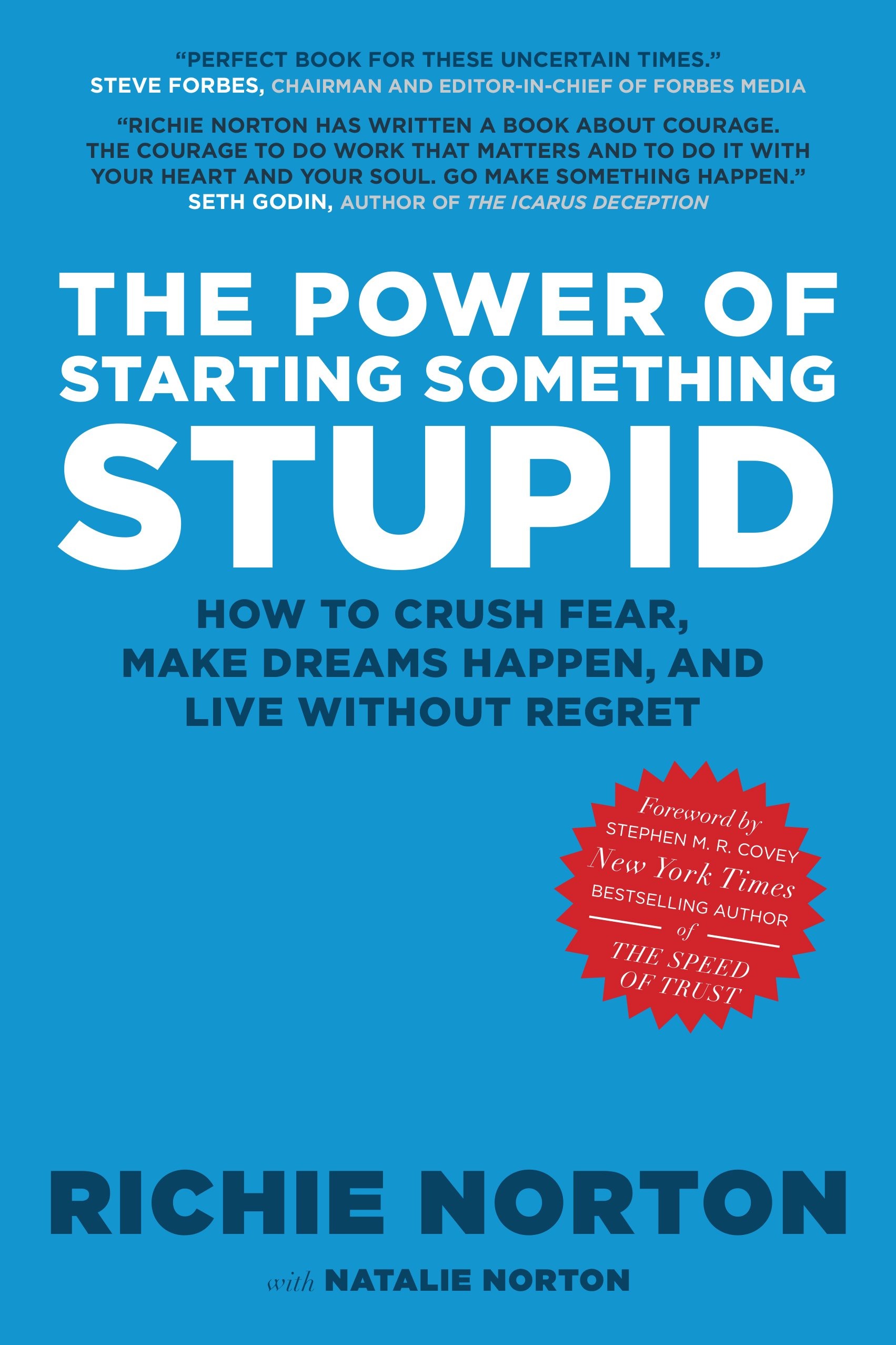
The Power Of Starting Something Stupid

Title: The Power Of Starting Something Stupid
Author: Richie Norton
“If you really want to do something, no one can stop you.  If you don’t want to do something, no one can help you.” - James A. Owen
Do you have some ideas and think that you must be crazy to think of something like that? Do you think your idea is just stupid and impossible? Well, Einstein once said: “If at first, the idea is not absurd, then there is no hope for it.” Richie Norton, in this fabulously easy-to-read book, attempts to break some of the mental barriers that stop you from living your crazy dream!

So, what does this book teach you? Alternatively, on what things can you can look forward to getting insight and clear your misconceptions about?

  • One, as the sub-title suggests: how and why to crush your fears, to dream and make your dreams come true, and to make sure you don't regret  not following them later. 
  • Two, how to stop blaming and, rather, overcome lack of time, lack of money, lack of education, or pretty much anything else that you want to blame on lacking. 
  • Three, differentiating and the need to differentiate future goals from present actions, and looking at the future as the accumulation of your actions that you do today.
  • Four, how to stop under-valuing your ideas, and discarding them off as 'stupid'.
  • Five, acknowledging flaws and vulnerabilities (in both yourself and your idea), as the first step to overcoming/rectifying them- so that you can successfully convert your 'stupid' idea into one that wins. 
The Power of Starting Something Stupid is more about having the courage and confidence to acknowledge an idea inside you, to work on it, to build on it, and to make sure that your commitment lasts till the very end to see it emerge as a success. The book is highly conversational in tone, and it feels like Norton is giving out advice that is actionable. It is an easy flowing read, that may seem simple and apparent at the face of it, but contains many actionable insights that can make you think better about the ideas in your head.

The book emphasizes the need to have determination, avoid procrastination, and be steadfast on your idea. While it asks you to be confident, it also asks you to do away with unnecessary pride that would hinder the implementation of the idea. It asks you to think rationally and beat your fears to dust. Norton asks you to own your ideas and make sure they win, through planning, and execution. The anecdotes and the real-life accounting that you find all over the book makes it a very interesting and smooth narrative for the reader!

It is an interesting read that will lead you to your stupid ideas, and tell you how to lead them both to success!

Tuesday, June 9, 2020

Hard Times

Title: Hard Times
Author: Charles Dickens

Thomas Gradgrind, a wealthy retired merchant who was known to be a "fanatic of the demonstrable fact", raises his children in the same manner, forbidding them any pursuit of imagination and grounding them to the factual truths in all subjects. Gradgrind also runs a school on the same principles and philosophy of rationalism. One day, he allows Cecelia(Sissy) Jupe, an imaginative girl, admission into the school on charitable grounds after her father disappears from the circus he was working in.  Gradgrind's two children grow up in their own confused manner, thanks to his active suppression of the imagination. Many events take place and the story meanders through the lives of Gradgrind, his children, their husbands and wives, the people in the town, Miss Sissy Jupe, and has wonderfully descriptive takes on the worker unions, the philosophy of rationalism, and so on. By the end, there is a classic turn around of Gradgrind and his fact-factory of a school by the gentle, imaginative, and kind-spirited Sissy Jupe. 

So, what makes this classic Dickens novel any special? 

1. It is a brilliant story. Dickens has always been an author whose descriptions I absolutely love. Reading a paragraph or two out of his books can literally paint the scene in front of your eyes. His novels are always of infinite, minute details that make it such a pleasure to read. 

2. It satisfies the classic-hunger for the classic-lover. Old school classics have a way with how they take the story, and usually have dramatic set-ups. The language is another pleasing oddity with Dickens' classics, and you get enough of it here. 

3. This book is incredibly short, considering that it's written by Dickens! Hard Times is a quick read compared to any other novel of Dickens. It is also has a different setting in the small, grim, industrial backdrop of Coketown, in contrast to the usual London country set up of most of his novels. And, this brings a fresh change to how we have usually seen the descriptions in his books, and also how the storyline is maneuvered. I really enjoyed it. 

Hard Times is typical and atypical of Dickens, both at the same time. And this, according to me, is the best part about this book. We get our familiar Dickens, yet it is adapted to a different backdrop and stimulating storyline, and this freshens up our exposure to classics in a very wholesome manner! I loved it, and so will you (especially, if you love Dickens)!

Today, incidentally, happens to be the 150th anniversary of this grand and legendary author and litterateur. I feel happy and honoured to be co-incidentally finishing this wonderful tale today, and putting up this post. If you want to read more on the life and works of Charles Dickens, check out my post on this man who lived his great modern life!