Hey!

Welcome, and you can check out my posts. But, I don't write here anymore. So, if you are interested, come on over to https://sandhyavaradh.com/

Saturday, January 25, 2020

The Nine Most Favourite Characters: All Time (And, Six Of Them Happen To Be Women!)

Image from Pinterest
The most natural thing for a staple fiction reader is to constantly fall in love with so, so, so many characters. It’s actually impossible to number them. I’d hate if somebody asked me to name one favourite book or one favourite character because it would be the meanest question on Earth, or it’d be from someone who doesn’t really read. But, still over the years, some of the love fade a little for some characters, but some others are just as strong as the first ever day we set eyes on them! Here’s the list of my 9 most favourite characters, who I’ve loved through all the books I’ve read, and I’ll also tell you why I really love them. These are some of the characters from whom I’ve been inspired through how I grew up.

NOTE: There is no preferential order whatsoever in the list below. The numbering is just to make sure I stop at 9!


Now, Jeeves is the coolest guy I’ve ever met. With that clever and witty English humour, Jeeves is just the perfect valet to have. Not just is he polished, sincere, and fun, he is also a life-saver. Jeeves captures your heart with that rib-tickling humour, and makes you wish you had that sense of humour and sarcasm, or atleast a friend like Jeeves! If you won’t love Bertie Wooster, and his cheery and sarcastic valet Jeeves, will you love anyone at all?


By now, it’s clearly established that I’m a big Tolkien fan. I have to say that I was actually reluctant about reading the Hobbit initially, and look at me now! Fun note, most of my absolute favourite books were once something that I was reluctant to read. I have many, many favourites from Middle Earth, but Strider is my absolute favourite. A king, a royal, an all-deserving, warm-hearted, Aragorn, son of Arathorn, was the bravest of all characters, and he went through things that he did not deserve at all. But, that’s not the point. He never gave up, and he never backed out, and he stood up for himself. Strider has been one of the strongest characters I’ve come across. And somehow, he played a big role in my mind when I grew up. 


Ah, Higgins is a beauty. You start admiring him from the opening scene of Pygmalion. Higgins comes off as a smart, extremely shrewd, and talented phonetic professor, bordering on arrogant. But, Higgins knows how to learn and unlearn. With Shaw’s moulding of the relationship between Eliza and Higgins, you learn so much about perspectives, and the phonetics professor, cockney specialist, is bound to stay in your heart.


Who doesn’t love the cheery old detective lady who gets around solving crimes through gossip and intelligence? While Poirot’s methods were those of neatly aligned, methodical investigations, Marple uses her ‘grey cells’ in her own style. And, yes, I love Poirot but he couldn’t make the cut. Miss Marple is one of the fictitious woman I look up to. She always taught me that what necessarily has been followed by all need not be how you do it. The old lady is so inspiring, and absolutely kick-ass!


Tuppence, or Prudence, is Christie’s young detective, a sleuth, and a spy with a passion for espionage. Running a detective agency with her husband Tommy, she’s the boss, inside and outside! There was a time when I seriously hoped and believed that I’d become a detective like Tuppence one day!

6. Sophie Amundsen (Jostein Gaarder)

A 14 year old girl becomes the student of an old philosopher, Alberto Knox, and is pushed to think beyond her barriers into a world of wonder, possibilities, and innovative thinking. No wonder she was a favourite to another 14 year old girl who read Sophie's World! Sophie is someone who is ready to learn, challenge herself, and look at things with a neutral perspective even when things are against her! She opens you to a world of absolute wonder and strength.


George has been my most favourite character since 2007! Georgina, or George, is the kick-ass adventurous girl all teens want to be. I loved and read all the books in the Famous Five series, and George is a beauty that Enid Blyton gave us! For a 8 year old, George is the only lesson they need to be strong, bold, and fearless!


I think Hermione was the first character to normalise being a “cool nerd”. Why can you not top the class, and still be the most fun and cool person to hang out with? Why not pour over books, and still be adventurous? She is a character who broke stereotypes of nerds being a bore! And, me being decently smart kid (haha, yes, I’m praising myself, excuse me), she was one of the characters whom I loved to identify with when I was in school.


Oh, Anne and speculations of her imagination are treasures for a child. When Anne drifted down the Lake of Shining Waters lost in thought, I could swear that I did too! Anne is a very progressive character, displaying passion, strength, and kindness all at the same time. She is a pure character, and again, a heavy influence since I read Anne of Green Gables.

Holy gods, it’s already 9?! Did you notice that out of the nine, six of them happen to be women? I did not pick on purpose, but it was something I realized when I was writing point 9! And, that’s probably because I am a female, and naturally some of the strongest, inspiring female characters have left a strong impression on my mind! I thank all of them for teaching me all the things that I’ve learnt from them, and they definitely play a significant role in who I am today.

Who are your favourites?

Friday, January 24, 2020

Where now are the horse and the rider? A Tolkien Gem.

Today, one of my friends, during a conversation asked me to pick out one more favorite of Tolkien's poems, apart from "All that is gold does not glitter" and "The road goes ever on and on". While I love these two, there are so many others that I really like.

Here's one of them, very beautiful, very touching, stimulating your grey cells to think!

“Where now are the horse and the rider? Where is the horn that was blowing?
Where is the helm and the hauberk, and the bright hair flowing?
Where is the harp on the harpstring, and the red fire glowing?
Where is the spring and the harvest and the tall corn growing?
They have passed like rain on the mountain, like a wind in the meadow;
The days have gone down in the West behind the hills into shadow.
Who shall gather the smoke of the deadwood burning,
Or behold the flowing years from the Sea returning?”

After a really long and tiring day, I was thinking about her question, and flipping through my Tolkien collection and I found this gem from The Two Towers, and thought why not share it! If you have read the two towers, I'm sure you'd recognize the scene, and would be able to bring it before your eyes.

Which is your favourite Tolkien poem? Let me know in the comments!

Thursday, January 23, 2020

What Makes Us Human

What makes us human?

Knowing there is good,
choosing the bad.
Knowing there is light,
hiding in the dark.
Knowing there is hope,
choosing to sulk.
Knowing there are some who care,
not heeding to them.
Knowing we all die,
trying to live.
Knowing the truth,
but loving the lie.
Knowing our mistakes,
and not being sorry.
Knowing it all, yet canvassed in ignorance.
Some of these, if not all.
That’s what makes us human.

And the moment we set ourselves free from the canvas,
we shall be something else.
Beast, or God?

Wednesday, January 22, 2020

Do You Write A Checklist?

Image from Clipart
The January to March phase is one of the busiest phases in the semester at the University. There are intra-moot rounds, and internship applications for the summer, and classes that you can't bunk, and sports fest, and mid-semester exams, and what not! With too many dates, tasks and deadlines, one thing that comes to help is a checklist. 

Checklist is a quintessential component in most professions. Be it medicine, law, piloting, engineering, art forms, anything at all- checklist saves our face at the end of the day. Have you read The Checklist Manifesto by Atul Gawande? (That's a definite review post for another day, but do read it!) A Checklist basically makes your life easier, and brings down the amount of mistakes possible, if not nullifying them completely.

A surgeon essentially has a checklist for pre-surgery, through the surgery, and post-surgery. A pilot has a checklist for take-off, landing, emergency situations, each and everything!

From my mom trying to run the household, to big companies undergoing corporate mergers, everything runs on a checklist. I recently prepared a checklist of all the compliance a listed company needs to do before merger when it's a related party transaction. Haha, too much jargon? I did it on purpose- simply put, it's a corporate decision that can affect the economy of a company, and subsequently the economy of India if it's a big enough Company!

So, when I draw out a checklist, I have a broad view of what needs to be done by when to avoid unnecessary complications and headache. Some people think you need to write a checklist everyday to effectively use your time. It's not like I haven't tried it, but personally it doesn't work very well for me. So, while I believe absolutely in the power of checklists, I make a broader one with provisional deadlines spanning for an entire week or so. I am more comfortable dealing with such checklists as they fit in more realistically into how I go about getting things done. 

So, do you write your checklist? If yes, that's great, keep going! If not, do try it out. You'll know its power when you see it in your execution. Also, don't go rigidly by what you read about daily checklists, or weekly checklists, or whatever version. It is what works for you best that you need to do. And, you'll know that only by trying them out. After all, if it solves the purpose it is meant to, then even if it is a new method that isn't followed, it's great for you!

Guys, get your notepads out, and jot down all that pending work. Get them done!

Tuesday, January 21, 2020

asdf ;lkj

Since when I've been in eighth grade my dad had asked me to learn typing. I remember he gave me a booklet to learn typing. It asked me to place my fingers strategically on these alphabets and type a full page of a-s-d-f-space-;-l-k-j, and that was the end of what I ventured to learn from the book. Soon, even without actually learning typing, I became pretty fast with it, thanks to the constant use of laptops. However, it has to be said that I can't type without completely looking at the keyboard. 

By sheer habit, my fingers automatically go to the location of the keys, but once in a while I need look at them to make sure if they are doing fine. This, could have been avoided maybe if I'd learn to type according to the books. 

Increasingly, the relevance of typing is on the decline. From keys, we've comfortably gone to the era where we "swipe" on a board in the touchscreen surfaces, and we also have styluses through which we can just write like in paper and the system interprets the strokes of the hand-written alphabets to very successfully convert them into typed text. 

Even these seem a generation back at the rate the world is progressing. With absolutely awesome speech-to-text speech recognition applications and devices, would the necessity to know typing really be as necessary for personal purposes? 

But, sometimes- rarely actually, even with all that technology that's developing, when I have to spin out a 10,000 word research paper or moot memorial in law school, I just wish I knew typing and didn't have to look at the keypad for assurances. 

Maybe, should have not gotten bored so quickly, and should have completed that page of asdf ;lkj which may have motivated me to complete that workbook. 

But, meh, which kid ever thought one day they'd have to write 10,000 words moot memorials overnight? 

P.S. : A lighthearted post, stemming from my moot preparations mood. I know I promised to write in the mornings, but University schedule just gobbles the day up. 7.52 PM from 11.58 PM is still good progress! Kudos to me, and I'll try harder!

Monday, January 20, 2020

A to Z: On How To Create A Sustainable Change

Image from Sustainability Illustrated

Apple fell on Newton's head, and then suddenly we all realized the concept of gravity. 
But, gravity had always existed, and continued to exist. 
Can we draw a parallel, and say that be it discoveries or imagination it always derives its source from what already exists? 
Do you think humans have the capability to create something that in no way existed before? 
Every object we know, though the object might have been new at some point, is made up of stuff that we know and exists. 
For instance, let's consider the creature of imagination: unicorns. 
Given the fact that we know of the existence of horns and horses, we pieced together two elements that exist to imagine something that doesn't. 
How and what, then, do we pride ourselves to have discovered?
Is the various combinations, of what already exists that we piece together, something to feel accomplished about?
Just a few seconds of thought is enough to realize that humans can just shape what is given to them, and not create anything novel. 
Knowing this, is it fair for us to deplete the resources that we have?
Life would come to a standstill, if the resources we have are not used effectively.
Mankind is an intelligent species, and such intelligence is a double-edged sword. 
Not so long ago, our ancestors seemed to have lived in a world that was replete with resources, and within the short time, we have managed to cause exponential depletion in the name of development.
Our duty, as responsible citizens of, I will not say the world, our own locality, is to make sure that our neighbourhood understands the impacts of irresponsible behaviour, and starts to pay heed to the environment and its resources.
Panacea to this ill is to use the well known principle of 5 R's.
Question your neighbourbood on their practices, and promote small changes for a better future.
Refuse, reduce, reuse, recycle, and rot- all possible products in your neighbourhood.
Stay within your neighbourbood, that's where you can effect a change and actually contribute. 
To help the world, you first need to help yourself, so don't just preach sustainability, you also need to follow it.
Unless every neighbourhood feels the need to change, and also implements change at small levels, there is no way a change can be seen at a city level even, forget the world level.
Very effective ways to help people get into the groove of the 5 R's of sustainability is to start them at schools, work spaces, hotels, restaurants, where there is a lot of scope to do so. 
Where there is a will, there is a way, after all. 
Xerox of documents and unnecessary printouts can be avoided in today's world of technology, so do it only when necessary. 
You need to be the change you want to see.
Zeal is all that is required!

Sunday, January 19, 2020

How Accountable Is A Bank For What You Keep In The Bank Locker?

Most, if not all, of us have bank accounts. And, one of the most common facilities that a customer opts in the bank where he/she has an account is availing the "Locker" facility. But, what if one day, somehow mysteriously your stuff in the locker go missing? Can you hold a bank accountable? Can you ask them to compensate you? Or, are you left to cry in a corner?

A banker and a customer share many types of relationships depending on what type of service the customer avails. When you have a locker in your bank branch, the locker is treated as a fixed, immovable property, thus creating a lessor-lessee relationship between a banker and a customer. A lessor is someone who leases or lets out a property to another. To put simply, bank is like the landlord for that cubical space of the locker you keep your stuff in, and you are just using the leased out property. 

Section 105 of the Transfer of Property Act defines the term "lease". There are four key criteria for an act to qualify as a valid lease.

1. Lease can be with respect to ONLY immovable property. Here, as already said, the vault/locker is treated in law as a fixed and immovable property. 

2. Possession of the immovable property must be transferred from the lessor to the lessee. Now, how is this happening in the case of the bank locker? All of you who have a locker facility in a bank, or have seen the locker of a bank, would be aware that when you avail a locker facility, the bank provides you with a vault wherein there are two keys, or a double lock which has to be opened. One, is a key that you would possess, and the other is a key that the bank will keep. It is virtually impossible for the bank to open your locker without you and your key. Thus, this is qualified to be called a "transfer of possession" under law as you have the access to the vault and the bank does not. 

3. Possession is transferred for peaceful enjoyment for a specific duration. Simple enough. When you have a locker, you are allowed to keep whatever you wish so long it is not anything illegal. And, this facility is not forever. You are bound by a specific duration as agreed by the contract signed between you and the bank at the time of availing such facility. 

4. Possession can be transferred only in favour of some rent/premium. The bank doesn't offer their locker for charitable purposes. Nor do they give it to you for free because you are their valuable customer. If they did, it wouldn't qualify as a lease. The bank charges the facility usually through premiums, or periodical rents. 

Satisfying all the conditions required by the Transfer of Property Act, there is no question or doubt on the fact that the locker facility is a lease. Then, if there is anything missing from what you kept in your locker in the bank, is the bank responsible?

The law says no. A lessor is not responsible for anything that happens in the immovable property when the possession and enjoyment of the property is with the lessee. Unlike a pawnor-pawnee relationship, or a bailor-bailee relationship, the lessor-lessee relation gives more freedom to the lessee to do what he/she wants with the property, but at the same time reduces the liabilities of the lessor. So, if there is something gone missing, what is to be done? An FIR or stolen/missing property can be filed by the bank and the customer, and wait for the investigations to come. But, a customer can't proceed with any action against the bank, unless negligence from the bank's side can be proven. If, for example, the bank had allowed access to your vault negligently without confirming identity to someone who is not you, then maybe there is a chance to make a case against the bank. Unless you can pin on something that is under the bank's control and which the bank ought to have done, there is no way a bank would compensate for your loss.

Then, why do so many people avail the bank locker facility? I guess it's because there is a general feeling that the property you keep in bank lockers are definitely more safe than keeping at home, because of the additional security there, which makes sense as the banks account and keep track of every move of those accessing lockers. 

To conclude, it is important to know the various different rights you have with your bank, and also know what rights you don't have. 

Saturday, January 18, 2020

Is A Heads Up On Law Needed Before Starting A Company?

Businesses can be in many different sectors. And, they all require various legal compliances. For example, a startup is basically a new Company, and in India they have to comply with the various regulations and Acts prevailing in India. In fact, it is not just about complying with the Companies Act, 2013, they’ll also have to think about GST compliances, TDS compliances, IPR compliances on trademarks/patents/designs/etc. It is true that a sectoral company would not waste time in actually following up all the compliances themselves, but will just hire a lawyer for their legal cell inside the Company, or hire a firm to deal with the legal formalities. And, that would be very efficient. But, still, for independent small startups with not really much funding in hand, a little legal knowledge would be helpful. 

Let me make you understand why it’d be helpful to actually learn what you need to comply with legally and why you need to comply. So, when I applied for my LLR (Learner's License), I was told to go to a driving school, and provide my details so that they’ll apply for the LLR on behalf of me, and also teach me how to drive and make sure I get a license before the LLR expires. I just did a little bit of homework, went to the RTO website and found that there is an online portal for the application of an LLR by yourself. Now, when this is possible, why would I pay them a fee just for them to fill up such a form? Some told me that though the website has such provisions, it is better to go through the Driving School as an agent because they may not really check the websites for the applications. Maybe, that could happen. But, I had nothing to lose, so I applied on my own for an LLR with no extra fee or hassle, and boom! I got my LLR in flat one day without any hurdle. It’s okay if it hadn’t worked. But it was great when it did work. 

Now, your law firms are going to be the Driving School. They will handhold you throughout the process, and, in their best power, make sure you get your work done smoothly. But, you have to pay them their hefty fee. And, there is nothing wrong at all in paying them and getting it done if you have the money. But, when you are a small Company starting out on own, you may or may not have enough funding, and a knowledge of what compliances need to be followed, and why they need to be followed, and which part of the compliances you can manage on your own with your team with no extra cost, is going to be extremely useful. It’s best to hire lawyers, that’s what they are for, and that’s why we go to law school and study all these subjects in detail. But, I feel that a general awareness and understanding will help you in a long way by putting you in an informed position when you are dealing with your lawyer. 

All of the information is available on the net, but as far as I have seen, they are widely scattered. What if there is a primer with FAQs on the  basics of these compliances? I think such a primer can be effectively created by those who know the law, and also know the lay-man questions that arise in the head of a person/group of persons who want to start a Company.

Let’s say a group of my friends approach me, and tell me they have an idea for a service, and they want to start a company. They plan to go to a proper firm that will help them out with all the compliances, but even before going there, they just want a heads up on the legal process. Wouldn’t a primer for a legal perspective for a person not connected with the legal field be helpful?

I think it’s a great idea I can work on this semester with one of my subjects in this semester being Corporate Law. What do you think about it? Do you think it’d be useful for you if you were planning on starting a Company? Would you feel better if you have a primer in short, small FAQ format? Or have you come across anyone who has already compiled it, and has made it available on the web, without actually sitting for a consultation to know about it?

Putting forward an idea, and your comments are absolutely welcome!

Friday, January 17, 2020

Why Writing In The Morning Is 100% Better Than Writing At Night

I decided to do a post a day this year: 2020. And, this is my 17th post. My semesters have begun, and I noticed that I have fallen into a cycle of doing everything else through the day and then sitting to write a post right before bedtime. Initially, that seemed like the best time to schedule the task, until I realized today that it had already become a "task"?

I am writing because there are so many ideas spinning around in my head, and it's a good place to sort them out. I am writing everyday so that I can read more, I can think more and I can write more. But, after a regular day with lectures, meetings, other deadlines, I just seem to become lazy and not devote the time that a blog post deserves. 

I just went back to look at what times I've been posting my last few blog posts: 10.51 PM, 10.48 PM, 11.05 PM, 11.16 PM, and now that's sample enough to prove my point. If you've read my post on 5 Things That Help Me In College, you'd know that I go to bed early, and it's just much better if I write a post through the day when I can give it more time, and work on it sincerely. 

Here are some of the reasons I think mornings are a great time to write:

1. You're refreshed. 
2. You get time to think through the day, and work on your post.
3. You won't feel like just crawling into bed and not caring. 
4. You won't feel like it's a task/duty. I am writing because I love to. And, I am writing everyday so that I think better. I shouldn't force it to become a burden, and stop bad habits before it does become a burden. 
5. You have enough time for backups. Like today it was 11.40 PM. And, my laptop hung. So, I typed out this post on my phone. If it was morning, I'd have had enough time for a backup.

One of my friends rightly summed it up when I was voicing out how I should write in the morning: "Not just because you're lazy at night, but morning is a great time."

It's 11.58 PM gosh! I promise today is the last day. See you tomorrow morning! Good night, sleep tight!

Thursday, January 16, 2020

I Am A Handbag, And This Is My Story

Image from Clipart
I am typing this out in my lady’s old smartphone. So, if you come across any typos, please IGNORE.

Well, you already know who I am, right? The title says it. I am a handbag. And, what am I writing about? It is my story so far. I’ve mentioned both of these in my title because my previous owner, an English teacher, always insisted her students to give a “suitable” title to their writing. And over the years, after witnessing many a fatal red-ink circles over the titles, I have come to understand that here “suitable” means a title that explains and conveys to the reader what your writing is about. 

Moving on to my story, and I am going to start right at the very beginning.

I was born on 20 June, 2000. I was a dark blue baby with comic designs all over me. I was the most beautiful of the whole lot. So, naturally, I was immediately shipped along with a dozen others to the city’s leading fashion bag store- The Bagstore. I gazed at the big mall entrance, from where I was trolley-ed three floors up to the store. Among hundred other shops, I spotted the board stylishly written: The Bagstore.

Well! That was my destination. I was one of the show pieces. That suited me well because I could observe everything from my seat instead of being in a dark dungeon of a storehouse! But I faced one particular problem- nobody bought me. 

First, it was all very fine. I made good friends with the other bags, and we really did have a fun time. But soon, each and every one of them found their owner. I was left alone to wait for what seemed like an eternity. 

When women stopped to gaze, or even passed pretty slowly, I gave my best enchanting smile, hoping that they would notice. Yes, they did notice. They even came near me, examined me, and exclaimed about how very cute I was. Most of them, kindled my hope by hugging me and tugging me in their arms, while looking at the full-length mirrors of the store. Yet, none of them ever bought me. 

‘Why is it so?’- that was the question that racked my brain. Then, I began to notice a pattern in their behavior. All of them, at the end, looked at my price tag; they sighed audibly. They placed me back in my original place. All of them, invariably, glanced longingly at me and then left, never to return that way. 

So! The reason must be my price. Isn’t it unfair that we Bags ourselves cannot decide our price? After all, the money doesn’t even come to us! What is important for us is a nice owner, not the money. And, in this case, they had set a very, very high price for me since I was the “cute bag”. I realized that being too beautiful was also a problem, being a bag. Not being cute is also a problem- you might never get sold, but at least they had that chance among those who prefer the less expensive! 

I was anxious about finding an owner soon, before I became “out of fashion”.

Then came Neela. She was the boon to my prayers. A middle-aged, stern looking lady, clad in crisp cotton saree, and with round spectacles lodged loosely on her nose, clearly way out of the target-audience I was trained to smile at, purchased me. It was a dream come true! I was so faithful to her, and gave the brightest, most enchanting smile I'd ever given to make sure that passers-by had a compliment for her about me. She always smiled softly when she received them, and gave me a few lovable pets every time somebody complimented. I was never happier.

Several years rolled by. I learnt many things about Neela. She was an English Teacher, and a proficient one at that. She corrected her students' answer scripts sincerely, and I got to learn much of the English I know from her. I also got to read so many interesting novels that she carried around with her in me. She particularly was a fan of the plays of George Bernard Shaw, and read and re-read most of them. She carried a generous amount of cash, and stored all her bills meticulously. She also carried with her chocolates, safety pins, a lip balm, her spectacle box and her phone charger always. Most of my inner-side came to be stained with read ink and scratches.

I was a very happy Bag, until one day there came a decisive turn in the fate of my life. She had left me at home one day, and when she came back, there was a new Bag, shinier, bigger and seemed to be of a new fashion. My panic grew as she slowly started shifting her stuff out of me on to the table. I knew it then, the stuff wasn't coming back to me. She picked me up as she opened her cupboard. Trying hard to stay with her, I slipped from her hand and fell to the ground, hoping she would not discard me into the forgotten parts of the cupboard.

But, she picked me up back and gently placed me in the corner of the cupboard, and shut me into the dark. For a few minutes, I couldn't understand. It was all over, in less than a minute. 

"Feeling bad?" I heard a voice. I turned to see the other bags, most of them really old that I didn't even recognize their fashion. 

"Yeah, she threw me out," I said. 

"That's the lifetime of a bag, my dear. Neela is one of the nicer people. She would never throw you out," said an elderly Sling-purse.

I looked again properly at them, and realized there was a whole family there. I sighed, as I settled back, allowing myself a sad smile. 

Wondering how I am writing this out, then?

Several more years later, Neela took me back out. But, this time not for herself, but for her daughter. I gave an enchanting smile as the thirteen year old girl hugged me tightly, and squealed with excitement as she arranged her things in me. And she put her mom's old phone, which was now hers, and slung me on proudly. She was going out on a school excursion, and I was the dream bag she wanted from all of her mother's collection. 

I felt something familiar- that I had never been happier. And, it hit me that it's all just a phase, both happiness and sadness. 

And, presently, I type this out as my new friend is busy chatting up with her friends in the room. Life is not all too bad, it's all just a phase, and the cycle is bound to repeat! See you soon! 

Au revoir mon ami! (Oh, yeah, my little friend reads French, so I'm picking up a new language because Neela used to keep saying: you're never too old to learn!)

Wednesday, January 15, 2020

The Human Factor In A Future Of AI

Sometime back I had to write this essay from a given prompt titled "The Human Factor In A Future Of AI", and sharing it here for your reading. Comments are welcome!


The world that we see ahead is one where the line between humankind and technology is thinning down further as every day goes by. The rate of development of technology is happening at such an unprecedented, break-neck speed that it has become nearly impossible for the other complementary fields to keep up. The new talk is all about the world of artificial intelligence(AI)- a realm that even the men who have discovered it are not entirely sure about. 

Artificial Intelligence, to be simply put, is the theory and development of computer systems able to perform tasks that normally require human intelligence. The disruption by AI is already happening around us, and it is believed that this is just a microscopic part of an unexplored universe of self-programming intelligence. It is also expected that AI would successfully replace most of the jobs today, thanks to its high efficiency and almost impeccable accuracy. 

So, in this future of artificial intelligence replacing all that humans can do, in a much more efficient and successful manner, is there any human factor left for us to hold on to? Well, it all depends on objectives and perspectives. 

There are still things, definitely, that a machine cannot achieve by replacing a human being. A machine, whether programmed to gain intelligence or not, operates on pure statistics and algorithms. It takes its decisions and makes networks purely on the basis of logical arrangement of probabilities and mathematical models. What a machine lacks is instinct. And, this is human factor in the future of Artificial Intelligence. 

Since time immemorial, we have always known that evolution has been possible and life exists only because of instincts, and so there is no question on the power of it. AI can make machines intelligent enough to understand our instincts and the human emotional quotient, but they could never have one of their own. To simplify: it might gauge our anger and love, but cannot produce the same. That is where humans score over AI. As Australian scientist Alan Finkel puts it (Finkel’s Law): robots won’t replace us because we still need that human touch. Robots do not understand irrational thought and context. These things can be essentially dealt with only through instincts and empathy that AI will not provide the robots with. 

To sum it up: AI could make robots almost life-like but they would never actually have a life because humankind can be two things that AI-bots could never be: human and kind. And, that is essentially the human factor in the future of Artificial Intelligence. 

Tuesday, January 14, 2020

Trying "Lapet!" Instead Of Pongal-o-Pongal

Image from Businessworld
Today was the festival of Makar Sankranti, as known in most parts of India (Uttarayan in Gujarat, Bhogi Pongal in Tamil Nadu, Bihu/Lohri/ and a bunch of other names given in various other parts of India). These festivals are the harvest festivals celebrated all over India by different names, and are celebrated over two or three days. 

Studying in Gujarat, a popular practice in Northern and Western parts of India during Uttarayan or Sankranti is kite flying, and I got to try that. My University had a stock of it, and they gave us all the kites and the thread as a part of celebrations on-campus. 

All you need to do is get your kite up in the air, pull or leave the string of the kite at the right time, and see it soar! Sounds simple? Not really, take my word. Conceptually, I felt pretty strong and seemed to understand what those expert-kite-flying-friends made look simple. But, when I tried on my own, my brain just forgot what I understood, and I swear it was just frantic pulls at the string that sent it crashing down. Oops. But, I wasn't alone, so yay we tried, and it so much fun! 

One of my friends was teaching me where to make the holes, and how to tie the thread. That part is easy. Then you get the kite up in the air. This is by far the most difficult, and I should say it requires practice. 'When the kite is looking up, you pull. That's how it goes up,' I told myself while trying to get the kite up and also remember the rules. But, somehow my brain always got it wrong and pulled it when the kite is looking down, and within no time the kite was on the ground. 

Kite flying is not just about flying. They also try to cut off others' kites. It's a game. And, it requires a lot of skill. So, when you want to cut someone's kite, you take your kite and the thread above theirs, and let them roll it, until their thread gets caught in yours and then you pull it sharply. It's not simple at all. And, there it goes, as they shout "Lapet!", meaning "wind it up" to signify that the opponents have to just roll back their threads! My friends cut 5 other kites with a loud, cheerful cry of Lapet!

It was so much fun. And, the kite flying ended with a special lunch in the University mess with Undhiyo, Jalebi, Gujrati Dal and Pooris. And, tomorrow there is an offer near my college at a Tamil Restaurant for a special meal of VenPongal, SakkaraiPongal, Medu Vadas and Payasam, which I can't wait for! 

Wish you a very happy Pongal!

Monday, January 13, 2020

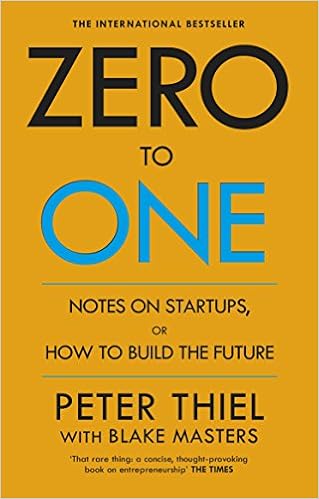
Zero To One: Notes On Startups, Or How To Build The Future

Title: Zero To One: Notes On Startups, Or How To Build The Future
Author: Peter Thiel with Blake Masters

Flip open the book and it starts with a bang for an opening, that'll leave you nodding your head, agreeing with the author. 

"EVERY MOMENT IN business happens only once. The next Bill Gates will not build an operating system. The next Larry Page or Sergey Brin won’t make a search engine. And the next Mark Zuckerberg won’t create a social network. If you are copying these guys, you aren’t learning from them." 

And, this is literally what the whole book is about. There are two tones to the book. One, where he is actually talking about the subject. And two, where he is giving his own opinions about a variety of things and projecting a contrarian philosophy. The book starts off with a very rhetorical tone of why we should start thinking new and not keep "copying", which is the "the challenge of the future" as he puts it. Then it moves on to insightful details on the economics of building a monopoly, dealing with sales, markets,  lean methodologies and also the culture of the companies. The examples ranging from all the top companies we know in the world give us a good understanding, especially on how to think and not what to think. 

The book mostly is of the tone and content of something that you would agree with. If you are a person who generally has a sound understanding and good logic, most of what is said feels like a good and much needed recap of something you already know, with some addition of jargon and methods. 

As brilliant as the book was to read, I felt myself not in sync with what the author was saying in a few parts. When he talks about "copying", it is not possible to dismiss as something he is projecting to make you think new. It almost feels like he is dismissing the events that are not just copying but comes with a lot of development as copying. And, though it is important to understand how we need to go from "Zero to One", I think it is equally important to acknowledge that development happens after the initial push of the guy who did the "Zero to One".

Another thing I felt myself dissenting about is how the author feels about focusing on just one subject and dismissing a "broad curriculum". While this may work for some, and that population of people is pretty less, I think studying over a broad spectra is what that pushes you to be innovative. I, for one, prefer a wide range because I find more scope in terms of how you can contribute. Life and our needs are not restricted to a particular field. In fact, all the good innovations have happened over an inter-disciplinary field, or even a multi-disciplinary one. So, though it's important for us to dig deeper into a subject, it's not up to everyone to do it. People versatile with multiple subjects are equally important. And, I find the author himself deriving inspiration in his book from a wide area of subjects!

The book is a brilliant collection of thoughts, and huge doses of truth that you may know on the sidelines of your brain that will push you to think. Here is one of my favourite lines from the book, especially relevant to a student:

"By the time a student gets to college, he’s spent a decade curating a bewilderingly diverse résumé to prepare for a completely unknowable future. Come what may, he’s ready—for nothing in particular."

In today's world of competition to grab that dream job, or a lustrous career, it is important to know and understand that the resume is not everything, or at least should not be. 

The book also covers various aspects, optimistically suggesting a better future where we do go from zero to one, instead of hitting a stagnation. It talks about the fundamentals of a startup organization that is important to ensure that it doesn't crumble, and also how to look at success and failure. It's a thought provoking book that I enjoyed reading. 

My takeaway from the book: Think, think, think. But, not necessarily like others. 

Sunday, January 12, 2020

Hercule Poirot's Christmas

Title: Hercule Poirot’s Christmas
Author: Agatha Christie

Old Simeon Lee behaves strangely. He suddenly feels that all his scattered sons, and their wives, and even his late daughter’s daughter must come together on the occasion of Christmas. He sends out letters inviting them, and surprisingly, all of them accept the offer. Even Harry, the black-sheep of the family arrives home for Christmas.

There is a tension in the place because the family has united after many years. The members are not comfortable, except Harry and Pilar (Simeon’s granddaughter). That day another unexpected visitor comes to meet Simeon Lee, claiming that he was Stephen Farr, the son of Ebenezer Farr, partner of Simeon Lee when he was in South Africa. Simeon Lee immediately persuades that Stephen stays for Christmas with the Lees.

Suddenly, on the day of Christmas Eve, they hear a horrible scream from Simeon Lee’s room. They rush up and find the door locked. So, Stephen and Harry break the door down. There they see old Simeon Lee on the floor- his throat slit. But things seem very odd. There is too much blood everywhere.

Superintendent Sugden, Colonel Johnson and Hercule Poirot investigate the case. While doing so, the family members describe the scream they heard in many ways.

David, describes that it was like a soul in hell. Hilda describes it as a scream by a person without a soul, inhuman, like a beast. But it was Harry who came nearest to the truth. He said it sounded like killing a pig.

Two things helped Poirot solve the case: One, Lydia’s quoting from the Lady Macbeth “Who would have thought the old man to have so much blood in him?” And, the second, Pilar seeing Sugden and saying that he looked like old Mr. Lee.

Now, now, can't wait to know what the hell happened to what should have been a Merry Christmas? Read the book to find out.

It's a really amazing, full-blown suspense that only a Christie novel could give you!

Saturday, January 11, 2020

Daisy Miller

Title: Daisy Miller
Author: Henry James

In a European society that was still traditional with respect to how women ought to behave to be a part of the "polite society", enters Henry James' unabashed, honest, fresh, open and flirtatious American heroine Daisy Miller. An innocent soul with an outspoken mind, Daisy Miller is the root of horror to all those who believed in their air of archaic tradition. Daisy Miller meets young Winterbourne, who is an American student considered by all as one who shuns archaic ways, on the banks of Lake Geneva. 

Here's a sample of Winterbourne's confused opinions on Daisy:

"Was she simply a pretty girl from New York State? Were they all like that, the pretty girls who had a good deal of gentlemen's society? Or was she also a designing, an audacious, an unscrupulous young person? Winterbourne had lost his instinct in this matter, and his reason could not help him. Miss Daisy Miller looked extremely innocent. Some people had told him that, after all, American girls were exceedingly innocent; and others had told him that, after all, they were not."

Though captivated by this chatty, honest American girl, as the book puts it, Winterbourne feels she is a little too forward for polite society. A classic narrative of the bonding between Winterbourne and the charming Daisy Miller, and the tragic end with Daisy's death, makes the crux of the story. 

Books like Daisy Miller are not just for their story, but the pleasurable character development, and the narration that capture you. It's a book that makes you smile warmly unaware as you turn every page. A short, 88-page read (shouldn't take more than 2 hours), and it's a perfect classic that'll make your day.

Friday, January 10, 2020

When The Mind Goes For A Walk: Navigating The Switch-On, Switch-Off Cycle In Class

Image from: https://bit.ly/37UFqs6
I was one of the people in the University who landed there right after my 12th, straight from school. After a strict regime in school with an 8AM-to-4PM-schedule, the five hours of lectures in the University seemed like a ultra-cool upgrade during my first semester. But right after three months of the first semester, even the five hours felt a little difficult some days. Five hours is easy, you think, right? Looks like it's what you get used to. When your brain is used to 8 hours a day, it wants 5 hours a day. When your brain is used to 5 hours a day, it wants 3 hours a day. 

Little greedy there, ain't we?

I try to listen in all classes. They help greatly when you are studying for exams, even if during the class it feels like the professors aren't really doing much.  But, your brain is bound to get switched off. It takes a lot of energy and determination to stay in a switch-on mode all the time! Like my dad used to say, your mind goes for a walk. It's very difficult to control your mind and train it to listen, especially the subjects where the faculty is not particularly making it interesting, or if the subject itself is a dry one or your not-so-favourite one. So, some days, your mind just won't listen to you. Mine just goes: on, off, on , off, on, off, on, off, until that dispersal bell blares.

It doesn't happen all days. But, I can't say it never happens, either. Sometimes, it's okay to go on a sub-level, partial on-off mode, when it's just way too boring. Obviously, your mind would choose to take a walk and go to far more interesting places (maybe, you are thinking about a hot cup of coffee, or the morning breakfast you had to skip to get to class on time, or the movie you watched the previous day), and unleash the daydreamer in you. 

But, you can't let it happen everyday. So, here are a few things that I have seen people do to beat it. 

Sit on the first row, or wherever the teacher is going to look most. Yes, it may be difficult to wander off when somebody is staring right at you more often. Sometimes, the teacher may be looking for a sign of understanding/comprehension, and it's impossible to fake it all the time. So, I think you'd automatically start paying more attention.

Take notes. This is by far the best. Take down everything the teacher is saying. You would have to listen for that, so it's next to impossible to daydream at the same time. However, there might be days when you don't exactly want to write so much, so you could try the other methods (or just give yourself a cheat day!).

Ask Doubts. This will not work for all. If you are like me, you might just prefer not to talk much in class. But, if you are the kind that don't mind, keep asking doubts (stick to valid ones though, please). You might develop an interest in the subject, and also make yourself known to the faculty, and keep track of the class. 

Sit with someone who asks a lot of doubts. Now, this is for you if you don't raise your voice in class much. Confused how this might help? The teacher is going to turn every time your friend raises a doubt during the class. Even if you wander off, you'll be pulled back to reality soon enough that you don't miss anything important. 

And, I mostly do the first two. It works pretty well with me. But, all of us are different, and we have our own way of managing things. If you struggle with concentrating in class, and find yourself getting into off-mode pretty often, you could try one of these, or a combination of them. I'm sure it can help to an extent, until you make your own tweaks to it and help yourself. 

But, hey, side-note: Sometimes the best of ideas you get is when your mind goes for a walk. So, when you get one, do jot it down and work on it later! Good luck!

Thursday, January 9, 2020

The Soldier's Art

Title: The Soldier's Art
Author: Anthony Powell

War is cold, loud and brash. It is something that has an effect on everything that bears down living normally. Bombs are dropped. There is no food. There are air raids. Bullets from guns fly through the air. There are those who are wounded. There are those who get stranded. There are those who lose the loved ones. There is loss, and separation, and struggle, and more struggle, with the war that seems to go on indefinitely and unceasingly from both sides. There are those who have no choice but to fight. And, is it fair fighting? Soldiers are caught between the decisions, and are played like pawns in a big game schemed out in the chaotic and unruly world of political agenda and personal gains. And, the civilians are left to struggle, half of them unable to comprehend why things happen the way they happen during wars. 

The Soldier's Art is grim, funny, and undoubtedly moving tale of the period of war between June 1940 and June 1941. The novel follows the story and experiences of Nicholas Jenkins, Major Widmerpool, Chips Lovell, Major Finn, Charles Stringham, and several others. Set in the time where Germany is already deep into the war with France, and Hitler was establishing his power, the novel focuses on the deadly side of silence during war. The novel focuses on the life of a soldier as he waits for orders, and for instructions that ship them off to a far corner in the world to fight in unknown lands. It talks and projects heavily the numbness they face as they go through a war, sometimes irreparably broken somewhere inside them. It takes on the heavy dependence of soldiers on intoxication and alcoholism, and how they use it for an escape. The novel brings before our eyes the painful stabs of unexpected sorrow, grief and separation. 

In the last conversation that Jenkins has with Stringham, moments before Stringham dies in the bombing of his building, Stringham reads out a stanza from a poem that captures everything of the novel. 

I shut my eyes and turn’d them on my heart.
As a man calls for wine before he fights,
I ask’d one draught of earlier, happier sights,
Ere fitly I could hope to play my part.
Think first, fight afterwards-the soldier’s art:
One taste of the old time sets all to rights.

— Robert Browning

And, the last line foreshadows the death of Stringham, after having a conversation with Jenkins: "one taste of the old times". And, it also signifies "The Soldier's Art", which is also where the title of the novel comes from, to fight for the nation and die valiantly, and play their part. 

I had this book lying around in my house, so I picked it up and read it. And, later found that it is the eighth of Powell's masterpiece of 12 brilliant novel-sequence: The Dance to the Music of Time. This was brilliant, and I may have lost out on references from the previous volumes. But, I hope to read them all, and regale in Powell's absolutely smooth writing. 

If there's one phrase that could express my feelings after reading it- absolutely brilliant!

Wednesday, January 8, 2020

The Last Chance


A neat, lean, thirty-ish, crisp looking Indian lady in formals, walked up the podium. The auditorium fell silent as she switched on the mic. 

“Esteemed scholars, ladies and gentlemen, welcome to the 25th International Conference on Human Survival. It has been a privilege for India to host this important and urgent SOS conference. Without further ado, I would like to call upon Mr. Devesh Kesari to break the news. Thank you. Mr. Kesari, you have the floor for the next fifteen minutes.”

*

Humans are weird creatures. They know how to think, to communicate, to invent and innovate. But best of all they know to live. To survive through hardships. To sustain and establish themselves. Till date they are the most intelligent living terrestrial species. 

Humans are weird creatures. They do not have any enemy. So, they play enemies among themselves. They go on a war to establish peace. They divide themselves to create harmony. They invent guns to protect. 

But humans are also stupid. Not because they don’t know nature is always more powerful than themselves. But because they know it full well and yet exploit it. They are stupid, not because they don’t know there is a limit to their atrocious behaviour, but because they don’t change their behaviour even when they know they are crossing the limits. 

Earth survived the twenty-first century. But the trouble brewed up early in the twenty-second. And, then, man realised his mistake. But he continued to be stupid. When he realised that he cannot sustain longer, he just wanted to make the most of it and swindle as much pleasure he can from the time he has. 

But it can’t be entirely said that man didn’t try. He did. But the situation had gone beyond his ability to frame a solution. Man tried to invent machines. But machines were not useful. In fact, some were counter-productive. And, man didn’t know how to make anything other than machines. Things that have life. 

‘It can’t be saved anyway. I would rather enjoy myself than try to make changes,’ he thought. 

Well. man is so immature. But nature is not. 

Mother Nature is sweet as ever. And there, she passed on a boon, to the earthlings- her very own children- to save them from decline and herself from destruction, that she had gotten from the Gods, as a last chance for the intelligent earthlings to learn and mend their ways.

And what is this venom that we talk about that man invented unaware that it could endanger himself? 

Plastic.

Well, man can’t invent living things to consume plastic. But, God can. And, that, Mother nature graciously passed on to her children with the hope that they learn. 

There is our chance to use it wisely and save ourselves. Our one last chance.

Nature has provided us with the best chance- a tree that can degrade the polymeric structure of synthetics and plastics. In simple terms a tree that feeds on plastic, with a lifespan of exactly 80 years.

*

Dev hadn’t spoken a word about the actual statistics of human destruction and survival. Nor did he need the full 15 minutes to make the speech. He thought that if statistics could help, it already would have. Humans, when provided with statistics, only looked forward to manipulating it and fooling themselves. Thus, he had ended his statement on a human note, as a sincere appeal to all of the humanity that was left on this Earth.

Tuesday, January 7, 2020

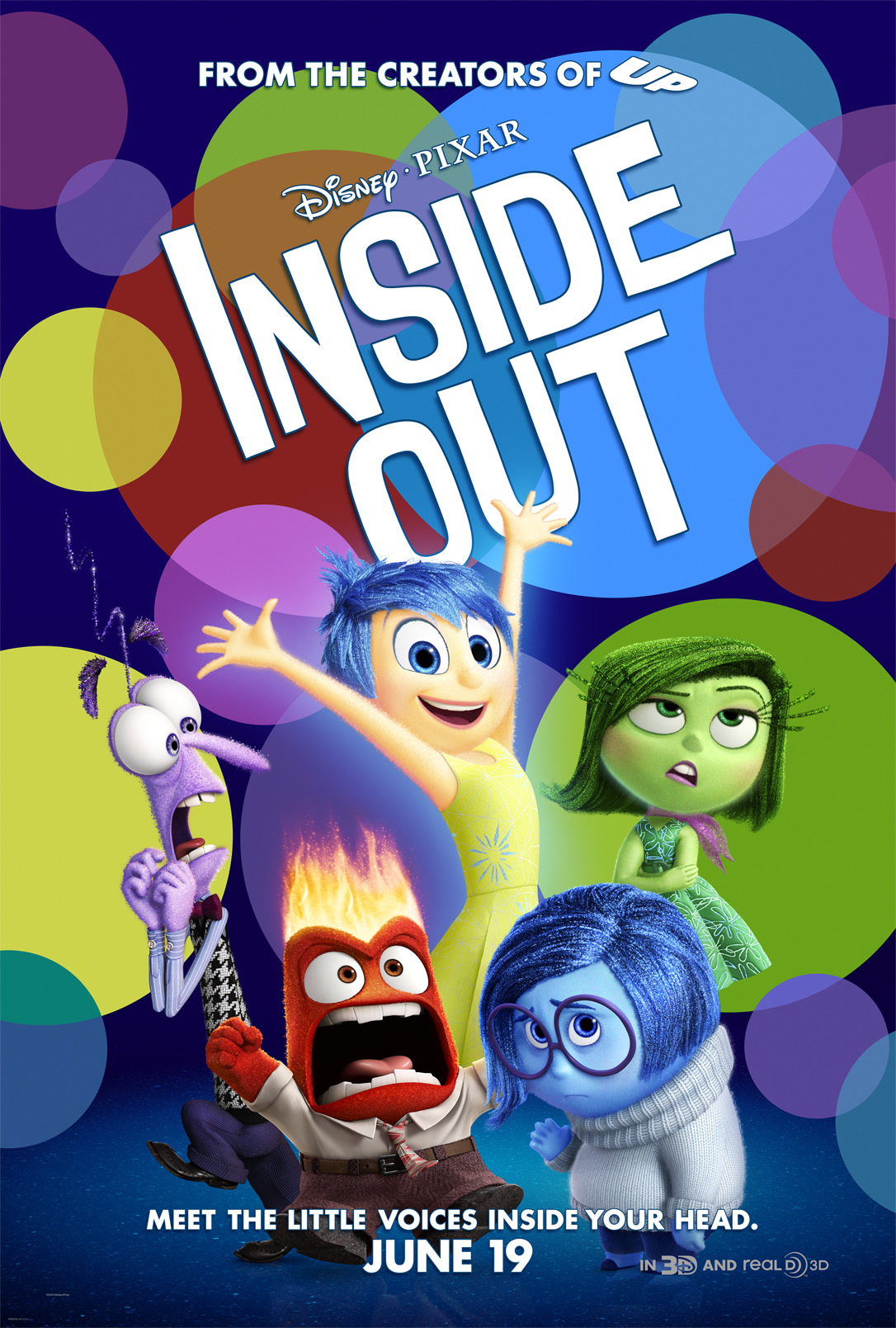
Inside Out

Movie: Inside Out

Directed by: Pete Docter, Ronnie del Carmen
Written by: Meg LeFauve, Josh Cooley, Pete Docter
Running time: 94 minutes


Eleven-year old Riley and her parents move from their home in Minnesota and shift to San Francisco when Riley's father gets a new job there. Riley is controlled, like any of us, by her emotions and their memories. Joy, Anger, Sadness, Disgust and Fear, work around tirelessly in Riley's brain to try and ensure that Riley has a "happy day". And, when they learn that the family is moving, they struggle to keep up Riley happy. 

Joy, the one responsible to make Riley feel happy, is a little too ambitious in the beginning, wanting all and most memories to be joyful. Joy puts down Sadness and keeps her at bay from coming to Riley. However, this lands them in trouble, as Joy and Sadness get sucked out of Brain Headquarters in a mishap, and land in the mazes of long term memory- far, far away from the active brain HQ. Now, with them removed, Riley can feel neither sadness nor joy, and her life is solely controlled by fear, disgust and anger, who though function with good intentions cannot produce the results that Joy or Sadness can. With the absence of Joy and Sadness, Riley's core memories and islands of personality such as Family Island, Friendship Island, Goof-ball Island, Honesty Island start falling apart. 

Left alone with Sadness, Joy comes to the shocking realisation that sometimes allowing someone to feel sad is what lets them be joyful later. She understands the importance of not neglecting any emotion. On an adventurous expedition back to the Headquarters, Joy and Sadness work together, and finally reach on time to save Riley from her thoughts of running away from home. Joy gives Sadness a free hand over Riley to set things alright, and to get back happiness in her. And, since then, Riley's memories are not overpowered by just Joy, but lets in other emotions, and has a beautiful mix of all.

One of the most brilliant movies ever, teeming with innovation and a fresh perspective on something that all of us know and experience every day. The importance and necessity to balance all emotions is something that we all struggle to do even as we grow up. It made me teary-eyed, and melted my heart. It is one of the most refreshing, thought-provoking, inventive feel-good film I've watched. The screenplay and the sequencing is brilliant, and the visuals and animation needs no more say than "Disney-Pixar".

A beautiful, wonderful film that everyone needs to watch!

Monday, January 6, 2020

Shantaram

Title: Shantaram
Author: Gregory David Roberts

Lindsay, an escape-convict and most-wanted prisoner who escapes the Victoria's Pentridge Prison, arrives at Bombay with a fake, forged passport and the name of Lindsay Ford. What should have been a stopover journey in the city of Mumbai, becomes an extended stay and soon Lindsay finds himself wanting to stay in the city. Lindsay acquaints himself with a local Maharashtrian man named Prabhaker, and hires him to be Lindsay's guide. Lindsay finds a good friend in Prabhaker, and starts settling down with the ways of Mumbai. 

On a visit to Prabhaker's native village in Maharashtra, Lindsay gets the opportunity to meet Prabhaker's family. Prabhaker's mother decides to give Lindsay a proper maharashtrian name, and gives him the name of "Shantaram", meaning "Man of God's Peace". On the way back to Mumbai, Lindsay and Prabhaker are robbed, and Lindsay loses all the money that he saved up for a life in Mumbai. This forces Lindsay to push off the better areas, and live in the slums of Mumbai. The day he arrives in the  slums, there is a big fire that destroys most of the properties in the slum. Lindsay sets up a free medical clinic for the people in the slum. 

Lindsay soon gets involved with the people of the slum as he gets to gets to know them better. Shantaram, as he proudly identified himself as, gets to fall in love with the culture and people of the Mumbai slums. The story leads on with Lindsay getting involved with the Mumbai underworld and its dons, getting caught in Arthur Road Prison in Mumbai, and also involvement with Afghan mujahideen. Finally, the story ends with Lindsay's realisation that he has turned into everything he hates, and he makes a resolution to live an honest life worthy of the beloved name given to him- "Shantaram".  The book ends on the note of his preparation to leave to Sri Lanka. 

The view of Mumbai, its slums, its underworld, its lepers, its charm and its problems are captured through the lens of Lindsay. The book seems to be based highly on Gregory David Roberts' life and personal experiences in Mumbai. The book is a charming overflow of descriptions, and brings the dynamic and fast-paced city of Mumbai before your eyes as you read it. It is a highly self-reflective narrative, and ponders on the lines of the thoughts running inside the brain of a person like Shantaram/Lindsay. But, it is also a fast-paced narrative on the likes of a thriller.

It was an engaging and unputdownable read!

Sunday, January 5, 2020

Little Lord Fauntleroy

Title: Little Lord Fauntleroy 
Author: Frances Hodgson Burnett 

Little Cedric Errol, living with his mother in New York, suddenly finds out that he has inherited the title of "Lord Fauntleroy" from Mr. Havisham, a lawyer sent by his Grandfather. Cedric learns that his father's other brothers had passed away, and he was the continuing lineage of the family, and thus had naturally inherited the title. Cedric's grandfather, the Earl of Dorincourt, who hates the United States, and was heartbroken that his son had married an American woman, now invites his grandson Cedric to come stay with him in England to be best suited to his title "Lord Fauntleroy". 

When Cedric arrives, the Earl is taken in surprise as he finds the little American boy charming, contrary to his pre-conceived notions about what an American-brought-up would be like. Cedric, in the truest of beliefs thinks his grandfather to be one of the most honourable, and strives to live up to the expectations of the Earl. 

The story of the Earl easing down on his unruly likes and dislikes, with no heart for anybody else’s, because of the pure nature of little Lord Fauntleroy makes up the rest of the story. There is also an interesting twist in plot when a lady brings her son and fights to be the rightful inheritor of the title, claiming she is the wife of the Earl’s eldest son Bevis. 

Little Lord Fauntleroy is a beautiful book that is bound to make you smile every turn of page. The innocence of the little boy, and the Earl's relationship and attachment to the young Lord that develops and grows through the story, is heartwarming It is story that will resonate with young and old. 

It’s a classic must-read.

Saturday, January 4, 2020

Academic Jokes On Twitter

Having done a bunch of projects, research papers and a publication in law school, academic jokes became highly relatable at one point through my semesters. Academia Obscura is one of my absolute favourites when it comes to "the hidden silly side of higher education" on twitter. Here are some of my favourite tweets from them.

"How to find manuscript typos
1. Click Submit"

"Academia in a nutshell: being knowledgeable in a narrow domain that nobody understands or cares about."

"Footnotes are the bane of academic writing."

So, when they came out with a book on the same lines, I got it to read. And, if you think academics is all "stuffiness"and "elbow patches", then this is the right book to pick up to change your mind. It explores the love of an academic on his subject, and at the same time takes a dig on how the strict structural formalities can bend the patience and the capabilities of the best of academicians.

Everything in the book is simply put, but would tickle your bones with humour as it is highly relatable and real. Most of what you would read is something that you would be going through or would have gone through, or at least would know someone who has gone through a similar patch.

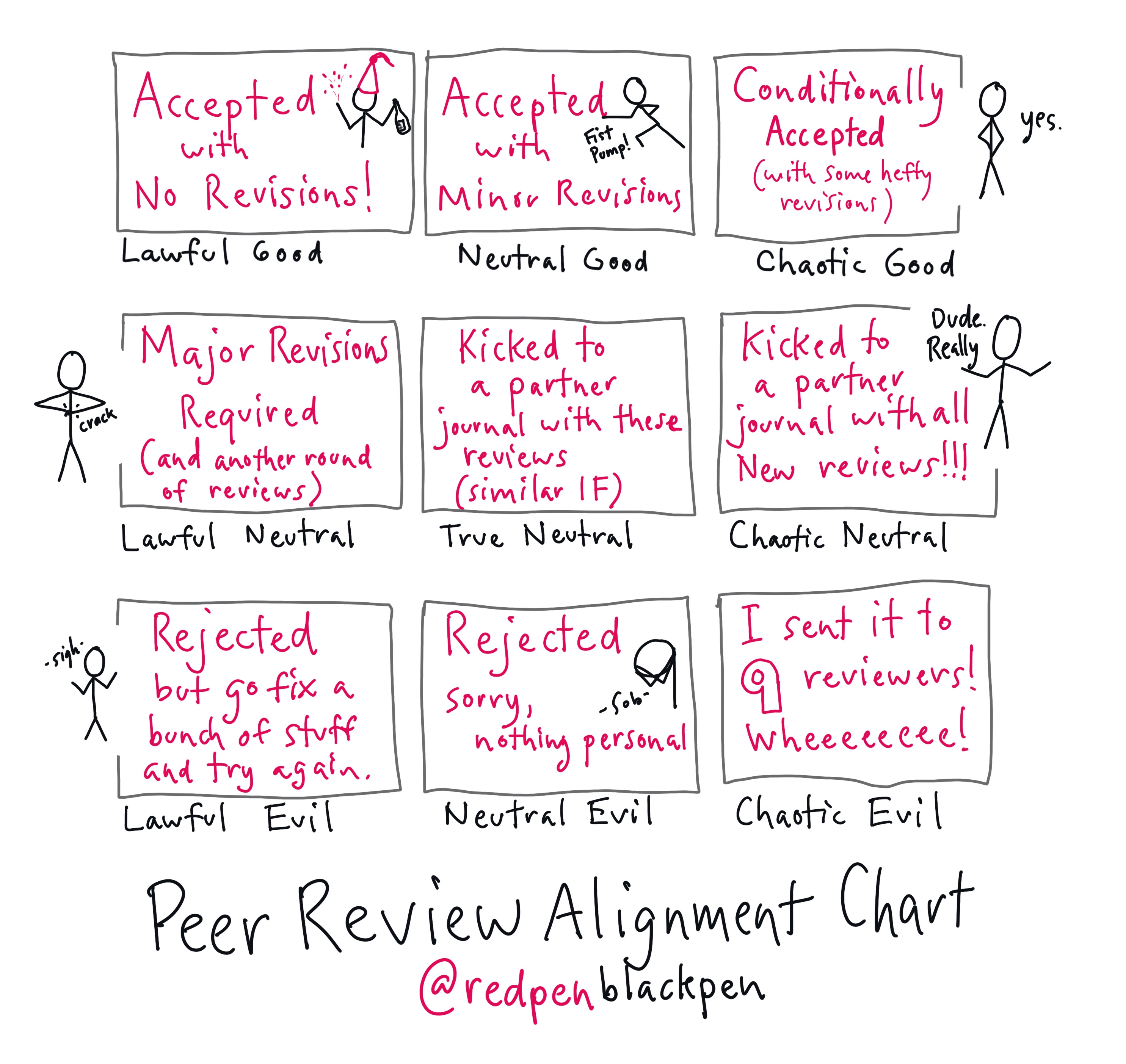
Another great account on twitter to get small comics/illustrations (that are sometimes so true that it pushes you to borderline guilt) on academic jokes is RedPen/BlackPen.

There are several other similar handles on twitter, but these two are my absolute favourites. If you have your favourite handle for academic jokes, do share in the comments! 

And (uh-hmm subtle promotions?) you can follow me @sandhya_varadh!

Friday, January 3, 2020

The Motorcycle Diaries

Title: The Motorcycle Diaries: Notes On A Latin American Journey
Author: Ernesto 'Che' Guevara

A young twenty-three year old Che Guevara and a fellow adventurer Alberto Granado, step out of their comfort zone, and start from Buenos Aires to explore the beauty of Latin America on 'La Podersa', translated to 'the Powerful One', their 500cc Norton. They travel cutting across Brazil, and ride through Argentina, and the whole longitudinal length of Chile, Peru, Columbia and Venezuela, to finally fly back to Miami from there.

This book is the first hand account of Che Guevara's first trip across Latin America with his friend and it offers a close insight at the young and cheerful heart, and also the serious and ironic image of the young man.

With an introduction to Che Guevara, a chronology of events, and a map and itinerary of the places travelled in The Motorcycle Diaries, the book, when read, has a way to pull you in and visualize the experiences and adventures of Che on his motorcycle. 


It is a travellogue which captures the heart of all things human, and the actual beauty in the journey. Che takes us close to his experiences with the people across the countries of Latin America. The book is written in a narrative style with a lot of drama and hilarious anecdotes, by the end of which you feel like you just finished seeing a movie.

It's a wonderful read.

Thursday, January 2, 2020

10 Judgements That Changed India

Title: 10 Judgements That Changed India
Author: Zia Mody

I was presented this book by a relative when I was going to join law school. I read the 10 cases that were discussed in the book before I joined, and it made absolute sense to me as a person who did not really know anything about the Indian law at that time, and I was fascinated. After two semesters of studying Constitutional Law, I picked up this book again and read through the cases, which now I had a strong familiarity to after the course on Constitution of India for a year. And, this time, I truly appreciated the beauty of the book for the purpose it serves. I understood what Zia Mody, in the book itself, meant by saying that the idea of writing a book of this nature was "to seek to bridge the gap between life and law". 

Several Hon'ble Justices of the Supreme Court of India have delivered wonderful and courageous, and landmark judgements which serve as the milestone to the rights that we have today. This book discusses 10 such landmark Supreme Court judgements-

  1. Kesavananda Bharti v. State of Kerala (1973)
  2. Maneka Gandhi v. Union of India (1978)
  3. Mohammed Ahmed Khan v. Shah Bano Begum (1985)
  4. Olga Tellis v. Bombay Municipal Corporation (1985)
  5. Union Carbide Corporation v. Union of India (1989)
  6. Indra Sawhney v. Union of India (1992)
  7. Nilabati Behera v. State of Orissa (1993)
  8. SCAORA v. Union of India (1993)
  9. Vishaka v. State of Rajasthan (1997)
  10. Aruna Ramachandra Shanbaug v. Union of India (2011)
These landmark cases cover a variety of fundamental issues discussed by the Supreme Court such as supremacy of Indian Constitution, importance and sanctity of the Preamble to the Constitution, religious fundamentalism, delayed justice and public justice, reservations in India, euthanasia, custodial death, and so on. The Indian Judiciary, whatever downside you pile upon it, still stands to be one of the strongest pillars in the country. 

As Soli Sorajbee, former Attorney-General of India and father to Zia Mody, writes in the book's foreword, Zia Mody's analysis of these landmark cases that still have a lasting impact on the law will be useful not only for the legal fraternity, but also the general public that is keen to understand their rights in the legal scenario. 

It's a great book, and if you're going to law school in India, do give it a read definitely. 

Wednesday, January 1, 2020

120 Seconds

He looked out of the window as he sat stuck in traffic, inside a taxi cab. The traffic signal was on red for 120 seconds.

Hundreds of people- kids and adults, men and women, old and young, healthy and sick, rich and poor, without any difference, carried on with their morning routine. He watched them speculatively as they meandered through the haphazardly parked cars and two-wheelers, dodging the traffic on the road, and simultaneously taking care not to mess with the lounging canines that ruled the streets of the city, crossing the stretch of stench-filled drainages to the side of the road that was relatively better.

‘And, at the end of the day, they all return to the stench’ he mused.

He let his eyes wander. There was only one thought on his head. All of them pursue something everyday, but for what? They differed in qualification, and yet there was no difference in their routine. Be it a graduate, student, businessman, housemaid, or a beggar, they all ultimately were part of the same lethal routine. 

Through his window what he saw was people who, through the course of their life, got so consumed in monotony that they forgot the original purpose of the routine that they set out to achieve. And sooner or later, the routine itself became the purpose, trapping their lives in a vicious loop. 

But amongst all the black and white monotonous scrambling of the real world caught in an illusion, his eye caught the colourful sight of a six year old destitute kid making a drawing on the white walls using black charcoal. He saw the hills and vales, with blossom trees bearing luscious fruits, and greenery abundant. And, through the valley flowed a gushing river, so pristine that for today’s world it could be no more than a dream. 

He could not help but realize the irony. A black charcoal on a white wall showed more colour. 
Would she be caught in the same routine when she grows up? Or, would she continue to spread her colourful thoughts for all to see, just like the drawing on the wall?

The speculations were cut short within those 120 seconds of truth, as the car behind them gave short, irritated honks. The car moved forward as the traffic dissolved. He continued with his routine.