Hey!

Welcome, and you can check out my posts. But, I don't write here anymore. So, if you are interested, come on over to https://sandhyavaradh.com/

Thursday, March 12, 2020

I Opened A Book by Julia Donaldson

Here's a poem by Julia Donaldson that has always been one of my favourites!

I opened a book and in I strode
Now nobody can find me.
I’ve left my chair, my house, my road,
My town and my world behind me.

I’m wearing the cloak, I’ve slipped on the ring,
I’ve swallowed the magic potion.
I’ve fought with a dragon, dined with a king
And dived in a bottomless ocean.

I opened a book and made some friends.
I shared their tears and laughter
And followed their road with its bumps and bends
To the happily ever after.

I finished my book and out I came.
The cloak can no longer hide me.
My chair and my house are just the same,
But I have a book inside me.

Hope you enjoyed it too!

Tuesday, March 10, 2020

The Theory Of Everything


Movie: The Theory Of Everything
Directed by: James Marsh
Written by: Anthony McCarten
Music by: Jóhann Jóhannsson
Running time: 123 minutes

The life of Cambridge PhD student Stephen Hawking goes happy and smooth through his University days as he effortlessly excels and stumps his colleagues, and falls in love with an arts student Jane Wilde, until his muscles start failing. After attending a lecture about black holes, Stephen is pushed to think that black holes must have existed at the beginning of the Universe, and this leads him to his thesis on the beginning of the Universe and time itself for his PhD. 

One fatal day, walking across the University campus, Stephen's legs fail, and he falls flat on his face, hitting his head. Stephen is diagnosed with motor neuron disease that shall eventually, and slowly, take away from him all voluntary muscle control, and a life expectancy of two years. Shattered, Stephen puts his all into working on his thesis. But life takes a turn as Jane marries him irrespective of his progressively deteriorating condition. The film is about how the man who was given two years to live defied all expectations, and shattered all boundaries, both personally and professionally. 

Eddie Redmayne is brilliant as Stephen Hawking, slumped in his chair, making you reconsider if it really is just acting. The film is beautiful, though in some parts it lacks the effect it seeks to produce. It is an extremely good film with some great acting. It focuses more on how Stephen's personal life and care pushed him to a life more hopeful, and how it helped him excel professionally. With nothing really science-based in the movie, it in fact humorously portrays how Jane understood what her astrophysicist husband was courting all the time. 

I really enjoyed the movie. It is true that some sequences disappoint, as you expect it to make a better impact on you, but overall the movie is really nice and enjoyable!

Monday, March 9, 2020

The Power Of Coalition

Image from Indian Express
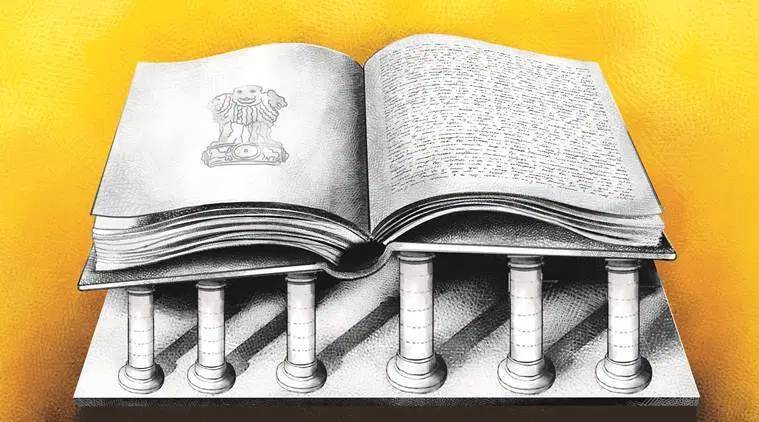
India is a vast country accommodating an abundance of sociologically variant groups, co-existing in glaring inequalities. It is an indisputable fact that one of the key factors to bring a change towards the positive direction, in terms of lifting the seeming parlance of equality into something that actually exists, is the nature of the government, playing an important role in steering the country towards development. And, it resonates clearly that a coalition is much more effective in creating a change that is harmonious to development. 

Why is it right to think that a coalition government possesses the potential to reconstruct the steep pyramid of inequality into a platform of equality accessible to all? There are a numerous reasons to the same, but considering the scope of this essay, two concerns that very important for India shall be analysed. 

The first concern where the coalition government walks over a single party government is the field of economic development. The economy of India can be characterized as a developing mixed-economy. The 1990s in India is rightly termed as the ‘Era of Coalitions’. The ex-RBI Governor Dr. Venugopal Reddy, in a speech to the audience from Hudson Institute, Washington, USA, said that the highest growth in India from 1990 to 2014 was clearly during coalition governments. The consensus-based decisions that happen in a coalition government greatly help in the Indian context. A coalition produces better economic results than a single party with a strong majority. When the economic status of the country progresses, it is an empirically proven point that gender equality is promoted and the gender gap is reduced, with the right policies in place. Thus, the country inches closer to, not one, but two prominent ideals- economic development and gender equality

The second concern addressed by a coalition, better than a single party, is that of social stratification. The fact that a coalition government is an amalgam of multiple parties with widely varying ideologies is often considered a defect. It is seen as a hurdle to progress because of the long-drawn process of framing policies, incorporating all their ideologies. But, it is important to note that the same may be seen as one of the greatest strengths of this form of government. The varying ideologies bring out balanced policies, and ensure that they do not act as a boost to just one or few sections of the society. By framing policies that are less discriminatory and more accommodating, it is only a natural consequence that the gaps of social stratification will begin to close slowly but steadily. 

All systems have their own merits and defects. So, how do we decide which system is better? One method is looking into the matrix of risks versus benefits. When benefits outweigh risks, it is upto us to step up to the challenge of deciding to create a positive change. For a country like India, equality is still a far away goal, and a coalition government might be the first little right step towards it.

I wrote this essay for an event, but eventually did not send it through. Arguments for and against a coalition government is clearly possible, and this essay was written from the standpoint of the topic we were given: The Power of Coalition.

Sunday, March 8, 2020

What Is A Blockchain?


Ever heard of the fancy word blockchain used a lot nowadays? Maybe, you glanced it on the morning newspaper headlines about bitcoins. Or, maybe you just saw the word on an article with a confusing content. After looking at that word multiple times, and not really taking any effort at all to understand what it is, I finally decided to look it up so that I can at the least understand what the article I was reading was talking about. Let's take a basic look at what the word means. 
"A blockchain is a distributed database that acts as a peer-to-peer ledger system."
Okay, if you are like me, you won't know what that line means. Ledger system? Peer-to-peer? Distributed database? What in the world, really?!

So, to put it in a simpler, more understandable form, and to express how I understand it in its most basic way: A blockchain is essentially a list of records, called blocks, that keeps adding on further and further with increasing data, that are linked through cryptography. Each block contains a sort of mark of time and detail of transaction, and this cryptographic hash of the previous block is linked to the next block. Also, this cryptographic chain of blocks, by its complex design, is resistant to modification of the data.

The next question after this basic understanding is: SO? To answer this question, let's look at how the CEO of Ubiquity, a blockchain startup, expressed it, in one of the articles.
"The blockchain allows any individual or party to independently verify that a transaction or record existed in a certain form at a certain time." 
So, a blockchain works similar to torrents or what is called as a peer-to-peer system, where thousands of computers around the world are connected and running the same software, working with the same data, and tracking the data all the way back to its origins. The storage of these transactions ensures that a block or' node' that basically holds some of the transaction and time data, should be replaced by other blocks. The data stored on this block is not only stored on this server, it has network-wide backups, so the overall architecture makes sure to avoid a single point of failure.

That is the most basic information that I gathered today, without confusing myself too much. And, this was enough to comprehend all those articles, without feeling like neglecting a word that may have a major impact on the meaning of the article. And, a huge disclaimer is that blockchain is not probably as simple as this! But, it is just a little better than just knowing the word. 

Hope you got a basic understanding, if you didn't. And, if you know more, then please do add it in the comments! 

And, if my basic understanding needs correction, I'd be happy to learn! Let me know through the comments below! 

Saturday, March 7, 2020

The Concept Of An Extended Workplace Under India's POSH Act

The POSH Act, in short for Prevention, Prohibition and Redressal of Sexual Harassment at Workplace Act, 2013, introduces the concept of ‘extended workplace’ covering under its ambit any place visited by the employee arising out of or during the course of employment including transportation provided by the employer for undertaking such a journey. Hence, any form of harassment at a company-sponsored event whether within or outside of the normal working hours would also fall under the scope of the POSH Act.

It is now well accepted that a workplace is any place where working relationships between employer and employee(s) exist, going beyond the physical boundaries of the primary workplace or office building. 

A workplace is defined as- 
“any place visited by the employee arising out of or during the course of employment, including transportation provided by the employer for undertaking such a journey.”
As per this definition, a workplace covers both the organised and unorganised sectors. It also includes all workplaces whether owned by Indian or foreign company having a place of work in India. 

Workplace is any place where “working relationships” exist and, in addition to your office, it also constitutes workplace of an external client, premises of other organisations, hotels, restaurants, and other venues during official functions/events, workstation of other employees, lifts in the building, Restrooms/toilets, corridors, canteens/cafeteria/entertainment zone, official tours/field visits etc.

As per the Act, workplace includes: 
- Government organizations, including Government company, corporations and cooperative societies;
- Private sector organisations, venture, society, trust, NGO or service providers etc. providing services which are commercial, vocational, educational, sports, professional, entertainment, industrial, health related or financial activities, including production, supply, sale, distribution or service;
- Hospitals/Nursing Homes;
- Sports Institutes/Facilities;
- Places visited by the employee (including while on travel) including transportation provided by employer;
- A dwelling place or house. 
The Act defines the Unorganised Sector as any enterprise owned by an individual or self-employed workers engaged in the production or sale of goods or providing services of any kind, or any enterprise which employs less than 10 workers. All women working or visiting workplaces

In Gaurav Jain v. Hindustan Latex Family Planning Promotion Trust and Ors. the court clearly upheld the scope of the act to include protection to women when on an outstation visit with respect to or in relation to work. 

In Jaya Kodate v. Rashtrasant Tukdoji Maharaj Nagpur University, the Bombay High Court pointed out that the definition of 'workplace' is inclusive and deliberately kept wide by the Parliament to ensure that any area where women may be subjected to sexual harassment is not left unattended or unprovoked for.

Though such effective, and clear remedies are available in the laws, it is important for us to be aware of our rights, and the remedies we can seek in case of a mishap. The rate of cases successfully obtaining remedies under the POSH Act has also been proved highly effective. 

Learning the rights and duties under the law is important for all, as these rights and duties are endowed only upon us. As the legal maxim says: ignorance of law is no excuse, and we have a duty to know our rights and obligations.  

Friday, March 6, 2020

Cinema: Copyright Holders, Infringement, and Tests

It is undeniable that a film is the combined effort of many, many people, and also a creative reservoir tanked together. Many people with many roles and aspects are integral for an idea to materialize on the big screen. 

Section 2(d) of the Copyrights Act, 1957, defines author:
"author" means:
(1) In relation to a literary or dramatic work, the author of the work;
(2) In relation to a music work, the composer;
(3) In relation to artistic work other than a photograph, the artist;
(4) In relation to photograph, the person taking the photograph, the artist;
(5) In relation to a cinematograph film or sound recording, the producer; and
(6) In relation to any literary, dramatic, musical or artistic work which is computer- generated, the
person who causes the work to be created.
According to Section 17 of the Copyrights Act, 1957 the first owner of copyright is defined as under: 
Subject to the provisions of this Act, the author of a work shall be the owner of copyright therein. Section 17 statutorily recognizes the author of the work to be the first owner of the copyright. The author is defined under the Act for various works, which come under the law of copyright. 
So, it is fairly clear from the provisions that a producer is the copyright holder of a cinema. But, how can infringement of a copyright be contested or proved? Is it necessary to have scene-to-scene copying? Or, is substantial copying sufficient to prove infringement? If yes, what exactly is "substantial"? 

In the case of R G. Anand v. M/s. Delux Films, the following was held by the Supreme Court that lays down authoritative clarity on the test/necessary factors while considering an infringement. 

Summing up what the Supreme Court held in the case- the details necessary to successfully prove the infringement of the copyright of a film are as follows:
- same form, manner, arrangement and expression of the same idea
- substantial copying, where substantial means "literal imitation of the copyrighted work with some variations here and there"
- viewer, after having read or seen both the works, is clearly of the opinion and gets an unmistakable
impression that the subsequent work appears to be a copy of the original
- there should not be broad and substantial dissimilarities between the two works apart from the
similarities
- clear and cogent evidence
The SC also held in R.G. Anand case- 
"The effect of the dissimilarities pointed out above clearly go to show that they far outweigh the effect of the similarities mentioned in para 9 of the plaint set out above. Moreover, even if we examine the similarities mentioned by the plaintiff they are trifling and trivial and touch insignificant points and do not appear to be of a substantial nature. The mere fact that the name of the Madrasi father was Subramaniam in both the film and the play, is hardly of any significance because the name of a particular person cannot be the subject matter of copyright because these are common names." 
In the above case, the Court found that there was no copyright infringement. So, to conclude, a mere claim is not entertained as a copyright infringement. But, however, a film's portrayal and execution of an idea is protected by copyrights. 

Copyrights, and IPR in general, is a very interesting field. Soon, in a subsequent post, we can explore why revisiting old notions about intellectual property is necessary in the present era of memes, remixes and other revision-creativity that is equally creative, and needs to have an effective protective mechanism.

Thursday, March 5, 2020

Know Your English


Title: Know Your English
Author: S. Upendran

When I was younger, I wrote so many stories, but always was confused about titles I must give. So, I used to pick up Know Your English by S. Upendran, and flip it through till I got inspired for a suitable, idiomatic title. Well, that's pretty much how Much Of A Muchness happened.

Based on the popular weekly column in The Hindu since 1982, there are 4 volumes in the series, giving us hundreds of idioms, their stories of how they came to be, and also their usage.

The series is extremely popular as a weekly column in The Hindu, and my friends and I always went straight to the column to check out the idiom for the week whenever we got the paper in school.

It is a cool compilation, ordered alphabetically, and expressed and explained in simple, clear and concise language. While the blurb of the book says that is would be useful for "teachers, students and those who are keen on honing their speaking and writing skills", it is also for those like me who can use it for such off-beat purposes.

So, next time you want to throw in a cool, appropriate idiom, remember to flip through this wonderful book!

Wednesday, March 4, 2020

And, What Haven't I Played?

Reminiscent pieces of writing are simply hilarious, and very rewarding. It shows you how much you have grown. It shows you how much has changed, and it shows you how much more will change in the coming years. 

26 December, 2014
"Looking back, I sincerely wonder about how many different games and modes of workout I have tried since Class One. In Class One, I seem to have gone to some dance class called “Swingers” in Pondy Bazaar. The fact about it is everybody remembers everything about it except me. I remember almost nothing. My dad claims to have taken me sincerely to every class, waited till it got over and have brought me back home. My mom remembers it all too. Why! Even my grand-dad says he has come with me many times to the class in ‘Challa Mall’. So, there is nothing much to say about my dances back then because I simply don’t remember anything. But then, it grows more interesting as I continue further. 
For some reason, which I have no clue about, I stopped going to the dance class- Swingers- and instead started playing a proper game- Table Tennis. That went along for quite some time. I played in a YMCA branch near my house(and was pretty good at it too). I was known for chattering non-stop with my TT friends. There used to be this coach who used to make us run around the ground ten times, skip a hundred times and give us those kinds of exercise. That is where the fun part comes! I never used to do it properly, and try all means of dodging.

But then, after sometime, I got bored of TT and the place became pretty crowded, and I didn’t get much of a chance to play. So, I quit playing TT. After that, I tried playing badminton for sometime in the same place, but didn’t stick with it. Well, at that time I even went for a chess class, but that wouldn’t hook me up, either.

All this while, my brother stuck on to one game- Tennis. He too was playing in YMCA. My dad then put my brother in a better place to continue his Tennis. That place was wonderful! When my brother joined, I told my dad that I seriously wanted to play Tennis. And ta-da! I was already going to my first class! I actually loved that place. I still do. The main coach was an old man whom we fondly referred to as “Tennis Thatha” while speaking to ourselves. He used to come everyday and coach us. We went four days in a week. I played Tennis there for three years(longest ever), from Class 6 to Class 8. 
I would have continued it there, but then we realised that the place was too far and that we couldn’t continue further because there were other classes. Both of us- my brother and I- dropped Tennis and decided to join some game in school. My brother had to choose between Basketball and Football. He chose football. I had two options too- Basketball and TT. I didn’t want to go for Basketball, so I chose TT again. I have been playing TT for two years now. I like the game very much. I went for the Clusters tournament representing my school last year, and my team came fourth place. But, now, I will have to stop playing TT also, because it takes up 2 hours every three days in a week.  
I cannot leave out the fact that I always complained about my school not having cricket or football coaching for girls. I remember how, back in Class 7, my classmates and I used to run for the cricket bats before the boys could get at it, so that we can train ourselves to play well and form a girls cricket team. We believed that one day we would be the eleven of the school’s A-Team in girls. We used to think of approaching the heads and asking for a girls’ team to be formed. One of my classmates used to say: “Hey, first we should be good at it. Suppose they allow the team to be formed, and we don’t know anything!” Yes, we used to practice for that. We sometimes went to the extent of challenging the boys! But I’m happy that now my school has coaching for girls in football. It came only this year when Class 6 girls went and represented.

And, amidst all this every year I go for the swimming course in Woodlands in the morning, since Class 4. It started with me being afraid of the water, and my dad not wanting me to be so. I improved year by year because of the awesome master I had. It is amusing to recall how terrified I used to be, and how I used to cook up all kinds of aches(especially stomach ache) so that I needn’t go to the class. The only thing that would make me overcome my fear is the cheese sandwich that my dad promises to buy if I swim well. Now, I am not afraid, and I can swim pretty decently.

But the question now is: what do I do if I quit TT?

I will have to do something. Something that is good, and doesn’t take up much time." 

Weirdly, I took back to dancing again, with Contemporary and Zumba. And, I also decided to get back to TT when I joined college. It is nice to note that I carried on a few pieces of doubtful questions, and have answers for them today!

Tuesday, March 3, 2020

Rule of Lenity

Rule of Lenity is a judicial doctrine requiring that those ambiguities in a criminal statute relating to prohibition and penalties be resolved in favor of the defendant if it is not contrary to legislative intent.

Justice Ginsburg invoked the rule of lenity. The rule of lenity was especially appropriate here given the draconian sentence in the respective statute relevant in this case. Justice Ginsburg thus adopted the narrow reading of “tangible object,” interpreting it to reach only objects similar to those at the heart of the Enron debacle that spurred the statute’s passage — those used to “record or preserve information.”

I think the rule of lenity should apply to the case if recourse to traditional tools of statutory construction leaves any doubt about the meaning of “tangible object”, as it would be appropriate to invoke the rule of lenity.

The landmark discussion by Justice Ginsburg, led to the rise of nine broad criteria: 
"(1) the nature and seriousness of the offense;

(2) the pervasiveness of wrongdoing within the corporation;
(3) a history of similar conduct;
(4) timely and voluntary disclosure of wrongdoing and willingness to cooperate;
(5) a compliance program;
(6) remedial actions;
(7) collateral consequences, including harm to shareholders, pension holders, and non-culpable employees;
(8) adequacy of prosecution of individuals; and
(9) adequacy of civil or regulatory enforcement actions."
This aspect of legislative history narrows down the reasonably susceptible interpretations. This provides that it is appropriate to invoke the rule of lenity. Thus, it impacts the outcome of the case. If you think about it, rule of lenity is connected to the same basis as the whole basis of the burden of proof described in my earlier post. 

To conclude: a judge needs to be fair and just, and that includes not to waver from the letter of law whatever the popular public sentiment is- whether such sentiment is towards the alleged victim or the accused. Increasingly, as the public finds more media to voice their opinion and sentiments, the judges have to stick to their roles. After all true justice in the sense of law is only possible when they do justice to their role.

Monday, March 2, 2020

Internships

We are back at that time of the semester when everyone is frantically applying to a hundred places for a place in the summer internship slots. And, on a such a momentous frame of time, I present to you an honest report that I wrote after my first day of my first internship ever. 

*

Day One of my month-long internship with the Tamil Nadu Human Rights Commission started off yesterday. I was asked to report to their office at 10.30 AM. Being a punctual girl, I was there right on time to be greeted by a lady staff. She inquired about me and then when she learnt that I was a student, she asked me to wait until “sir” came.

Slowly people trickled into the office room and smiled at me, and I smiled back at them too, expecting one of them to be the “sir”. No such luck. All of them smiled pleasantly and told me that “sir” would instruct me on everything that I had to do. It was eleven and most of the staff had come by then.

Finally, at eleven-thirty, an elderly man walked in and everyone greeted him. The lady staff who first spoke to me signalled that he was the one I was supposed to report to. I, an eager first-time intern, immediately stood up and gave him a bright smile, and informed him I had come for the internship. He smiled and just waved me to sit back in my chair again. And then, for another hour he went on with his job as I sat there just observing the people work.

The office room is a small space with six work desks and a few extra chairs. There are piles and bundles of case files piled up everywhere. There is a computer in one of the work desks that stores details of the cases in an excel sheet. There are also two telephones in the room for calls from the public.

At twelve thirty, “Sir” finally asked me to pull up the chair near his desk, and I got to know his name. He started briefing me about the Human Rights Commission. I am just summarising what I learnt from him yesterday.

The SHRC was divided into three wings- the administrative wing, the legal wing and the investigation wing. These three wings operated in sync. The Commission is headed by the Chairperson who is a retired High Court Judge. Also, it has two members- one of whom is a High Court Judge and the other is an IAS officer.

The State Human Rights Commission is for lodging any sort of complaint on the working of any government official. The complaint should be such that it is on something that is within the scope of their duties as an employee of the government. These cases that are filed on the officials are then sent to the Investigation wing of the HRC from the legal wing. After analysis, a report is sent back to the legal wing. Then a date is set for the trial and the petitioner and the defendant are allowed to present their case, they are questioned, witnesses are examined and cross examined, and finally orders are passed. The judges do not have the power to give out a punishment for the official found guilty as they are protected by the state powers. So, instead the order authorizes the HRC to send out a recommendation to the official which is filed on his name. Such recommendations for being found guilty of an offense can cut out incentives such as promotions and retirement benefits for the government official.

Sir gave me a bare act of the 2006 amended version of The Protection of Human Rights Act, 1993 with State Human Rights Commission, Tamil Nadu (Procedure) Regulations, 1997. I was pretty proud to read the bare act as I could now, after one whole semester at law school with Legal Methods as a subject, could identify parts of a statute such as the short title, long title, definition clauses, provisos and non-obstante clauses. It felt like something that I learnt was being put to use.

Sir then detailed me on how I should make an entry of the cases and their statuses (Pending/Closed) into the case book classified year-wise and case number-wise. I did this job for sometime. And then, I was asked to attend the phone calls and take down the name, district, case no. and the petition date from the caller. This was a lot of fun and I liked doing it. For every case, the entry must also be made in the excel sheet. I did this job also for sometime. The jobs that they made me do were kind of repetitive but that is all the job there is.

They also told me that I could go through some of the case files when I was making the entry if I was interested. I did try to do that but since all of the cases that I dealt with yesterday were in Tamil, and in quite unintelligible handwritings, I gave up after sometime.

There are also three trial courts in the campus and I would be able to see some of the proceedings in the future.

Overall, Day One went good.

*

Reading this now, I realised that none of my other internships were this chilled out. They were all hectic, and mostly with extended working hours, sometimes even on a Sunday.

But hey, they're all good, good memories, and I've met some of the most brilliant people thanks to the stints of internship.  And, looking forward to more!

Sunday, March 1, 2020

On Balance: An Autobiography

Title: On Balance: An Autobiography
Author: Leila Seth

Leila Seth, in her autobiography On Balance: An Autobiography, starts with the story of how she took up legal studies because of the fact that it could be conveniently combined with taking care of her son and husband. She then delves into her life in field of litigation talking about the difficulty she faced as a woman barrister in Calcutta in trying to find a senior, of her lighter moments as the sole woman judge on the otherwise all-male bench of the Delhi High Court, and her general courtroom experiences. She also portrays her views regarding corruption, discrimination and delay in the legal system. Some judgments dealing with education and with inter-personal and constitutional law have been highlighted by Leila Seth. She also, in great detail, narrates and reminisces her experiences as a member of the 15th Law Commission of India. The spirit of the book deals with taking India forward in its judicial journey. 

The title of her book, “On balance”, fits Leila Seth, as depicted by herself in the book. It was her balanced and sensitive approach of life around her that helped her become the first woman judge of the Delhi High Court, and then the first woman chief justice of a high court, paving the way for other women chief justices. She was judicious on the bench, but however retained the humanity in her. Her devotion to gender justice was evident in her book dealing with every law governing women, regardless of religion.

Injustice, death and discord are given their due but dignified place in the book. Having twice declined the offer of becoming a judge of the Patna High Court, because Patna held no career opportunities for her husband Prem Seth, this dedicated professional has also proven that you can be a committed homemaker simultaneously. What separates this book from others is that Justice Seth understands straight away how difficult it is to balance the demands of a high-pressure career in law, and the constant sacrifices that Indian wives and mothers anticipate, keeping it real.

The law was, and remains still, a male bastion. She, with great humour and vivid memories, describes an incident where a group of people entered the High Court to "sight-see" the woman judge! Justice Seth describes early tribulations faced by her as a rare woman lawyer. 
“I was used to arguing and doing the best for my client and case and then ‘letting the damn judge decide’. I soon realised that I was now that damn judge; and that the tremendous responsibility stopped with me.” 
“On Balance- An Autobiography” was a beautiful read. It teaches us many life lessons penned in the most impacting and real way. For all of us, this inspiring book is definitely in the must read category!

Saturday, February 29, 2020

Random Acts Of Kindness

I remember, we had a very ironic CBSE activity when I was in school: a compulsory 'random' act of kindness. And, we had to come to the class, and narrate what random act of kindness we performed. How did it turn out? A big, fat joke. While the idea of being kind is a noble and important one to teach to young boys and girls, the fact that they made us do a compulsory kind act for grades defeated the whole purpose. Honestly, none of us said the truth. We just invented something on the spot, and when one kid said something nice, ten kids after that repeated the same thing with mild twists in the story. Very effective lesson, isn't it?

In fact, it is not that none of us were kind. It is just that when your act of kindness is truly random and inherent in your behaviour, you will never realize or acknowledge it as doing something "kind". A true, natural act of kindness is appreciated, praised and cherished by the receiver or the onlooker, never by yourself. And, if you really are going to note down and boast about a random act of kindness, then there are more chances than not that you had a hidden personal agenda behind the act, and it wasn't really out of inherent "kindness". 

Kindness is all around us. We do, not one, but hundreds of random kind activities for the people around us. We pick up a dropped pen. We say thank you. We allow somebody to stand before us in a line. We share our food. We listen to their rants. We share their highs and lows. And, they do the same to us. That's where the important part comes. While it is absolutely not necessary to consciously keep track of doing kind things, we should always take a moment out and consciously appreciate the kind act others do. Well now, taking time out to give them a nice word of appreciation in itself is a kind act!

Kindness is like respect. You be kind, and you will see others being kind to you. Kindness is a wide umbrella that incorporates and overlaps with other key human traits such as forgiveness and helpfulness. So, even though the CBSE could not execute a noble lesson, we all got the message clear and right. 

So, as the image says, in a world where you can be anything: be kind!

Friday, February 28, 2020

If This Then That: Cool Way To Get Your Social Media Formulas


I put up a blog post everyday. And, then I sometimes get busy with other work, and forget to share it out there on social media. While I have a fair share of regular readers and subscribers to the blog, it is still unfair to expect people to know about a new post unless you put it out there for them to see. 

Promoting your content is as important as writing your content. It is true that when you maintain a regular blog, there is a lot of automatic traffic and audience, with a sharp increase in number of daily and weekly readers. But, it is still important to reach out, and (shamelessly) promote. Twitter, Instagram and the likes can reach a much wider audience than one can think of, and that is why it is important to put it out there for all of them to read and comment. 

IFTTT, short for "If This Then That", does just that for me! It is a free web-based service that creates chains of simple conditional statements, called applets. An applet is triggered by changes that occur within other web services such as Gmail, Facebook, Telegram, Instagram, Pinterest and numerous other social platforms. It is free, and also a premium version is available for businesses. 

My beautiful autopost formula on IFTTT reads this:
If any new post on your blog, then post a tweet with an image to @sandhya_varadh
Uh, excuse the subtle twitter promotions. But, the point is that the platform is brilliant. You can substitute the underlined part with any available service, and there are tons available! Not only is this useful for people like me in order to auto-post on a social media platform, it is also useful to set alarms, reminders, emails, and can work brilliantly for businesses.

The interface is also very user-friendly with a cool and simple design. IFTTT also has an app with a simple and elegant user-friendly design.

For all those who are looking for something similar, check this out! 

Thursday, February 27, 2020

What To Eat: Dealing With Midnight Hunger Pangs

If you're a student in a University, then staying up till 12 or 1 AM is normal. And, if you do stay up till that late at night, feeling that hunger pang tug at you before you go to bed is also normal. What we usually do is go out and eat a second dinner literally in the middle of the night (here, in my college we have a night mess that serves damn nice hot, buttery parathas), or you'd probably just order your food on Swiggy or the likes. 

Uh, but, University students stay up late every single day almost. Yeah, now, so the paratha slowly becomes a luxury because it'll start to make a dent in your pocketses(oh, yeah, preciousss!). But, let's assume you are rich and have no dearth of money. Then eating out every night when you are hungry is going to make you get a cute little tummy that will probably grow out to look not-so-cute-anymore. 

That calls for the need of healthy, filling, tasty snacks- tough combo, really, next to impossible! But, here are three items you can try. I have always found these fulfilling and tasty.

      1. Bananas! 
Tasty? Absolutely. Healthy? Without a doubt. Affordable? They're the best.

Here's some mildly-researched health facts:
Other than being rich in vitamin B6, bananas are a good source of vitamin C, dietary fibre and manganese. A medium-sized banana will provide around 320-400 mg of potassium, which meets about 10% of your daily potassium needs.
Needless to say anything more, right?


2. Peanut Chikkies 
If you aren't allergic to peanuts, then go for this! What can beat a bar of peanut chikkies held together by sweet jaggery that melts in your mouth! Not only does it satisfy your sweet tooth, it is also very healthy. 

Now to health facts:
Peanuts are an especially good source of healthful fats, protein, and fibre. They also contain plenty of potassium, phosphorous, magnesium, and vitamins. Despite being high in calories, peanuts are nutrient-rich and low in carbohydrates. Jaggery is no less: loaded with antioxidants and minerals, they are rich in iron and act as a detox, helping cleanse the liver by flushing out nasty toxins from the body. 

3. Dates 
Phoenix dactylifera, commonly known as date or date palm, is a flowering plant species in the palm family, Arecaceae, cultivated for its edible sweet fruit. 

Haha, just eat it. It's one of the tastiest dry druits, and are extremely nutritious. They are high in fibre content and antioxidants, and promote good health. And, they are easy to eat. Nowadays, they come in many varieties and are available seedless. 

My friends eat a lot of other midnight snacks: greek yoghurt, health/yoga chocolate bars, blah blah blah. No doubt they are tasty and relatively healthy, but they are also expensive. These three snacks to munch on at midnight are not only healthy, but extremely affordable to most of us. And, I can assure that you will not get bored of eating them (unlike how you will if you munch on yoga bars, bleh).

So, next time you want to snack on something, try one of these! Do you have a favourite, healthy snack? Add to the list in the comments!

A Week Of Exams

Frantic search,
then I find my notes
- shall we begin?

Day and night,
in sun and moonlight,
but the mind is in doubt
as I turn through pages.

Up, down; north, south;
front, back- 
any other way I can bend my luck?

Picked up the pen,
the hand ran
across the page,
and so did the ink.

The bell blared, 
a smile blossomed
- wait, is it already over?

P.S: Exam week got me too experimental (for short of time). Hope you enjoyed it!

Tuesday, February 25, 2020

Burden Of Proof

'A hundred criminals may be let free to ensure that no innocent is captured.' Controversial, and you may have other opinions. But, that is what the law is for. As much as there is need to serve justice, there is also the impending need to ensure that only, and ONLY, the guilty is punished. Whether in reality the circumstances match such an ideal or not is doubtful, but the intention of the law itself is honourable, and needs to be looked up to.

The burden of proof is a concept of common knowledge, essential to litigation and dispensing justice. The concept of burden of proof is incorporated in the Indian Evidence Act, 1872. Under Indian law, until and unless an exception is created by law, the burden of proof lies on the person making any claim or asserting any fact. Reference should be made to the following provisions of the Indian Evidence Act, 1872 with some illustrations to understand the proposition.

Section 101 of The Indian Evidence Act, 1872:
Whoever desires any Court to give judgment as to any legal right or liability dependent on the existence of facts which he asserts, must prove that those facts exist. When a person is bound to prove the existence of any fact, it is said that the burden of proof lies on that person. 
Illustration:(a) A desires a Court to give judgment that B shall be punished for a crime which A says B has committed. A must prove that B has committed the crime. (b) A desires a Court to give judgment that he is entitled to certain land in the possession of B, by reason of facts which he asserts, and which B denies, to be true. A must prove the existence of those facts.
Section 101 of the Act is also read with sections 102, 103 and 104 that talk about on whom a burden of proof lies, what is the burden of proof when it comes to a certain fact, etc. All interested can refer a bare act. The construction of the words are simple and clear in the provisions.  

Proof must exist "beyond reasonable doubt" to have a successful conviction and pronouncement of guilt of a person. A mere doubt, or a mere possibility of the innocence of the person, can ensure that there isn't a conviction. Why is there such a law? A single, highlighted, everlasting, equity-based principle in law is that a bona fide person must never be put through hardships. 

True that the loopholes of the "chance of innocence" will be manipulated by hundreds to escape their guilt. True that it is disheartening to see a criminal walk through open doors using such loopholes. True that justice is not being served to the victim. But, it is also true that this is the only saving chance of an innocent who has been framed by the opponents as guilty. 

Evidence Law is a beautiful subject. Not only is it designed to help catch a culprit, but it is also designed in a way to have a saving net to the innocents who fall in the pit of framed and fraudulent litigation. Before we blame the law for letting culprits escape "even when there is enough evidence", we need to understand that they were let go probably because our enough wasn't enough, and there was an inkling chance of possibility of innocence left. 

So, when the court is left with a looming question of 'what if the accused in innocent', we have a possibility of justice gone wrong, and that is exactly what the law tries to avoid in good faith. The execution of these laws may be faulty. What isn't, honestly! But, the intentions are all in good faith. 

Have you watched the absolutely brilliant crime-drama 12 Angry Men? If not, add it to your list! I haven't come across a better movie with a story line that is exactly the subject matter of this post!

Monday, February 24, 2020

"We, The People Of India"


The most significant and beautiful part of our extensive and elaborate Constitution of India is its Preamble. We, the people of India, gave to ourselves a wonderful, forward-thinking, and progressive nation when we imbibed the fundamental traits of being a sovereign, socialist, secular, democratic republic nation that will forever strive to uphold justice, equality and fraternity in our Preamble to the Indian Constitution. And, "we, the people" gave all of this to ourselves, according to the preamble itself. And, are we sure we all know the preamble well?

We, the people, have committed to ideals that we will hold on to as citizens of India. We, the people, still can't be sure that all of us know what the preamble actually says. What a shame! My law school has a huge display of the preamble in our campus, and it is one of the most favourite spots of all in the University. On to one side, there is the library that holds the wisdom beyond, and under the preamble, is a humble space for all to think, act, and imagine freely true to the ideals of liberty and justice enshrined in the Preamble. 

The Preamble serves as a guiding light for the Constitution and judges interpret the Constitution in its light. It indicates the sources from where the constitution has come: the people of India. It declares the freedoms which the people of India intended to secure for all citizens, and the basic type of government and polity which is to be established. In another words, preamble as such is widely accepted as the quintessence and spirit of our Constitution, as it embodies the fundamentals as well as the vision and commitment of a newly liberated nation, after its passing through the inevitable birth pangs of national independence from an oppressive and colonial regime. 

Kesavananda Bharti v. State of Kerala is an important, landmark judgement in India. D.G. Palekar, J. held that that "the Fundamental Rights are an elaboration of the Preamble, as an overstatement and half- truth". Undoubtedly, the Constitution is intended to be a vehicle by which the goals set out are hoped to be reached. In the opinion of H.R. Khanna, J. "the preamble is a part of the Constitution and walks before the Constitution”. S.D. Dwivedi, J. expressing his concurrence with the conclusion arrived at by A.N. Ray, J., held that the "Preamble was a part of the Constitution because the heading “The Constitution of India” was placed above the Preamble". It is also helpful to note that Justice Dwivedi has held the Preamble to be a part of the Constitution and then also referred to it as a provision of it.

Such is the importance of our Preamble, and it places upon us a self-assigned duty to uphold India's constitutional values as its citizens. It is also sad truth that most barely know what the Preamble says, and what those words mean in their true spirit. The Preamble is not a legal document for just lawyers to quote, judges to refer, and law students to study. It is, in fact, everything that the Indian nation is, and should be. 

Feeling a little doubtful about the Preamble after reading this post? Let's go back, and read it once!

Sunday, February 23, 2020

Beat The Heat: Elaneer/Narial Pani/Coconut Water

Image from dreamstime.com
February is near its end, and so are the winters. In fact, I feel the winter has long gone. So, what does that signify? Lots, indeed! Why, summer is the ultimate season of mangoes, watermelons, ice creams, milkshakes, lemonades, sodas, juices, sarbaths, jigirthandas and all the other delicious, lip-smacking drinks and eateries that isn't allowed on a cold, wintry day. And along with so much freedom comes the terrible, unforgiving wrath of the sun down on the city! 

Ice creams and juices don’t help beyond a certain point. They give instant relief from the heat, but nothing more. For a long-lasting, healthy, natural, replenishing freshness, nothing beats tender coconuts! Yes, tender coconuts- the hard nut that comes in shades of yellow and green storing the soothingly cool, and sweet coconut water despite the ever-growing temperatures- are the panacea for the hot weather! Technically, for those who are interested, coconut water is the liquid endosperm, of the tender coconut. 

Take time out to go to the stocks of tender coconuts that would be available around every corner, and enjoy sipping the cool coconut water straight from inside the tough nut through a straw inserted in a single hole, deftly made by the sellers. For those who aren't satisfied with just "cool" coconut water, they can bring the whole tender coconut without making the hole, and store it in their refrigerator to have a cold drink. Even the laziest goose can have a sip at the doorstep, as some of the sellers bring the tender coconuts in pushcarts! A sip of the sweet water, and the weary faces turn cheerful again. Well! When you drink it you almost actually feel a cool breeze blowing, and slowly enveloping your body. 

Tender coconuts not only make you feel cool but are also very nutritious. In fact, they are the most nourishing beverage that nature has given to the people! They contain many essential proteins, minerals and vitamins that keep our body healthy, especially during summer. Tender coconuts help stop dehydration of the body. They clear the body of toxic wastes. They also bring down the rashes and heat boils that attack us so often during the summer months. So, naturally, tender coconuts are the best solution to beat the heat during the summer for young and old. 

One of the things that make me smoothly sail through the Gujarat heat and it's unforgiving Loo winds that blow through the day is the Narial Pani sold by the fruits bhaiyya who comes to our college through the week.

So, you want to stay cool this summer, with maximum benefits? Tender coconuts to the rescue!

Saturday, February 22, 2020

The Wave Of Emotions

Image from pixels.com
She went away from home to a far land.
Didn’t realize the pain.
When people said they were ‘homesick’, she laughed, made fun and thought she would never feel that way.
Only not much later, she realized it was not so easy.
New place.
New language.
New culture.
She couldn’t even talk, and felt the void.
Felt the mind voice constantly nagging.
Tears sprang unwarranted.
A superficial smile was pinned to the face and an eternal frown in the heart.
Soon, she met nice people, made good friends.
A whole new life seemed to have begun.
Time ran.
The day became a hassle of classes and chit chats.
Learnt to stay awake late at night.
Learnt to still get up early and make it on time to the classes without having to skip breakfast.
Suddenly, one evening, life took a new dimension.
Met a falsely familiar face.
The next few days went on like a dream.
The tears had stopped.
The void filled.
The mind voice nagged on other things.
A genuinely happy smile replaced the frown.
Time flew.
The day became a constant connect to something relatable to home.
The mind took a devious path.
The mirage of heart fluttered towards the one who made her love home from far.
Then it changed.
The connect disconnected.
Afraid, she tried to mend it- in vain.
A sense of helplessness flooded.
She was disillusioned.
Ego would not let her talk.
As the week went by, helplessness turned to anger.
The heart raged.
The mind was in chaos.
Realization hit her hard.
Why try so hard to connect when there is none at all?
She went through it all only to realize that she was the one at fault.
The mirage disappeared.
The illusion vanished.
She was glad to get back her heart.
The disconnect had affected.
But not anymore.
Thinking back she realized what the problem was.
She was just too scared to be scarred.

Friday, February 21, 2020

Graying Line

The child hides behind the veil,
but as near to null is the attempt to hide light,
so is that dark hauntingly visible on the child.
A rotten history .
But as it hides behind
you have two choices-
Pray take pity on the young life?
Seek solace in hope 
that rotten as the history may be,
the future need not? 
A morally white intention.
Give out the hidden child?
Stay quiet as them seekers hunt the child that has
made blood shed and wrecked lives- 
as that is morally black?
The graying line straddles us, to
we find life through gut and conscience.