Hey!

Welcome, and you can check out my posts. But, I don't write here anymore. So, if you are interested, come on over to https://sandhyavaradh.com/

Monday, December 23, 2019

The Little Prince

Title: Little Prince
Author: Antoine de Saint-Exupéry

It’s been so many years since I first picked the Little Prince to read. As a young girl, the book immediately struck a chord in me. Several years later, a few months back, I picked up the book again fondly to read on an off day in college. And, a smile was immediately pinned to my face, and my heart was happy and light. One of the most beautiful books I’ve ever read, the Little Prince is a delight to the reader, filled with optimism and a fresh perspective. I’d hate to spoil and give away the beautiful, very simple story that’ll melt your heart. So, here’s a post to, instead, make sure you read it. 

"The grown−ups' response, this time, was to advise me to lay aside my drawings of boa constrictors, whether from the inside or the outside, and devote myself instead to geography, history, arithmetic and grammar. That is why, at the age of six, I gave up what might have been a magnificent career as a painter. I had been disheartened by the failure of my Drawing Number One and my Drawing Number Two. Grown−ups never understand anything by themselves, and it is tiresome for children to be always and forever explaining things to them."

The story of the Little Prince and his Rose is a heartwarming tale of the gift and purity of childhood that people lose when they grow up. And, to sum up the effect of the book, without giving spoilers (because it is such a pleasure to read this one), here’s something from the book itself:

"Here, then, is a great mystery. For you who also love the little prince, and for me, nothing in the universe can be the same if somewhere, we do not know where, a sheep that we never saw has−− yes or no?−− eaten a rose... Look up at the sky. 
Ask yourselves: is it yes or no? Has the sheep eaten the flower? And you will see how everything changes... 
And no grown−up will ever understand that this is a matter of so much importance!"

The Little Prince is a book for every child to retain and every adult to learn from. Beautifully illustrated, the characters are sure to take a permanent place in your heart. Do yourself a favour and read it, it’s a book that you’ll treasure and cherish forever.

Sunday, December 22, 2019

What does the Legal field need to utilize AI?

Image from Timo Elliott
In the legal field, there are enough and more sets of data that can be generated for standard document clauses, online contract clauses, filing of delay petitions and finding out necessary documents to be attached to such petitions, to name a few. 

Here is something interesting that I learnt in the introductory course to Artificial Intelligence(AI) and Machine Learning(ML) by deeplearning.ai. Let’s look at companies in general. It is important to understand the difference between a company that uses AI, and an AI Company. The difference can be understood easily with an example. Let us say that a big store has an online website. Would you consider it the same as Amazon or any other internet company? Just like a company that uses the internet is different from an internet company, similarly a company that uses AI is different from an AI Company. 

To use and incorporate technologies of AI and ML for your business, there are two most basic requirements-
  1. It must be a simple concept.
  2. Lots of data sets must be available for the task. 
Without these two key requirements, ML works poorly where there are complex concepts that needs to be performed from a small set of data or new types of data. Therefore, to utilize the tools that AI provides for your business, it’s wise to create a huge data set, and then execute pilot projects. 

All these are simple tasks, and generating a huge data set to feed for the effective use of ML is not difficult. It would be worthy to consider giving these aspects a thought, in order to efficiently handle the volume of cases, and the delay in filing them, in our country.

Saturday, December 21, 2019

What should you be prepared for in Courtroom?

Image from Clipart
Internship is a place where we learn a lot of things. As a law student, interning is not just to learn the subject, but also get a first-hand exposure to the culture, how people interact socially, professionally and personally, how to grab opportunities, how to tackle situations you don't want to be in, and how to navigate through that work-life topography. 

I was called by the Partner of the firm I'm interning in, and he questioned me on what I learnt from the court observations. While I rattled out case facts of what I worked on, and what the judge ordered, he pointed out what I should be learning.

Here's a simple but interesting aspect about the courtroom drama that I learnt in this internship. Essentially, the job as a lawyer is to understand the case and play to the strength, wherever it lies. Everything is under the control of an experienced lawyer to whom all facts have been disclosed, except five crucial points. And, these five make or break your game in the Courtroom. 

These five things that I will list out are the things that's completely not in the control of anyone. 

1. Facts. The facts are what happened. There's nothing you can do about it. There's nothing you can change or improvise. It's what it is, and definitely not under your control.

2. Laws. The law that your client's set of facts attract cannot be changed. The laws that are relevant to your facts do not change, and whether or not the law is on your side, you have to play along and make the best of it. That's where a smart lawyer looks for loopholes in the law when it's not entirely in his favour. And, that is where using intelligence for an interpretation from a different perspective helps. But, it stands finally that you have no control over the law itself. 

3. Judge's disposition. Judges are also humans with their own thoughts. Even a judge who aims to be unbiased, may have certain preconceived notions, and you can do nothing about them.

4. Judge's mood. Maybe, the law and the facts are in your favour, and the Judge is neutral about your issue, but what if he's in a bad mood? A bad mood could be due to anything at all. Like already stated, judges are also just humans. 

5. Opponent's arguments. Never underestimate the case, or the opponent. It's impossible to know what unforeseen tangent of interpretation your opponent might throw. It's unfortunate to underestimate and lose.  

A smart lawyer, and a sensible one, gauges all these five unpredictable balls that are out of his control, all within the first thirty seconds of how the case begins, and juggles them to suit his case. Easier said than done, it's something that comes with years of practice and good mentoring. And, that is also probably why it's a pleasure to see the arguments of two brilliant lawyers in court, each juggling these five aspects to play in sync with their case. 

Friday, December 20, 2019

A Scene From the Bus Stand

Image from VectorStock
The local buses usually come frequently in my place, but the days when the frequency is very slim is not uncommon. The other day, I was waiting for a bus at the bus stand at around eight o’ clock at night, the “peak crowd” time, and I seem to have been in an observant mood. Just looking at the people in the bus stand left me thinking bemusedly on why people do what they do. 

A big crowd was standing expectantly waiting for a bus. The size of the crowd just kept getting bigger and bigger, but there was no trace of a bus coming. One finally came, and the crowd, which had sat down by that time, exhausted and with no hope, started back to life when the bus turned the corner. Some hurried their children, some picked up their baggage, and there were cries and loud shouts for nobody knew what. It was all completely chaotic. And, when they all finally did find whatever they had to, they jostled up on the road pushing and elbowing each other to make sure they got in first. The bus had almost come near, and they were all perfectly ready to get in. They were all still ready to climb in, and the bus should have stopped. But it didn’t. Though it was mostly empty, the bus didn’t stop to pick up the crowd. They were still ready to hop in, when the bus passed them, and no other vehicle, close to the appearance or utility of a bus, was in sight. 

And, all the jostling and elbowing and pushing stopped at the realization that the bus was gone, that it didn't stop, and they all scrambled back to the bus stop determined to catch a seat to sit, before others could occupy them. 

I just took a share cab instead of the bus that day, but the scene I had seen at the bus stand played out in my mind, bringing the amused, half smile involuntarily. 

Thursday, December 19, 2019

The "Hardy" Case

Image from ClipArt
Last semester, we had the subject of Arbitration in our course. Delving into it, one of the most important cases we studied was Union of India v. Hardy Exploration and Production (India) Inc. It is a landmark judgement by the Supreme Court of India, where the highest appellate court gave a clear distinction between the “seat” of arbitration and “venue” of arbitration in an agreement between the two parties to arbitrate disputes. 

Quick introduction to what is Arbitration: Arbitration is a method of alternate dispute resolution outside the courts, wherein the parties to a dispute refer it to one or more persons (the "arbitrators" or "arbitral tribunal"), by whose decision (the "award") they agree to be bound.

I am not going into details of the case, but those interested can read it here on Mondaq. But here’s the relevant paragraph from the article to understand what exactly is the significance of the case in arbitration-

“Aftermath of Hardy Case is that the Supreme Court has now settled the law that venue or place can be termed as seat of arbitration if something else is added to it as concomitant. The Court in Hardy Case didn't lay down the condition precedent(s)/situations in which 'place' in an arbitral clause can be construed as the Seat of arbitration as there are no exhaustive situations in which place can be construed as a seat and it depends on the facts and circumstances of each case.”

Now, during my current internship, I was called and asked if I have had a course on arbitration in college. And, then I was asked if I was aware of the “Hardy” case. Excited to have been asked something that I know of in detail (and remember), I explained all the positions held and the clarification of the law laid down by the Supreme Court. An amused, and half laughing voice from one side told me: “We all know that. That was our case, Hardy is our client.”

I was given further directions to work on some research questions in the same case. It may not be a huge thing, but for me I felt really happy, and a little proud, to be working on something that otherwise would have only been one of the many landmark cases that I study everyday in law school.

Wednesday, December 18, 2019

The Vendor of Sweets

Title: The Vendor of Sweets
Author: R. K. Narayan

Set in the familiar, fictitious town of Malgudi, with its air of gossip, and a waft of Indian flavours, the Vendor of Sweets is the tale of Jagan, an elderly sweet vendor who apart from his sweet shop has dedicated his life to reading the Gita. Jagan is a hardworking and humble man who was inspired greatly by Mahatma Gandhi and his principles, and tries to put to practice these core principles of the Gita and Gandhi. His wife Ambika had died early in life, and the responsibility of bringing up their son Mali came to rest solely on him. 

Jagan has an overflowing and unrequited love for his son Mali, who does not care what his father feels. Jagan worked hard, saved money and enrolled Mali in a reputed college, only for Mali to quit college and head to America in order to pursue a course of creative writing. Jagan, though not entirely convinced about Mali’s need to go to America to start writing, supports Mali and accepts his decisions with a happy and open heart. Through the years that Mali lives in America, Jagan gets numerous letters with descriptions of the places there. As a proud father, Jagan reads out the letters to all who meet him, and flaunts about his son’s capabilities, until one day when Mali returns home with a westernized look, a grand business plan, and a half American, half Korean girl claiming to be his wife. 

The crux of the story from here is how Jagan breaks his misconceptions, and how Jagan realises that a “foreigner” may be much better than his own son, and how finally he sheds the anxiety and the blind love that tied him to his son. It is a beautiful story of a conservative man, who after several attempts and failure to connect and bond with his son understands that the material world cannot provide the happiness that his heart seeks. 

With this underlying concept wrapped in relatable humour, Narayan once again brings us closer to his land and its people, transporting us into the heart of Malgudi.

Tuesday, December 17, 2019

Bleak House

Image from Britannica
Title: Bleak House
Author: Charles Dickens

I had started reading Bleak House long before, but gave up when it was too heavy for me to handle. But, after a semester of classes on Law and Equity in my law school a year back, I picked it up again a few months back and read it through. And, I enjoyed every dig, every syllable that Dickens had to say about the Chancery and its court of Equity.

There was always a problem about law not delivering justice in time. Sayings such as ‘justice delayed is justice denied’ is popular and known to all of us. Dickens captures the essence of it throughout his book. 

“The good ships Law and Equity, those teak-built, copper-bottomed, iron-fastened, brazen-faced, and not by any means fast-sailing clippers are laid up in ordinary.”


“Over all the legal neighbourhood there hangs, like some great veil of rust or gigantic cobweb, the idleness and pensiveness of the long vacation.”
If the whole narrative of Bleak House has to be simply put, we just need one of the most preliminary paragraphs of the novel to get on point with the theme and the storyline. It is also one of the most pleasurable and enjoyable descriptions I have come across. 

“Jarndyce and Jarndyce drones on. This scarecrow of a suit has, in course of time, become so complicated that no man alive knows what it means. The parties to it understand it least, but it has been observed that no two Chancery lawyers can talk about it for five minutes without coming to a total disagreement as to all the premises. Innumerable children have been born into the cause; innumerable young people have married into it; innumerable old people have died out of it. Scores of persons have deliriously found themselves made parties in Jarndyce and Jarndyce without knowing how or why; whole families have inherited legendary hatreds with the suit.”

It is a common fact of basic knowledge to all those who have Equity as a subject that the first and the most important principle on which the whole concept of Equity is founded is that- “Equity will not suffer a wrong to be without a remedy.” Want to know the truth of Dickens’ times? Here’s an extract that’ll clearly give you the answer.

“This is the Court of Chancery, which has its decaying houses and its blighted lands in every shire, which has its worn-out lunatic in every madhouse and its dead in every churchyard, which has its ruined suitor with his slipshod heels and threadbare dress borrowing and begging through the round of every man's acquaintance, which gives to monied might the means abundantly of wearying out the right, which so exhausts finances, patience, courage, hope, so overthrows the brain and breaks the heart, that there is not an honourable man among its practitioners who would not give—who does not often give—the warning, "Suffer any wrong that can be done you rather than come here!"”

Bleak House is an absolute pleasure to read. With Dickens, it is never just about the story, but the nuances of his narrative plays a very important role. Bleak house is a must read for all, and most definitely all law students. And, here’s a good suggestion from a fellow-reader: do some homework on equity before you get to Bleak House, I’m sure the fun will be doubled!

Monday, December 16, 2019

Vatha kuzhambu

Image from ticklingpalates.com
After living two and a half years in college with a friend circle that predominantly consists of people who are not from the South, I got a fair insight into what they actually know about Tamil food. Idli, dosa, sambar, uttappam and medu vada seem to be widely popular. But, others like paruppu vada, masal vada, keerai vada, bonda seems to be in the shadow. Some people know of rasam. One day they made aviyal in college, and I was so excited. It was made nicely and a lot of my friends really enjoyed it.

Every time, I hear one of them talk about Tamil food, I feel really tempted to not only tell them how many beautiful dishes they have no clue about, but also make them taste it. However, it's very difficult to find good South Indian places around my College, and even if we do find one I'm always skeptical about making them try the pongal or rasam or adai, in the fear that they would consider that to be the standard of the dish.

My love for thayir sadham (curd rice), or generally most South Indians', is something unheard of there. How would I ever make them understand the happiness that a "thalicha thayir sadham" can give? It is an experience that needs to be had. And, my favourite side to have with curd rice is the vatha kuzhambu. 

There are many south Indian dishes like sambar and rasam. But only one dish can make a cup of curd rice disappear instantaneously. This one dish is the golden drop Vatha Kuzhambu. Vatha Kuzhambu is a broth made with thick tamarind pulp. The best way to eat it (obviously, according to me) is to take a handful of curd rice and top it up with a couple of drops. The subtle taste of seasoned curd rice topped by a drop of the spicy and tangy vatha kozhambu is so soothing and tasty that we wouldn’t mind another cup of curd rice for it.

None of the other side dishes can match the home-made Vatha Kuzhambu which tickles the taste buds and leaves you wanting for more. Vatha Kuzhambu can be used as a side-dish or can be mixed with rice and eaten. There are two reasons for it to be called the golden drop. One, it has a deep, slightly brownish colour of gold. Second, it is supremely favoured by all tamil foodies. A drop of this dish takes you to the seventh heaven.

And, there are so many more dishes I would want to make them eat- idiappam, set dosa, adai, morkozhambu, all our karis and kootus, and so on. I hope one day they get to taste it all, for it is an experience in itself!

Sunday, December 15, 2019

Landscape Analysis- Parameters and Scope

Image from https://bit.ly/2rPzscF

Take any legal startup. There are some basic questions that come to our mind. 

What category of services do they offer?
Who runs it, and how long has the company been around?
How much do their services cost, and how long do they take?
Where do they get money from?
How many clients have they handled? Are there any big-shot, known names?
Who else does what they do, and for how much? 
How are they better than their competitors?

These, essentially, make our parameters of analysis. Given a legal startup, we dissect to find the answers to all of it- what, who, how, why, when, how much and who else. With this background, on the available data, it may be possible to further explore their milestone achievements/failures and their plans of expansion/closing down.

The scope of this experiment of a landscape analysis shall, at least initially, be restricted to legal startups based in India. The main aim of a startup is to solve an issue or to make a job easier for the customer. So, it entirely depends on the preference of the target audience. A legal service has to be analysed not only keeping the abilities of the company or its team in mind, but also the behaviour and the acceptance of the Indian customers. The functioning and utilization of a potentially brilliant startup is undoubtedly heavily shaped by the circumstances special to this country.

Therefore, an experiment to dissect such startups is what is attempted here, keeping in mind the parameters and the scope explained above. Stay with me, till I get back soon with the next post in the series!

Saturday, December 14, 2019

Landscape Analysis- Aim and Categories

‘Startup’ is the word of our age. From being a concept that was neglected for regular day and desk jobs, the present generation is set to thinking about how they can contribute to solve problems by coming up with their own solutions. And, there is a race for coming up with the best solutions for the same problem, with the society adopting a natural selection process of what’s best for them. 

The legal field has also seen the mushrooming of startups in the legal technology landscape, and some of them have gained popular success. In a landscape analysis of these startups, our aim is to take a bird-eye view of the categories of startups in the legal tech landscape and how effectively they provide solutions for the problems they set to solve. 

But first, what is legal tech? It is the use of technology to provide legal services. It can be the simplest software interface like an app, and can move on to use of complex AI programmes to cater the proposed legal services. 

As of today, in India, several legal startups have emerged, and they fall into one of the following categories-

Online legal service providers- These are very similar to traditional approach to lawyers, except that they are online. You can approach with any legal query online, and a lawyer will solve your query online for a fee. Some of these service providers have a subject-centric focus like providing startup-centric legal services, real estate centric legal services, etc. 

Searching and booking lawyers online- For those who have no idea how to approach and who to approach for a lawyer, legal startups have come up with the idea of a central window to search, review and book lawyers according to your need. 

Single window services for documentation and drafting- Why pay a lawyer thousands for drafting a simple contract, most of which has standard clauses? These startups aim at providing customized contracts at a fraction of the time and cost. 

Legal research tools (mostly case law finders)- These are tools aimed at simplifying the lives of lawyers. No longer does one have to run behind fat law books and work over days to find out relevant case laws, and other cases that have cited/relied on them.

Now that we have an idea of what exactly these legal startups are trying to provide, in the next post in this series, we’ll take a look at what parameters we would use to analyse them, and what is the scope of such analysis. Stay tuned!

Friday, December 13, 2019

Death Benefit

Title: Death Benefit
Author: Robin Cook

After a troubled and traumatic childhood, Pia Grazdani emerges as a successful and brilliant medical student from the Columbia Medical School. Her talent catches the eye of the Nobel laureate and molecular geneticist Tobias Rothman, who won his prize for working on a ground breaking project on virulent strains of salmonella, that is responsible for causing typhoid. Pia Grazdani accepts to work with him on his revolutionary project on growing full organs from stem cells, in order to provide transplantations at a fraction of the cost.

Edmund Matthews is the chairman of LifeDeals Inc., and he builds a base of thousands of customers for the company, convincing people to purchase their life insurances at a claimed “low cost” by presenting purely statistical and actuarial data. On stumbling upon the project of Tobias and Pia, he sees an inherent threat to his Company, as cheap organ transplants would spell a doom on his “low cost” life insurance business. He sets out to destroy their project.

The tug-off between these two parties, and each trying to be one-up on the other, makes the plot. It is a fairly simple and straightforward medical thriller, with a predictable storyline and ending. But, Robin Cook’s way of writing and projecting of the medical world and its sciences, makes it an enjoyable read.

I’ve always been a fan of Robin Cook. Since young, I have never had more clarity in anything else other than that I wouldn’t take biology in high school. But a strong dose of Robin Cook around my 9th and 10th standard, left me reconsidering it all very briefly. But then, my rational self told me that when I read Famous Five I wanted to be kidnapped to have an adventurous escape, when I saw Poirot I wanted to be a detective, when I saw Tommy and Tuppence I wanted to be a spy, and when I saw Stapleton I wanted to be a doctor. They were all no different, so my reconsideration was only to dismiss such novel-influenced thoughts.

But, thanks to those wonderful writers, I was all of them when I was in the world of their books.

Thursday, December 12, 2019

The Fountainhead

Title: The Fountainhead
Author: Ayn Rand

The story begins with a brilliant and naturally-talented Howard Roark, the protagonist, being expelled from the architecture department of the Stanton Insitutute of Technology, as he refuses to conform to the classical and historical styles of the subject, and finds the need to constantly innovate. He goes to New York and works for Henry Cameron, an architect who tried to be individualistic in perspective but failed due to the public backlash. Together, Cameron and Roark make some buildings using their innovation, but it does not pay them much.

Meanwhile, Peter Keating, Roark’s flatmate and fellow-student from the architecture department, graduates with a the top rank and joins the prestigious firm of Francon & Heyer. By establishing a great rapport with Guy Francon, he creates himself an edge over all the other colleagues. When Heyer dies, Francon invites Peter to take Heyer’s place. After the death of Cameron, Peter hires Roark to work under him, but Guy Francon soon fires Roark for not conforming to classical styles. Roark moves out to start his own company but is forced to shut it down when it does not receive any commissions. Roark joins work in Guy Francon’s quarry where he meets Dominique Francon, the daughter of Guy Francon. They are attracted to each other, but Howard moves back to New York soon in search of work from the money he made in the quarry.

Ellsworth Toohey, a talented architecture critic and a socialist, sets out to make Roark pay for his idealistic ideas. Toohey, in the name of socialism and collectivism, seeks to control the minds of people and reign power over them. Toohey sets out to destroy Roark’s image and reputation in social standing. He influences a wealthy man who wants to build a ‘Temple of Human Spirit’ to hire Roark for the same. Roark, in his idealistic structure, does not conform to any historical rule and also makes a nude statue modelled on Dominique to be placed in the Temple of Human Spirit, to everyody’s shock. Toohey, persuades the wealthy man to sue Roark for malpractice. Roark is shunned by all during the trial for not appreciating and conforming to the architectural practices in society. Dominique supports Roark and defends in his favour, but Roark still loses the case.

Dominique realising that men like Roark are never going to be supported, decides to stick to the general ways of the world, and marries Peter Keating. She does everything for Keating and completely dedicates herself to him. She even goes to the extent of convincing clients not to hire Roark, to support and ensure Keating gets all the attention. Gail Waynand, a tabloid newspaper publisher, is irrevocably in love with Dominique and pays Keating to divorce her. Wanting to build a home for himself and his wife, he employs Roark to build his house. Roark and Wynand become really good friends during the period of construction of the house.

One day, Peter Keating approaches Roark to help him design the construction of Cortlandt, the famed contract that Keating had acquired through influence. Roark agrees to help him on two conditions- anonymity at all costs, and constructing exactly according to his design plan. On agreeing, Roark designs the same for Keating. Wynand and Roark decide to take a long vacation. On returning, Roark finds that Keating could not ensure that his design was executed without tampering, and major changes were being made to Cortlandt’s construction. So, Roark dynamites the entire project to prevent a subversion of his ideal design. Roark is arrested, and his act is condemned by one and all in the society.

Wynand decides to use his newspaper to support his friend, but the tabloid quickly gains a bad reputation for supporting Roark. Toohey, an employee under Wynand, tries to persuade Wynand to run against Roark, but Wynand disagrees. Without Wynand’s approval, Toohey publishes statements defaming Roark, which leads to Wynand firing him, realising the dangerous nature of a man like Toohey. In the pressure of a dwindling tabloid supply, resigning employees and the rejection of his newspaper’s contents by the public, Wynand betrays Roark and publishes a column denouncing Roark, in the hope of regaining public support.

In the trial, Roark gives a speech on ego and integrity, and wins the sympathy of the jury, and thus is found not-guilty. Dominique leaves Wynand to be with Roark, and Wynand realizes his weakness, of how his success depends on the mass, of which he was often warned by Roark. Finally, he closes down his tabloid, and commissions Roark for a final construction project of the Wynand Building. Months later, Roark and Dominique meet on top of the steel construction of the Wynand Building.

All the characters, right from the very beginning reflect the idea by which they stand on. Howard Roark is the individuslistic, ideal man who refuses to partake where there is no innovation, and hates the idea of a subversion of his ideal state. Peter Keating is a comformist, whose decisions are based on the the response to be expected from the society. Ellsworth Toohey, the socialist architecture critic uses the concepts of collectivism for his own political and social agenda. Rand portrays the spirit of Toohey in wanting to destroy Roark as the personification of evil, making him the ultimate antagonist, and the most self-aware villain. Gail Wynand is a man who can appreciate and understand the likes of Roark, his only weakness being that his success depends on the favour of the public. Dominique Francon, the most bizarre and conflicting character in the novel, destroys herself throughout the novel with the idea that non-conformity will never be accepted, but finally settles with Roark, indicating the acceptance in being true to self, as projected by Rand.

All the characters are depicted in the extreme sense of the idea they represent, to paint the picture in line with the philosophy of objectivism as the concept of rational individualism, propagated by Rand.

It was, most definitely, an absorbing read.

Wednesday, December 11, 2019

Perry Mason Mystery: The Case Of The Queenly Contestant

Image from Goodreads
Title: The Case Of The Queenly Contestant
Author: Erle Stanley Gardner

In this classic Perry Mason mystery, Mason is faced with the case of a woman who wants to reveal absolutely nothing to him, but badgers him with legal questions.

Ellen Adair, a woman with an air of a Queen, visits Perry Mason with an earnest doubt about her right to privacy and when it may be considered as violated. When asked by the lawyer what her situation was, she decides to be vague and ambiguous, and requests Mason to just advise her on her queries. In a pique of interest, Mason does a background check on the queenly lady.

Ellen Adair was a contestant and had bagged the first prize in a local beauty contest that happened twenty years before. After her prestigious win, there seemed to have been many offers for her from Hollywood. She went looking for opportunities, but never came back to her town. There were rumours that Ellen had an illegitimate child with the son of a rich business tycoon.

Now, the local newspaper wants to run a column on her titled ‘Where Are They Now?’, but Ellen Adair is more than determined to remain anonymous. In a sudden turn of events, after a few days, Ellen Adair comes barging into Mason’s office with the exact opposite request, because the death of the man she had an affair with leads to the possibility of a multimillion dollar inheritance for her son. She wants the whole world to know the rumours about her illegitimate son, and also wants to have it proved.

With a simple set of queries turning into a murder case, every turn of the page, every chapter has a lie countering a fact, and Perry is forced to do some sleuthing and uncovering of the woman’s tale in order to save her from conviction for murder, because every word of Ellen Adair is a calculated lie until the very end.

The story with so many unexpected twists and turns and bumps, leave you wondering how such a solid mess could be sorted even by Perry. As a slight off-shoot from the regular Perry Mason mysteries, Perry relies on evidence, logic and his gut feeling rather than the usual skillful courtroom gimmicks that he pulls to wrap up the case successfully.

It was an unputdownable read that kept me on the edge wondering where it’s going before a straight-forward court scene revealed a classic Gardner-style ending.

Tuesday, December 10, 2019

Whiplash

Movie: Whiplash
Directed by: Damien Chazelle
Written by: Damien Chazelle
Starring: Miles Teller, J. K. Simmons, Paul Reiser, Melissa Benoist
Music by: Justin Hurwitz
Running time: 106 minutes

Whiplash. How it left me feeling, as the credits rolled in the end, can be accurately summed up in just two words: absolutely exhilarated.

Terence Fletcher is a jazz instructor and Andrew Neiman is a young, ambitious jazz drummer. The tension between Terence Fletcher's undying urge to push people's limits and Andrew Neiman's daunting attitude, that involves both condescending arrogance and impeccable confidence, to prove he is capable of taking Fletcher's push and much more, makes the crux of the movie.

In truth, there's nothing pleasant about most of the scenes in the movie. I feel the scenes can be best described as raw. Neiman's drive to become 'one of the greats', and seeing him being extremely unforgiving and hard on himself to try and earn credit from Fletcher, would leave you wondering how much farther one could go to prove oneself. Fletcher's brash tone stays intact throughout the movie. And, the clash of these two minds just seems like a bloody warfare.

Even scenes that by normal circumstances one would consider as exaggerated (like when Andrew meets with a car accident but still drags himself to stage all bloody and hurt to perform in a show where he has "earned his part", or the general excessive abusing of Fletcher) fit in magically well with the movie, and just adds to the rawness that the film oozes with in every shot. Be it the passion-driven jazz drumming, the intensity of Andrew Neiman's insane dedication, or Terence Fletcher's ruthless passion towards perfection, by pushing his students 'beyond what is expected' through his aggressive swearing that both motivates and demoralizes them, not one scene feels overdone, and it ensures that the eyes do not wander.

The music track is great. It has a gravity that can hold the attention, even of those illiterate to jazz or western music (like me). The music is one of the primary expressions in the film, and it contributes to the story as much, if not more, as the script and acting, to the varying emotions in the film. The actors have clearly done justice to the script and the tone of the film. Every main and side role has displayed the passion that the story-line commands. The director's slight and just-about-adequate focus on Andrew's love interest, and the relationship he shares with his father, gives the movie that essential tinge of the lesson of empathy without diluting the passion.

Overall, the movie was an intense display of powerful feelings that guide the way to success. It held my focus till the last individual beat of the drum, after which it let me sit still for a while, exhilarated.

Monday, December 9, 2019

The Next Sci-fi Plot?

Image from Clipart

I have a habit of sitting in class, and connecting the laws I learn to weave a story, a fantastic legal thriller. Perry Mason and John Grisham have fed in too much imagination. I remember sitting in the Contracts class in my second semester in law school listening to the lecture. Our subject of discussion that day was s. 10 of the Indian Contract Act which talks about the validity of a contract or an agreement. Our professor casually threw at us a statement- what if in the future intelligent computers make contracts? Will the same validity criteria hold good then, too?

Of all that he said that day, my mind took fancy to this single statement. A simple, amusing thought: fast forward into the future and see through the lens, to observe two computers placed royally in a five-star meeting hall negotiating and entering into a contract for their respective parties. Good plot for a sci-fi novel, with a villain and a few twists and turns?

Jargon like AI, Machine Learning, Deep Learning, and over-exaggerated threats of an army of computers taking control and wreaking havoc on humans, are all very popular. But how many of us actually know what they mean? I did not, though I was well aware of all the jargon in use. To further explore and understand if this is even possible, I did a small introductory course on AI.

AI can be broken into two parts Artificial Narrow Intelligence (ANI) and Artificial General Intelligence (AGI). While there has been tons of progress in ANI, with all the self-driving cars, speech recognition, visual inspection devices, spam filtering applications, etc., there has been next to no progress in AGI.

So, here’s an imperfect rule I learnt during my most basic quest to understand these terms: anything, any job that we do under a second of thought, is automated or will soon be automated. So, where there is a series of tasks one after another which takes an hour to complete, where each task only requires a second of our thought, it can be automated to be efficient in time, resources and produce an almost-error free result. For example, in speech recognition, though translation of a 15 minute podcast may take us sometime, every word we hear takes us less than a fraction of a second to be understood and written. So, it has been successfully automated considering other factors such as language, accent, etc.

Now, connecting these aspects to law, we need to ponder on two important things.

- What can technology do and what can’t it do in the legal field?
- What proportion of the lawyer’s roles does it take over?

Most clerical jobs such as calculation of stamp duties, searching of case laws, etc. has already been automated and there are a numerous menial tasks through the day of a lawyer that can be further automated.

But can two computers make a contract? The general clauses that exist in a format in every deed of a particular type may be automated, but the negotiation of clauses cannot be done under a second of human thought. Also, there are several unknown extraneous situations that come up between the two parties. And, since there is no progress in AGI, it may be next to impossible for computers to gauge such aspects as of now or in the near future.

But, in a hypothetical situation, if the computers were able to make contracts in representation of their human parties, what would be the criteria of a valid contract? Seems like a question that I’ve thought real less about, as I set around understanding if that is even possible. I can at least say that I do know what the terms mean and their most basic logic. But some good food for thought, isn’t it?

Endnote: I think it would be an interesting sci-fi plot. Should I unleash the imaginative writer in me and give the world its next bestseller?

Sunday, December 8, 2019

#DayOne


There is a constant question that I have been encountering for the last two years from all who know me- why aren’t you writing anymore? Fair question, and yet a tough one to answer, because I do not have one. Be it my parents, my school friends, the closest friends who have constantly read my writings and encouraged me with feedback, the college friends who have discovered my blog which feels stagnant for want of new content- all of them want to know why I stopped writing at some point in the past. Though, I answer to my defense, unconvincing for both me and the questioner, that I will start soon, that I am busy, that I lack the time after a busy day, and a hundred other useless excuses, I have reached that point where I take away the people and just take in the question.

Why am I not writing anymore?

Ten year-old me would frown highly disapprovingly at this almost twenty-year old me letting go of something that was so dear to her childhood. It makes me smile fondly at the thought of how this blog began as a small, unconscious journey in the summer vacations of 2010 to simply write about what I loved doing. Our school had the concept of writing reviews for the books read in our school library. It was a simple, and interesting format. My father, seeing me read one book after another, lost in the classic world of fiction, introduced the concept of a blog to me. It was new, it was fascinating and it was brilliant. I did not have to restrict my narration of what I loved in those books to just my parents, but could share it with the whole world. And, I could record every book I read!

I remember the pre-condition laid by my father when I agreed to the exciting idea of a blog- to get twenty-five posts written and ready before creating a blog. And, then I started writing a review in the same format as my school library provided, and within no time, I had twenty-five posts ready. It all started with a very sincere, childish review of The Wizard of Oz by L. Frank Baum. And, then, there was no stopping the enthusiastic girl for the next five years. Until even 2016, I had my blog going with at least a couple of posts a month, even during my high school years.

What was expected was that, my writing would grow again and reach a peak after I enter college. Did that happen? Nope. What happened, why not? No reason. Or maybe there were reasons. One, my utter laziness? Two, my disinterest in writing? It makes me shudder to think of the second reason, because if you take writing away from me I’d sit wondering of what else I have.

Looking through my blog, I can see me grow. Be it my writing, the books I read, the activities I did, the blog reflects the gradual growth in age and skill. Reflecting, I realize that the writing was that of a 10 year old, obviously childish and filled with heart-warming errors, but the effort was not. And through the years, my writing shaped into something much finer, but today I realize that 10-year old me was a thousand times better in her efforts.

Pause. Let’s not spiral down a path of self-pity as to what has become of the last two-years. There’s still a chance to reach that ‘peak’ within my college years. And, that is by starting. Not today, not tomorrow, but now.

A post a day, is a challenge that my dad has been proposing to me for years now. And, I think 2020 is a good year to see that materialize. Since, I seemed to have no reason to have stopped writing, I decided to give myself a heads-up and get into the habit. So, here’s my #Day1 with a little bit of self-reflection.

Thanks to all those who constantly embarrass me by badgering on what happened to my blog. Thanks to my Dad for introducing me to something brilliant, and also warning me not to lose it.

An optimistic Sandhya (do I see a faint smile on the ten-year old?), wrapping up with a smile, and looking forward to #Day2.

Tuesday, January 2, 2018

For Love Of Good Books!

1 January, 2018: I wake up to hear the sad news that Eloor Libraries is shutting down. It takes some time for me to even grasp, as I look at the facebook post, by another member who loves the library, announcing the same.

Eloor: that’s the name that reverberated the walls of my house since when I was five. I remember going there every weekend, and picking up four or five books to read through the week. In fact, that is the library that has literally seen me grow into the reader I am today. From the Beetle series, that had just a big picture and a single small line in a page, to binge reading series like the Famous Five, Amelia Jane, Sleepover Girls, Harry Potter and Hardy boys, to slowly exploring H G Wells, Robert Stevenson, and the children’s classics section that held Heidi, Hans Brinker and Silver Skates, Treasure Island, Little Women and the likes, to obsessing over the racks of Agatha Christie, Perry Mason, Robin Cook and Dan Brown, to graduating into Shaw, Dickens, Tolkien and the likes, as I grew older, the library has given me everything!

I remember jotting down random title names from various sources, and pestering the staff to find those odd titles for me. I remember how those Uncles who work there, smiled knowingly everytime I walked into the library. I remember how they bought copies of the books that the library didn’t have, because I wanted to read those titles. I remember when my brother picked up the same books that I had earlier read, and the member number 6066 was still scrawled in the vertical, rectangular white piece of due date paper, since when I had issued it some years back. Being very regular visitors, my brother and I used to call them up everytime there was a new book realeased by some author, and we wanted it to be issued to us first, or kept without being issued until we could come and collect it. To suddenly realize that the library is not going to exist anymore is painstakingly sad.

Eloor was a library that did justice to its tagline: for love of good books. The staff in the library, who we grew to call Uncles, have been there as long as I can remember, and were one of the best librarians, helping us with books and suggestions.

But, like my dad says, the shutting down of Eloor was not something unforceable. One major reason was that the number of people signing up and subscribing to lending libraries was coming down. Only people like us, who were members since a long time knew the real value of this place. I just didn’t expect to wake up one random day and hear that it’s going to be gone.

Anyway, I wrote this post in an urge as I really had to do something to hold on to the memories of this favourite place in Chennai that made my childhood wonderful.

I’ll miss reading books on the 6066 member ID, that gave me 14 days to finish the books I had issued and then come back for more.

Saturday, December 30, 2017

Idea

https://goo.gl/VobLMG
I look for her, but where is she?
Is she hiding away behind that tree?
But the oak can't hide her
'cause she's too bright!
And yet, I can't find her
'cause she's too shy!

Last time she came, she was early gone
Before I could play her my little song
But I can't stop thinking
'cause she's in my every cell!
And yet, I can't hear her
Well, I couldn't tell!

You might be musing: oh, what's her name?
I call her idea, and she's insane
But when she comes back,
she'll help me through!
Hey, hey Idea! I'm calling
Out to you!

Sunday, November 19, 2017

The Laws Of Perspective

I started with the course “Lectures On Digital Photography” by Marc Levoy. It is a course which was initially taught at Stanford for interested on-campus students, and then later at Google. Now all the lectures are available for free completely on Google Sites. Here’s the link: https://sites.google.com/site/marclevoylectures/home

Fifteen minutes into the first lecture, Mr. Levoy talks about one of the most important aspects of art- perspective. He talks about perspective in a scientific way. When you capture an image of a real object on a plane, be it as a painting, one of the earliest forms, or photography, which came much later, there are two important ways to look at it.


One was the natural perspective that Euclid explained in his book on Optics. The natural perspective discusses the distance between the eye and the object, and the angle the object subtends to the eye.

In simple terms, the natural perspective tells you that farther objects subtend smaller angles.

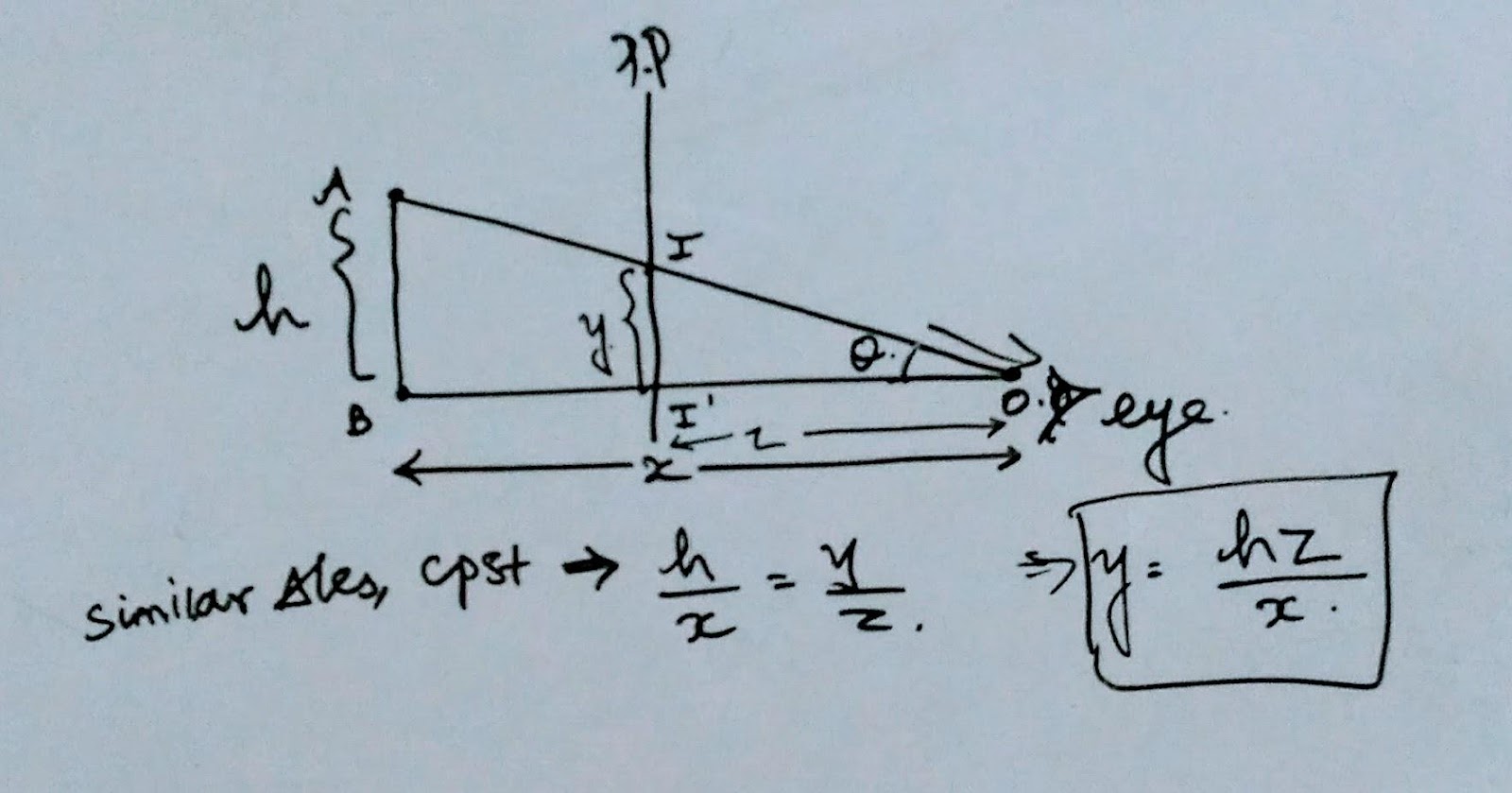
The other type is the linear perspective theory created by Filippo Brunelleschi. This basically tells you that closer objects are projected larger on a picture plane.


Using this simple mathematics as derived from the linear perspective theory, the approximate size of the projection on the plane as compared to the actual size of the object can be determined. In the above picture: y is the height of the projection; h is the height of the object; x is the distance of object from the eye; and z is the distance of the picture plane from the eye.

This was of key importance in the paintings during the Renaissance as the painters attempted to produce or showcase depth on a plane sheet. It was generally concluded from the linear perspective theory that all objects away from the painter must converge at a farther point.

So, how is this theory of perspective related to photography? Well, for photographers to choose an optimum focal length for the right aperture that would capture the scene, the way they envision, it is necessary that they have a general sense of perspective. It is not required, and is not possible, to do mathematics every time. But it is necessary to rather have a ‘feel’ of the right perspective that they need for a particular shot.

There is a tamil saying that translates into “Your hand doesn’t measure what your eye doesn’t”, which sums up the the topic of discussion here: perspective.

Tuesday, August 29, 2017

Why I Did Not Get My Hogwarts Letter


I was introduced to Harry Potter, and the world of wizards and witches when I was eleven. And ever since, I’ve always waited for my Hogwarts letter- most sincerely. People thought it was fiction but I knew it wasn’t just that. What I couldn’t understand though was why I did not receive my Hogwarts letter. Years on end, I peeped through the window to see if I could spot an owl approaching. No such luck.

Now, while pursuing B. Sc., LL. B., I finally found a convincingly probable answer to the question that has bothered me for the last seven years.

This semester we have a paper on Microbiology and Genetics. And, today, while winding up with the genetics topic, our professor showed us a video by National Human Genome Research Institute- Harry Potter and the Genetics of Wizarding.

Thanks to Prof. Eric P. Spana's wonderful lecture in the video, I got the reason why I might not be the one. For all those out there wondering why you didn’t get your letter- read this! The answer lies in your genes.

Let’s look at it this way: Why does Hermione Granger get the letter, but not us?
Brief answer: de novo mutations.

Let ‘W’ be the representation for the alleles of wizards/witches.
Let ‘M’ be the representation for the alleles of muggles.

To be a wizard/witch you need to have at least one dominant wizard allele ‘W’ or a recessive allele ‘ww’ gene.
Mr. and Mrs. Granger both are pure muggles(non-magical human beings).
So, both Mr. and Mrs. Granger are homozygous muggles: MM

Doing the Mendelian Cross:

Parents:                                   MM            x            MM
                                             (muggle)                  (muggle)
Gametes:                                  M                             M

Filial Generation 1:                                  MM            -----------------------> (Muggle)

So, how did Hermione, who was supposed to have only MM genes and be a muggle, become a witch?

De novo mutations are mutations that occur in an egg or sperm cell before fertilization or immediately after fertilization. ‘De novo’ literally means ‘of new’ in latin and refers to such new mutations.


De novo mutations may explain genetic disorders in which an affected child has a mutation in every cell in the body but the parents do not, and there is no family history of the disorder. Thus, even if there is no hereditary history whatsoever of magic use, the offspring can have a mutated gene affecting it, thus making the progeny magical.

Hence, Hermione got through to Hogwarts thanks to the mutation in her genes. This answers why she’s a mudblood.

But why not us too?

Well, de novo mutations occur at a frequency of ~77 per generation but only one of them occurs in a gene. So, analysing the past year students of Hogwarts we find just one person who is a mudblood in a given year. So for a wizarding or magical trait the frequency of de novo mutation in that gene is approximately 1 in 750,000 (considering the population of UK since Hogwarts is in UK).

That is a really slim chance. And, most probably we aren’t that 1 in 750,000 if we still haven’t got our letter.

That is why Hermione is a witch and we aren’t.

To know that our seven years of faith can be broken in one class of genetics with a little help from pure statistics is terrible. I can’t still stop waiting for the letter even after knowing the harsh truth.

And to conclude, and console myself for the rest of my life, I just figured a new argument:
Maybe, my letter was tied to Errol.